Showing posts with label Historical. Show all posts

Sunday, August 31, 2014

[Summertime] 1962 Disneyland's brand new Jungle River Cruise Expansion

05.10.11 - The password is "Safari," and Summertime visitors to Disneyland will be validating their passports, stepping aboard tropical steamers and sailing off on a brand new tropical adventure that may set jungle exploration back to the days of "Dr. Livingston, I presume."


The Summer 1962 edition of Vacationland took a through-the-binoculars look at the 1962 expansion of Adventureland.
For Disneyland's brand new Jungle River Cruise — part of another $7 million expansion at Walt Disney's Anaheim wonderland — has been designed as a combination "you are there" exploration and fun-filled laugh provoking adventure whose "actors" are elephants, tigers and many more beasts of the jungle.

Starting with a proven success — the true-life jungle cruise has been one of Disneyland's most popular attractions since opening — Walt Disney is adding a jungle-full of animated animals — startlingly life-like — and making the explorer's voyage longer and full of humor.

Top highlight is sure to be the Indian elephants — big ones and "little squirts" — who will frolic, splash and swim in a unique "elephant bathing pool." Their trunks loaded with watery surprises (for unwary animals and explorers), nearly two dozen of the full-size elephants will eventually call Disneyland "home," all brought to life through the marvels of Disneyland animation.

The emphasis in new attractions is on Adventureland, with (1) the "world's largest" Tree House, (2) a "Big Game Safari" shooting gallery, (3) a colorful African motif for portions of the bazaar shops and stores in Adventureland, and (4) the fabulous "Stouffer's in Disneyland" dinner-show restaurants.

The Swiss Family Tree House will tower 70 feet above the jungle. Spreading its branches 80 feet in width, it will include three separate "homes" at different levels — the living room, parents' room and boy's room, all inspired by Walt Disney's motion picture "Swiss Family Robinson."

For the youngsters, "the climb's the thing," but adults are sure to enjoy the "never before" panoramic view over much of Disneyland offered by this "species Disneydendron giganteum" of 150,000 leaves and 50,000 blooms.


Walt Disney's "Enchanted Tiki Room," one of three new restaurants at "Stouffer's in Disneyland" and Disney's first "by reservation only" dining spa, may steal the spotlight from the other new attractions. For Walt Disney is bringing together all the talents of his "imagineers" to create a complete dinner show performed by an exotic collection of birds, flowers and Polynesian Tikis that actually sing, talk and act!

Many new animation techniques, developed exclusively for Disneyland, will "bring to life" the birds, idols and flowers. And, lest you should think it's not possible for inanimate objects to sing and act, just remember that this dinner-show is based upon legends and myths treasured for centuries by the natives of the South Pacific.

Stouffer's, one of America's foremost restaurateurs, will also open European and American Kitchens in its Plaza Pavilion (facing Main Street) and a Tahitian Terrace overlooking Adventureland. The latter will feature nightly dancing and South Seas entertainment.

If you're a marksman, the new "Big Game Safari" is for you. While it's based on a time-tested shooting gallery tradition, this jungle hunt is an authentic Disney creation — a one-of-a-kind rapid-fire adventure where you'll shoot at all kinds of jungle animals and birds, each handcrafted for Disneyland.

So it all adds up to another big "bonus" in entertainment this Summer at Disneyland where the new adventures Walt Disney adds each year are the frosting on a $40 million entertainment "cake!"

From the Summer 1962 edition of Vacationland magazine, published by Disneyland.

Sunday, July 17, 2011

1955 - Celebrities, Officials Join Walt Disney To Dedicate New Era of Entertainment

07.17.11 - More than 50,000 visitors were attracted to Disneyland on Monday, July 18, when the Park officially opened its gates to the general public. Reactions were mixed but highly enthusiastic, ranging from exclamations of "fantastic" to "unbelievable" and "too terrific for words to describe." Governor Goodwin J. Knight of the State of California assisted Walt Disney and some 25,000 invited guests at the official dedication ceremonies of Disneyland on the preceding day, Sunday, July 17.


The preview of Disneyland was attended by many of the most familiar names in the world of entertainment, as well as civil and government officials, national magazine and newspaper editors and reporters, lessees and exhibitors from the Park itself, and local business, service club and Los Angeles and Orange County officials.

Stars Attend
The long list of names included such entertainers as Danny Thomas, Ozzie and Harriet Nelson, Art Linkletter, Irene Dunne, Jeff Chandler, Eve Arden, Marilyn Maxwell, Donald O'Connor, George Gobel, Margaret Whiting, Gale Storm, Ed Wynn and Charleton Heston, and the families and children of many of these and other stars.

In addition to Governor Knight and Lieutenant Governor Powers, government officials included Secretary of State Frank M. Jordan, Representative James B. Utt, Anaheim Mayor Charles Pearson and the mayors and councilmen of all Orange County cities, Mayor Norris Poulson of Los Angeles and Mayor George Vermilion of Long Beach, and California Senator Thomas Kuchel.

Other Guests
Other personal guests of Disney were the public officials of Anaheim, members of Los Angeles and Long Beach Chambers of Commerce, leaders of industry in Anaheim, members of the Chambers of Commerce of Anaheim and each city in Orange County cities, the clergy of all churches and denominations in Orange County, and the Orange and Los Angeles County Board of Supervisors.

Foreign consuls of Southern California sent children in their native dress to share in the entire program as representatives of children of the world.

According to C.V. Wood, vice-president and general manager of Disneyland, the preview guest list was one of the largest in entertainment history.

ABC-TV carried the premier ceremonies over a national hook-up. The gala show spanned ninety minutes of air time, with Walt Disney and Art Linkletter, television show star, acting as masters of ceremony. Linkletter was assisted by Bob Cummings, Danny Thomas, and Ronald Reagan.

Television coverage began at 4:30pm, when the Santa Fe and Disneyland passenger train, with railway tracks that run completely around the 60-acre Park, making its first official trip. Disney and Governor Knight acted as co-engineers.

From the Plaza the center of attention turned toward Frontierland. The gates of the log stockade which surrounds this area opened to allow horsemen Fess Parker and Buddy Ebsen, riding in from the Painted Desert, and an authentic model of a Wells Fargo express wagon to come forth.

Guests and following television cameras then entered Frontierland, the land of Davy Crockett. After inspecting the blacksmith shop, assay office, Golden Horseshoe Bar and other shops, guests and TV viewers saw Irene Dunne, motion picture star, launch the "Mark Twain," first river steamboat built in the United States in 50 years.

A visit to Tomorrowland was next on the preview agenda. As guests crossed the Plaza, hundreds of doves, symbols of peace and hope, were released from the entrance to the "world of the future." Viewed in this area, a city as it is expected to be in 1986, were exhibits of many of America's largest manufacturers, the TWA "Rocket to the Moon," the Autopia freeway of the future, Spaceport, and 20,000 Leagues Under the Sea exhibit.

The dedication day was completed with a visit to Fantasyland, where all the characters that Walt Disney has brought to screen life were viewed.


From the Sleeping Beauty Castle, the entrance to Fantasyland, 16 knights in shining armour rode forth on splendid steeds to stand guard as the Black Knight approached and ordered the drawbridge of the castle lowered "in the name of the children of the world," to whom the castle is dedicated.

When the Black Knight lowered the drawbridge, approximately 500 children from Anaheim Church Schools entered the magic kingdom to enjoy such features as the King Arthur Carousel, the Peter Pan ride over moonlit London to Never Land, the Snow White ride past the Wicked Witch and the Seven Dwarfs, and the Mr. Toad Wild Ride.

The Mouseketeers, child stars of the "Mickey Mouse Club," which debuts in October for a daily television show, had an important part in the dedication of the Mickey Mouse Theater in Fantasyland.


From The Disneyland News July 1955.

Tuesday, May 24, 2011

1975 - America is Marching Down Main Street

05.12.11 - "America on Parade" premiered last June as a joyful, colorful, wonderful patriotic pageant of the music, people and heritage of America — both past and present.


From the first strains of "Yankee Doodle" to the closing bars of "God Bless America," Disney's "America on Parade" is itself destined to become a part of the Americana it celebrates: something to be seen, remembered and treasured for years to come.
Thousands of Disney guests have already watched and cheered as Mickey Mouse, Goofy and Donald Duck proudly lead the three-quarter-mile-long procession through the center of each theme park.

The 50 giant-size parade units in the fun-filled musical extravaganza depict a variety of historical and memorable moments in the nation's 200-year past and highlight the contributions and achievements of the country's people. They present a stylized, whimsical and never-to-be-forgotten festival of America as only Disney can present it.

Towering above the throngs of young and old who gaze with delight and amusement are Disney's newest creations, the eight-foot-high, doll-like "People of America" — from Indians to auto drivers, Can-Can dancers to Ben Franklin, a Keystone cop to Uncle Sam — they dance their way through America's history and into the hearts and memories of those who watch one of Disney's most unique and delightful creations.

The parade, which features more than 150 people, is performed at both Disney theme parks daily and 3:00 p.m. During the summer months and some holidays there will be special evening performances of the parade followed by a red, white and blue fireworks display. As an extra attraction, each week the parade will salute one of the 50 states.

The parade's grand finale features high school and college marching bands especially invited to take part in this bicentennial salute.

From the first strains of "Yankee Doodle" to the closing bars of "God Bless America," Disney's "America on Parade" is itself destined to become a part of the Americana it celebrates: something to be seen, remembered and treasured for years to come.

From the Fall/Winter 1975-1976 edition of Vacationland magazine, published by Disneyland.

Sunday, May 08, 2011

1958 - Summertime at Disneyland - The Columbia 1790 sailing ship in Frontierland and Alice in Wonderland for Fantasyland

05.08.11 - The diversified Summer season at Disneyland gets under way in early June, when Walt Disney's Magic Kingdom will unveil two more spectacular new attractions, the Columbia 1790 sailing ship in Frontierland and Alice in Wonderland for Fantasyland.


Then, with bands playing, fireworks cascading a shower of color, and a wide variety of entertainment added to the popular attractions in the Park's five "lands," the Summer season will be underway.

By day, Disneyland is a beehive of activity. The Disneyland Band marches up and down Main Street and presents concerts in shaded Magnolia Park. Another group, the Strawhatters, plays lively Dixieland tunes from the bandstand overlooking the Rivers of America in Frontierland. A Mexican trio, Hawaiian entertainers and the Main Street Saxophone Quartet perform.

But daytime is only half the "show" during the Summer at Walt Disney's Magic Kingdom.

Each evening from June 13 to Sept. 14, Disneyland presents the spectacular "Fantasy in the Sky" fireworks display and Date Nite dancing entertainment, both provided free of charge for the enjoyment of nighttime visitors. During this Summer period Disneyland is open every day from 9:00 a.m. until Midnight, and until 1: 00 a.m. Friday and Saturday nights.

"Fantasy in the Sky," multi-colored bursts of fireworks, explodes over Disneyland each evening at 9:00 p.m. in a thrilling aerial show. This shower of color almost turns the mild Southern California evenings into daylight, and may be seen from anywhere in the Park.

Popular bands playing dance music to suit every taste highlight the nightly entertainment under the stars during the Summer months.

Each evening features a different type of musical and dancing entertainment, until 12 Midnight weekdays, and on weekends until 1: 00 a.m. There will be Western square dancing, polka and Rhinelander, and personality and talent nights each weekday evening. Friday and Saturday nights are special highlights, with three Date Nite bands performing.


In presenting these diversified attractions and special shows, with many things for every interest and every age, Disneyland continues to live up to its reputation as a place for people to have family fun together. In the words of Paul Speegle, columnist for the San Francisco Call Bulletin:

"The clear fact of the matter is that the moment you walk inside Disneyland's brightly-painted monument to childhood you check the nagging cares of the world and enter a land where everyone looks at everyone else through the joyful eyes of the young in heart. And don't look now — but the adults are bigger kids than the kids!"

From the Summer 1958 edition of Disneyland Holiday magazine, published by Disneyland.

Monday, May 02, 2011

The Matterhorn comes to the Magic Kingdom [1959]


The popular Skyway — the Swiss aerial cable-car trip between Fantasyland and Tomorrowland — passes directly through the Matterhorn Mountain, giving its passengers still other views of the colorful interior.
05.02.11 - Beautifully-hued grottos and caverns inside the Matterhorn are seen from the Skyway, the Swiss aerial cable cars, which now pass through the Mountain.

Thrilling bobsled runs down and through Disneyland's Matterhorn Mountain present a panoramic view of the Magic Kingdom, as well as a close look at the colorful Alpine grottos and caverns inside.

Rising skyward today at Disneyland is one of the most memorable sights in any land: the spectacular "snow-capped" Matterhorn Mountain.

Southern California's newest landmark is an exact replica of the famed peak in the Swiss Alps. Towering 146 feet above the Magic Kingdom, it's twice as high as the neighboring Sleeping Beauty Castle — once the tallest structure in the area.

Sight of the man-made Matterhorn alone will be a "show stopper," its "snowy" peak glistening in the Summer sun. From top to bottom, the Mountain is awesomely impressive, with every nook and cranny, slope and "snowcap" a perfect reproduction of its Alpine reality. But there's much more:
Two thrilling bobsled runs travel first to the near-summit, then circle downward to present a breath-taking panorama of the surrounding countryside. Before reaching the "glacier lake" below, the bobsleds glide through the Mountain itself for a view of Alpine caverns and grottos.


And now, the popular Skyway — the Swiss aerial cable-car trip between Fantasyland and Tomorrowland — passes directly through the Matterhorn Mountain, too, to give its passengers still other views of the colorful interior.

Once again, with the creation of the Matterhorn and other new attractions at the Magic Kingdom, Walt Disney has continued to fulfill his promise that Disneyland will always be adding new adventures that you and your family may participate in together.

From the Summer 1959 edition of Vacationland magazine, published by Disneyland.

Saturday, April 30, 2011

The Night it Snowed at Disneyland... or did it?


A foam similar to that used on runways was sprayed on the sidewalks producing the realistic effect of snow.
04.30.11 - Not really, but for several hours, one evening a little over a week ago, it seemed that way.

It was all part of a scene that will be included in the Christmas at Disneyland show starring Art Carney.

The television special airs December 8 at 8 p.m. on Channel 7 and features guest stars Sandy Duncan and Glen Campbell.

Along with these multi-talented performers, entertainers from our own Disneyland Cast, such as the Kids of the Kingdom and several Disney Characters, appear in the show.

The actual process of transforming Main Street into a winter wonderland took approximately four hours.

The first step was laying two foot square plastic tiles on the asphalt between the Market House and Town Square. These tiles were fitted together like a jigsaw puzzle and were later periodically sprayed during the filming with silicone to make the surface more suitable for ice skating. After the "plastic ice rink" had been layed, a foam similar to that used on runways was sprayed on the sidewalks producing the realistic effect of snow.

The final touch was provided by tossing plastic chips in front of a huge fan and a balmy California evening setting was transformed into what was seemingly a winter paradise.

From the Disneyland Line, December 9, 1976

Thursday, April 28, 2011

Notable 'Firsts' Highlight Spectacular Olympic Pageantry


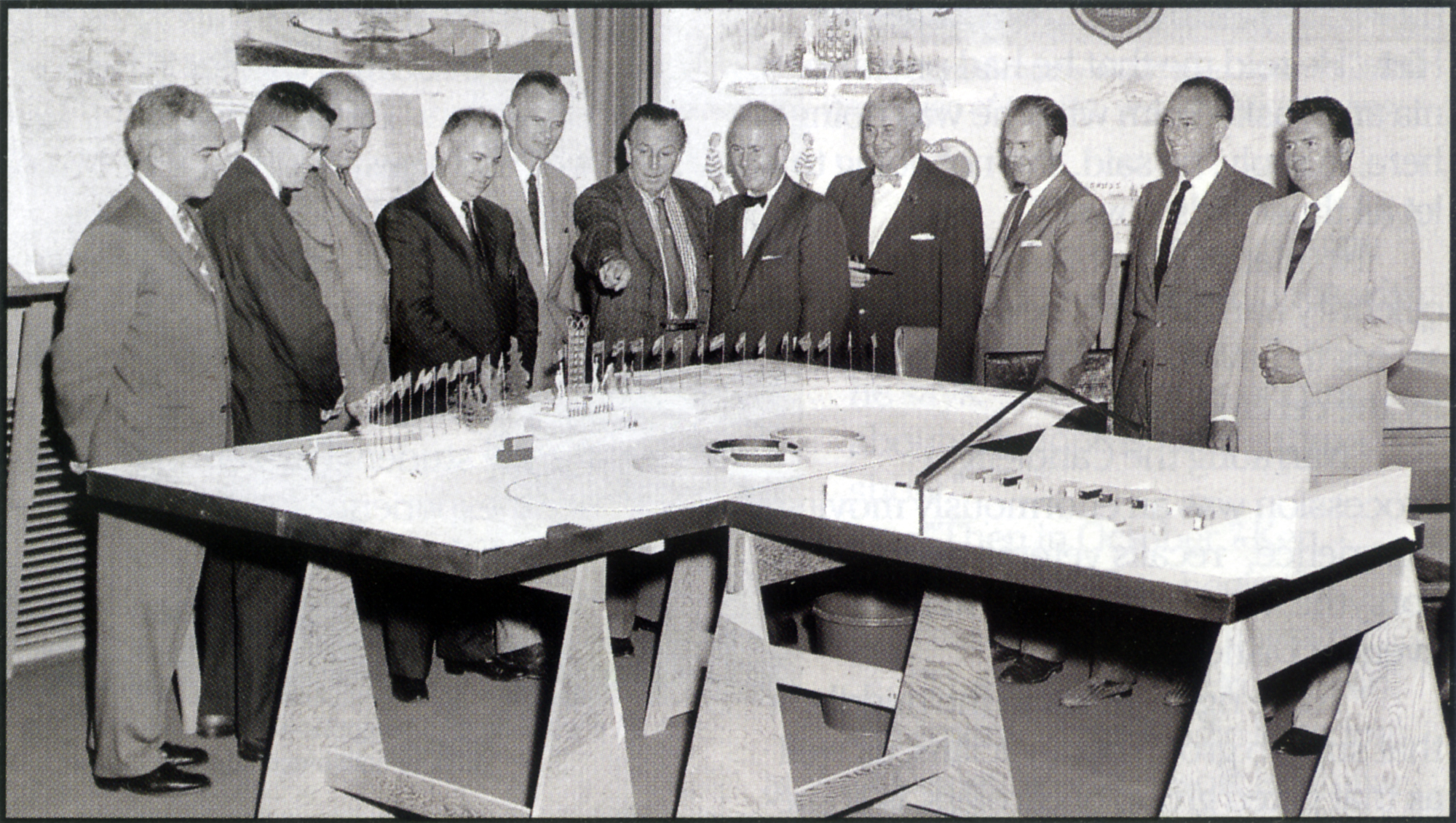
04.28.11 - A series of notable "firsts" highlighted the spectacular Pageantry program, which helped make the VIII Olympic Winter Games at Squaw Valley the most successful in the history of this international event.


Squaw Valley's staging of the Winter Games marked the first time the Winter Olympics had ever been held in the West (on the only other occasion that the Games were held in the United States, they were staged at Lake Placid, New York, in 1932).

When the Sacred Olympic Flame was flown from Norway in late January, it was the first time that the flame had been carried air-borne over the North Pole.

In preparing a splendid all-star program of evening stage shows, Walt Disney's Pageantry Committee offered the first in-person entertainment specifically for the benefit of the athletes.

The imposing 16-foot statues used for Squaw Valley's Avenue of the Athletes also marked the first time snow sculptures had ever been used for the Winter Olympics.

To a somewhat lesser degree, there were other "firsts" to be added to this list. These included the use of daytime fireworks for the opening day ceremonies, and the fact that the daily victory ceremonies were regularly held in the main staging area where all the spectators could fully enjoy the occasion (in the past, Winter Olympics' victory ceremonies had been held in almost impromptu fashion in some far-off area, removed from the view of audiences).

Undoubtedly, the Pageantry for the VIII Olympic Winter Games was the most elaborate ever staged, and set new standards for this important occasion on the world's sports calendar.

International sports authorities agree that the Winter Olympics in the past have rated as a poor cousin of the tradition-conscious Summer Olympics, and as a result have been sadly neglected.


It is to the credit of the United States, and to California and its youth in particular, that this situation now has been drastically reversed.

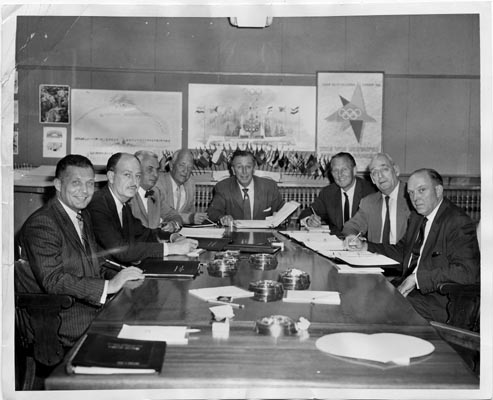
The full behind-the-scenes Pageantry story actually began, of course, when a group of Olympic officials, including Organizing Committee President Prentis Hale, visited the Disney studios in Burbank one day early in 1958.

Following a pleasant discussion over lunch of sports in general, Walt was invited to accept the post of Pageantry Committee Chairman.

"I didn't know then what I was getting into!" says Walt with a laugh.

However, the Burbank moviemaker tackled this assignment with the same enthusiasm that he utilizes so well, and to such advantage, in the making of his great motion pictures and television productions.

He quickly assembled a talented "crew" to handle the various facets of his ambitious Pageantry program.
Committee members included television star Art Linkletter, picked as Vice-President in Charge of Entertainment; Western Air Lines president Terrell Drinkwater, named Vice-Chairman in charge of Budget; Dr. Charles Hirt of the University of Southern California, named as Choral Director; Tommy Walker, former USC football star, and now a Disneyland official, as Pageantry Director; art designer John Hench in charge of Decor; Edsel Curry, Director of Special Projects; Joseph McEveety, Olympic Torch Relay Director; and Ron Miller, assistant director at Disney Studios, as Pageantry Coordinator.

In addition, a committee including Sam Brown, Margaret Herrick, and Lloyd Wright Sr., was formed at Hollywood's Academy of Motion Picture Arts and Sciences to select the feature films shown the athletes at the Squaw Valley theatres during the Games.


Inspired by Walt's own enthusiasm, his talented committee members travelled throughout the country in preparing the detailed plans necessary to make the Pageantry program functional.

Hench, for example, crossed the United States to visit Dartmouth College. There, he garnered valuable information regarding the famed Dartmouth ice festival, which features giant ice sculptures.

Numerous trips, of course, were made to Squaw Valley itself throughout the spring and summer of 1959. Every square foot of this scenic valley, nestling in the towering High Sierras, received special attention in considering the ground plans for layout of the Pageantry staging areas.

A few weeks before the Olympic Torch arrived by S.A.S. DC-7 from Oslo, torch relay director McEveety made a trial journey along the 600-mile route chosen for the carrying of the Sacred Flame to its new resting place at Squaw.

The weather on that occasion, of course, was different. It was good. When the actual torch relay was run, the weather proved to be just the opposite!

Dr. Hirt spent weeks visiting the many schools which provided choir students for the program. His tireless efforts contributed in large measure to the fine vocal results achieved that memorable day of the opening ceremonies.

Walt, himself, visited the valley on several occasions, going over every detail of the program fully.

The part to be played by the communications media in helping tell the Pageantry story was not overlooked, either.

A luncheon was held at the Disney studios before Christmas at which wire service, newspaper, television and radio officials, writers and announcers were fully acquainted by Walt of the upcoming Pageantry program.

Following this, periodic Pageantry bulletins were sent out to all program participants, as well as to key members of the press, to keep everyone up-to-date on the fast-breaking developments.


This ambitious news information project was supervised by Card Walker, Vice-President of Walt Disney Productions, and Director of Publicity on the-Pageantry committee.

The news project also helped point up another extremely important facet of the Pageantry: the great pride and enthusiasm demonstrated by California and Nevada youth in their key roles in the program.

Throughout the two states, wherever Walt and his committee members travelled, they encountered a great excitement and enthusiasm among the students.

"I have always said that the spirit of American youth cannot be daunted, and I think this was dramatically proven by their unselfish and wholehearted effort before and during the VIII Olympic Winter Games," said Walt Disney afterwards.

As noted elsewhere in this souvenir brochure, the 4,400 youngsters of the high school choirs and bands, and the CIF athletes, faced many problems in order to fulfill their assignments.

That they came through with flying colors is a tribute to all concerned. There were no "quitters" and there were no complainers. They had a job to do for their school, and for their state and for their country, and they completed this task in noble fashion.

An especial tip of the hat was due for the 125 Explorer Scouts who acted as official flag-raisers, Olympic messengers, and crowd controllers. These young men, aged 15 to 18 and under the leadership of Scoutmaster William King, proved exemplary representatives of one of the world's finest youth organizations.

Congratulations also were in order for Lt. Col. Albert Schoepper and his fine U.S. Marine Band, which lived up to all advance rave notices.

On opening day, when the large scale program was finally activated by Vice-President Nixon, many obstacles had already been overcome. Even so, there were many more met and successfully surmounted during the Games.

In the final analysis, however, the Olympic spirit prevailed throughout, and it was this great personal satisfaction of being an important cog in a really noble enterprise that made everything worthwhile.

Baron Pierre de Coubertin, originator of the modern Olympic Games, pointed out that the important thing in the Games was not to win but to take part. He emphasized the very essence of everyday living.

The youth of California and Nevada took his message to heart—and made us all very proud of them.
From The Pageantry Story, February 1960.


Tuesday, April 26, 2011

A 60-minute Ceremony that Took a Year to Prepare [1960 VIII Olympic Winter Games]


04.26.11 - The Opening Ceremonies of the VIII Olympic Winter Games lasted approximately one hour— but it took almost a year to prepare for that eventful 60 minutes!


It's a story that began in March 1959, with the first preliminary meetings between officials of the Music Educators National Conference and members of the Pageantry Committee.

At that time, authority was delegated to the California and Nevada Music Educators Associations to work with the Pageantry Committee in "amassing 2,000 or more trained singers and 1,250 or more trained instrumentalists from the public high school choruses and bands of California and Nevada to perform in the Opening Ceremonies."

Authority and achievement, however, are worlds apart. What followed were months of contacting band directors and choral leaders; applications submitted to the screening committee; selection of the "cream of the crop" among applicants to participate in the Ceremonies; hours and days of local and regional rehearsals; long hours of work to earn the money to get to Squaw Valley, and finally, "opening day" at Squaw Valley.

There was another side to student preparation in the pageantry story— the Olympic Torch. At a casual glance, transporting the Torch, symbol of international athletic competition between the nations of the world, would seem a simple matter. It could be flown directly from Morgedal, Norway (the "cradle" of winter sports) to Reno and thence to Squaw Valley.


But in the traditional Olympic spirit, the Pageantry Committee enlisted the aid of hundreds of runners from member high schools in the California Interscholastic Federation to carry the Torch some 600 miles through California to the site of the Games. More than 700 high school athletes and several Olympic track and field champions participated in relaying the Olympic Torch from the Los Angeles Memorial Coliseum— site of the 1932 Summer Olympics — to Squaw Valley.

This, then, is the basic "book" on the Opening Ceremonies pageantry. But the chapters of that book are filled with many dramatic moments in the overwhelmingly successful story of the preparations — and performances— that turned "authority" into outstanding achievement. And each and every one of the high school bandsmen, singers and athletes who took part turned in a Gold Medal Performance!


The Band and Choral Story

When the applications to participate in the Opening Ceremonies were mailed out, in the Fall of 1959, more than 30 bands and 70 choral groups from high schools of California and Nevada applied to be included in the mass band and chorus performance.

After long hours of listening and studying the recordings submitted by more than 100 high school groups, the committee, under the direction of USC's Dr. Charles Hirt, made its selection of the "cream of the crop" — 18 bands and 37 choruses from the two states.

Meanwhile, the selection and arrangement of choral and massed band numbers was being completed. A copy of the original Olympic hymn was discovered in Japan, translated from Greek into English, the music re-written and re-orchestrated. A special arrangement of the Star Spangled Banner was prepared. An original composition, "These Things Shall Be," was written, arranged and designated as one of the selections included in the Opening Ceremonies repertory. The others: "God of Our Fathers," "March of the Olympians," and "Conquest"

Finally, in mid-December, several key members of the Pageantry Committee gathered at UCLA. There, under the batons of Choral Director Hirt and Clarence Sawhill, Band Director, recordings of both the vocal and instrument numbers were made. By early January, arrangements were in the hands of choral and band directors at each of the individual schools.

Now the 3,680 students were ready to roll up their sleeves. Practice sessions— including 20 hours and more — were carried out on an individual school basis in 46 California schools and nine more in Nevada.

Late in January, Hirt and Sawhill became travelling musical ambassadors. In Reno, San Francisco, Fresno and Los Angeles, bands and choruses gathered for regional rehearsals. In less than a day's time, they were integrated into "one band" and "one choir"— at four locations separated by many miles. But the major hurdles still lay ahead.

Practice and local rehearsals were not the only job assigned to the students: they also had to earn their own transportation money to Squaw Valley. Many of them sold newspapers and candy, or worked nights at local stores, to earn their way to the Games.


Complicating the situation, there had been no dress rehearsal of the 1,322 bandsmen, or the 2,358 choir members, as single units— let alone a run-through with all 3,680 together. And the Opening Ceremonies were soon to begin.

On February 17, at Squaw Valley, Sawhill directed the combined bands in a full rehearsal. A few of the choral groups were also on hand. But the big dress rehearsal, the final tune-up, awaited the morning of February 18.

And of course it snowed. With a world-wide audience awaiting the verdict of whether the United States would prove to be an efficient, imaginative, enthusiastic host for the Winter Olympic Games, the snow came down in blizzard proportions.

The rest is history: the "warm-up rehearsal" that warmed few, the performance during the Opening Ceremonies that warmed the hearts of the world!

"It was," said Army Archerd in the Hollywood trade publication Variety, "the greatest show on Earth"

"It was," said John Garland of the International Olympic Committee, "one of the deciding factors in making the Games so successful."

"It was," said Cholly Angeleno in the Los Angeles Examiner, something that "Those who witnessed ... will talk about for years to come."

Perhaps Band Director Sawhill summed up the role of student participants as well as any other: "I have had occasion to work with and observe music students in 12 countries of Europe, Canada, Mexico, 48 mainland States and Hawaii. But on all these previous occasions the horizon had been limited to the locale.

"At Squaw Valley," Sawhill continued, "the purpose of performance was of world-wide proportions. I could tell that the students and their high school directors sensed this as I started working with the bands in small units. The universal language was coupled with the courageous spirit when the students stuck to their posts even through the storm."

The true spirit of youth that could not be daunted— a Gold Medal performance!


Olympic Torch Relay

Still another drama of major proportions began to take shape on January 31, 1960 at Morgedal, Norway, the renowned "cradle" of winter sports. With King Olaf in attendance, the Olympic Torch was sent on its way to the Winter Games.

Waiting in the wings for their cue to come "on stage" were 700 runners who were to convoy the sacred flame of international athletics safely through the State of California into Squaw Valley 19 days later.

If the spirit of the Olympic Games were to be capsuled, few better examples could be found than that of the runners from California Interscholastic Federation schools who participated in carrying the flame to its huge tripod in Squaw Valley.

For here were high school athletes— each of whom had trained for the one-mile he would run by carrying an eight pound shot-put in "practice" sessions—insisting on running in T-shirts and track shorts in spite of cold and wet weather.

As they ran, these CIF athletes were also kindling the interest of the people of California in the Olympic spectacle, bringing home to them the tremendous unifying spirit of the international competition about to unfold in the California Sierras. All along the 600-mile route, people lined the roads to catch a fleeting glimpse of the flame— perhaps seeing in it, and in the athletes who carried the torch, the hope for world peace through spirited but friendly competition among men and nations.

Radio reports, newspaper pictures and stories, and television newsreels carried this same message into homes throughout the United States and into many parts of the world.

School buses brought small children to the roadways to pass the message on to the generations of tomorrow. Many cities themselves joined in the Pageantry of the Olympics with special ceremonies heralding the arrival of the Torch. Bands assembled to play for mere moments as the torch passed. In smaller towns, residents lined the streets and passed the torch from hand to hand through the community.

Kudos were in order, too, for the California Highway Patrol, which assigned many of its top officers to escort the runners on their internationally-important mission. Patrol cars sped ahead of the athletes, heralding their impending arrival, and also cruised along as a rearguard protective unit.

From Norway by airplane the Torch came, to Olympic shot-putting champion Parry O'Brien at Los Angeles International Airport. Thence by helicopter to the Los Angeles Memorial Coliseum, site of the 1932 Summer Olympics. On to Glendale and Burbank in the pouring rain. To Gorman, 4,100 feet up on the Ridge Route on the third day. To Bakersfield and Delano, Tulare, Roseville, Modesto, where the tripods were as big as the one at Squaw Valley.

To Stockton on the ninth day, where it was carried aboard the yacht "Adventuress" Fleet Ship of San Francisco's Great Golden Fleet, to San Francisco for ceremonies at the City Hall; and on to Sacramento, where California Governor Edmund G. Brown officiated in special events on the steps of the State Capitol. Finally to Donner Pass, Emigrant Gap and the top of Papoose Mountain.

When Olympic ski champion Andrea Mead Lawrence sped down the slopes of Little Papoose, and Olympic speed skating champion Ken Henry relayed the flame to its destination, the 1960 Olympic Winter Games were underway.

But as they raced along the roadsides of California, 700 high school relay runners had performed a feat perhaps rivaling the actual lighting of the flame itself in importance: they had brought the spirit and meaning of the Olympics to the people of California and America.

From The Pageantry Story, February 1960.

Friday, April 22, 2011

Snow Sculptures at the 1960 VIII Olympic Winter Games

04.22.11 - The use of snow sculptures at the VIII Olympic Winter Games at Squaw Valley marked a new milestone in Pageantry history for this international event.

An impressive array of thirty 16-foot snow statues lined the Avenue of the Athletes at Squaw Valley, as well as other key points in the Olympic Village and staging area.

These huge sculptures created tremendous interest among the thousands who thronged the valley during the Games.

Wide-spread favorable comment was generated by the sculptures, which personified the various sports participants in the Olympic Winter events.

Perhaps merely by coincidence, the men outnumbered the ladies 21 - 9 among the sculptures.

Of the nine female snow statues, four were skiers, three figure skaters, and two speed skaters. Among the gents, there were nine skiers, seven hockey players, three speed skaters, and two figure skaters.

Months of careful planning and detailed work was required in the creation of these statues.

The paper work was carried out under the supervision of Decor Director John Hench at Walt Disney studios, with the subsequent construction being executed by Floats Inc., of Pasadena.

Use of the statues was first suggested by Walt Disney shortly after he was named Pageantry Committee chairman.

As a result, Hench visited the Dartmouth Winter carnival in February 1959, to investigate the technique used there in assembling their snow sculptures, which range as high as 40-feet.

The Disney art director also visited the winter carnival at Quebec, in Eastern Canada, to garner additional data for his long-term Olympic project.


Structurally, every Squaw Valley statue consisted of a metal frame base some seven feet high. A logpole in the center of the base was driven into the ground to insure stability. An intricate weaving of wire mesh and straps put "body" into the base.

The snow figures themselves, averaging eight feet in height, were added to the bases shortly before their shipment to the Games.

In addition to the 16-foot statues, Hench designed two massive 24-foot statues of a male and a female athlete, which were placed alongside the imposing Tower of Nations at the ceremonial staging area.

An eye-catching attraction in itself, the huge ceremonial Tower of Nations measured 79 feet high and 20 feet wide. It was here, of course, that the Opening, Victory and Closing ceremonies were staged during the Games.

Aluminum crests of all competing nations were suspended in the grid of the Tower of Nations frame, each five feet wide and six feet high. The familiar Olympic rings, set above the main frame, denoted the five major continents, linked to symbolize international friendship.

This file photo from Feb. 1, 1960 shows a ski jumper during the 1960

Thirty gleaming aluminum flagpoles were used around the Tower of Nations area for the flags of the competing nations.

As with the snow sculptures, these were donated by civic-minded companies and individuals, some of them from overseas.

With the Games over, the snow sculptures and flagpoles were being transported to their respective sponsor cities, companies or individuals.


From The Pageantry Story, February 1960 (a souvenir brochure created by the Walt Disney Co. for the 1960 Winter Olympics).

Wednesday, April 20, 2011

How I Met the King of the Leprechauns by Walt Disney

04.20.11 - Being half Irish myself, I learned about the Leprechauns of Ireland while I was still a small boy on our farm at Marceline, Missouri. I began to believe in Leprechauns, then, because some of my relatives had pretty convincing stories to tell about the magic powers of these Little People, and the tricks they could play when angry.


So, I promised myself that one day, after I had grown up, I would go to the land of the Leprechaun myself, and meet one in person. The opportunity finally came last year when we decided to use real Little People instead of cartoon imitations in a movie we were planning.

Most Irish in the old country respect Leprechauns. They leave food out for them at night, to keep them happy, and are careful not to disturb old forts and other ruins these wee folk guard as their very own. They are particularly careful not to throw water across any of the tiny paths Leprechauns leave in the grass, because Little People hate water, and there is no telling what sort of mischief they will be up to if they get their feet wet.

Anyway, once we decided on using real Leprechauns in the picture, I set out for Ireland to hire some. We needed about 150, all told, for the picture we had in mind.

How to find a Leprechaun? That was a big question. I found it wasn't easy. It takes a man mighty knowledgeable in the ways of Leprechauns to find one to talk to. I went to a library in Dublin. It was filled with books on the habits of Leprechauns. Each book recorded an encounter someone had with the Little People. There was even a little green suit which had been sent in to the library by a lady from County Cork. She had thrown out her wash water without looking where it was going and later found the fairy clothes hanging on a furze bush to dry. It was lucky nothing worse had come from such a careless encounter.

The librarian was an elderly scholar who soon took me in tow. He measured the clothing with a ruler.

"There you are," he said. "The man who wore them was just two feet tall. You could easily carry him in your valise-case."

"I don't suppose anyone ever sent you in a photograph?" I asked. " No, but we have the next best thing."


He took down a huge book, blew off the dust and opened it. It was full of wood engravings made by an artist who, it was said, had lived with the Leprechauns for years. From the pictures and the old scholar, I learned how the Little People came to Ireland 5,000 years ago.

"Well," began the scholar, "the Little People once were in heaven, living among the angels much as they live among the Irish now. Millions of them flocked together, and Brian Connors was King of them all, as he is today. Their lives were happy and peaceable until Satan started a war against the Angel Gabriel.

"Now, on the morning of the great battle, King Brian was lined up on the side of the White Angels, while across a valley were the Black forces of Satan. And when it came to hurling hills and thunderbolts, the Black Angels were beat from the first.

"The size of the Little People was their undoing. They found they were too small to lift a rock, let alone throw one. So Brian took them all to the edge of heaven to await the outcome, and that is where the victorious Gabriel found them.

"Any man," said Gabriel angrily, " that won't stand for the right may not deserve hell, but he is not fit for heaven, either." With that, he ordered the Little People into space, granting them one last wish. It was that they could live among any kind of people they liked.

"For two years they fell before reaching the world. And when they had circled it round and round they saw at last a beautiful island glimmering and sparkling in the middle of the sea.


"Stop there," shouted King Brian, "for of all the places we've seen, this is the nearest to heaven!"

"And that's why you find Leprechauns in no other place but Ireland." The old scholar stopped, through with his story. "I would like to capture that king," I told him.

So the scholar sent me to County Kerry, to find Darby O'Gill. Darby, he explained, knows more about Little People than anyone else in Ireland.

Darby lived in Rathcullen, a beautiful little town nesting comfortably in velvet green hills almost next door to Knocknasheega, the mountain where King Brian maintains his permanent palace.

I found Darby sitting in his gatehouse, telling the neighbours of his latest meeting with King Brian.

"When was that?" I interrupted.

"Last summer in the ruins atop Knocknasheega," the old man replied with a wink.

"Could you take me there? "

"Well, I suppose I could. But if it's Leprechaun gold you want, he may cheat you out of it as he did me."

"It is not gold that I want," I replied. "It is the king himself."

We set out on foot for the ruins, which were about a mile away. They were of an ancient abbey, broken arches and ghostly pillars where monks lived long, long ago.

"The king and his people are singing and dancing far below us in a great throne room of gold and black onyx," Darby said, pointing to the ground at our feet. "We may have to wait a bit before one of them shows up."

We sat down on a large stone, making ourselves as comfortable as we could under the circumstances.

"Now," Darby spoke up again, "if once you see one, don't look away. He may try a trick or two, throwing dust in your face or pointing away to distract your attention. But keep your eye squarely on him. That way you can bend him to your will."

So we waited and waited until the moon had nearly set. Then suddenly, a tiny tapping made us look around. There, seated on a ledge, was a Leprechaun, pounding away at a little shoe held against his leather apron. He was all dressed in green, with a little red hat with a feather stuck in it.

Cocking one eye as Derby had shown me, I presented myself.

"Good lad!" shouted Darby. "You've got him!"

The little man screamed at me in Gaelic and kept pointing this way and that to distract me. But I held on and finally, with Darby interpreting for me, I got him to notify the king we desired an audience then and there.

To my surprise King Brian spoke English. He is an educated man, you know, who makes it a point to keep up with the times. But his voice was all there was to him. There was nothing at all to be seen.

"Mr. Disney has come all the way from America to see ye, sir," explained Darby, talking to thin air. "Why don't you let him?"

"I've come all the way from the middle of the mountain to have a look at him," replied Brian's voice. "What's this I hear that he doesn't want our gold — is it some new trick maybe?"

Well, the king was happy to hear of my Irish ancestry, and that I'd come all the way from America, and that I didn't want any of his gold. So he condescended to let me talk to his crown and suddenly there it was before me, hanging in space and moving around in starts and stops as if for all the world it had a mind of its own.

"I'm going to do a moving picture about Ireland — the real thing," I told the crown.

"What is that to me?"

"I want you to be in the picture."

"Is it mad you are??"

With that the king appeared. I must have shown my excitement for King Brian shouted, " What ails you? Did you never see an immortal mortal before? "

"I've seen an engraving of you, but it didn't do you justice. I expected an older man," I said in a friendly way.

"Faith, I've only been on this earth 5,000 years!" shouted the king.

"You don't look a day over 4,000," I told him, smiling.

I'd scored a point. The king was so flattered at the compliment, he promptly agreed to come to Hollywood and show his handsome face to all the world.

"Well," he said, "if it's a Leprechaun picture you want, then it's Leprechauns you'll be needin' for the parts of Leprechauns."

Two months later he arrived at the studio with 150 of his subjects, all ready to make the first Leprechaun picture in the history of Leprechauns, which in honour of those who made it possible, we call DARBY O'GILL AND THE LITTLE PEOPLE.

From the Darby O'Gill and the Little People press materials.

Monday, April 18, 2011

Horse, Motor Car Share Main Street, U.S.A.'s Thoroughfare

04.18.11 - An almost forgotten era of America's history is relived by guests entering Disneyland's Main Street, USA. The feeling of a typical small thoroughfare of the 1900 era will be experienced by guests strolling down Main Street, U.S.A.

Walt Disney, who was reared in a small mid-western town of Marceline, Missouri, worked with his staff in building Main Street, U.S.A. so that the uniqueness of this street would be authentic to the smallest detail.

The same demand for detail is designed into the Main Street vehicles. Many types of unique conveyances are represented on Main Street, U.S.A.

The four horse-drawn streetcars on Main Street are composite reproductions of 19th century streetcars you might have found in such late 1800 cities as Chicago, Boston, Philadelphia or New York.

WED Enterprises, Walt's planning and designing firm, built the horse-drawn streetcars by working from photographs of earlier authentic vehicles.

The large horses which pull the streetcars are either Percheron, Belgian, Clydesdale, or a cross between Shire and Percheron. These horses each receive a minimum of 30 hours special training before going "on stage." Each works a four-hour day, five-day week, and is given taxi service to and from the stables — it sure beats our work week!!

The horseless carriages on Main Street, U.S.A. are a composite of the design and size of many gas-driven cars of that early period of automobile history.

The three horseless carriages that carry guests entering and exiting the Park run on two-cylinder water pump engines that chug and snort just like the originals. But not everything is a reproduction. The external parts, such as the horns, lights and wheels, are authentic.

The green and yellow double-decker Omnibus is as authentic as any bus you might have found on the main streets of New York, Chicago or Boston at the turn of the century. An old electric English klaxon horn is the only original part used in the building of the two Disneyland Omnibuses.

The Studio designers built the Omnibuses or for that matter, all the vehicles, so that guests would have greater comfort, safety, and convenience. The drop frame chassis is from a modern day truck. Having a modern day engine, the buses also include power steering and power brakes.

On your next visit to the Magic Kingdom, leave the hustle and bustle of today's streamlined transportation and travel down Disneyland's Main Street, U.S.A. The years will roll back until there is only the sound of a casual clop-clop of a horse-drawn streetcar and the chug-chug of the horseless carriages.

From the fall 1968 edition of Disney News magazine, published by Disneyland.

Saturday, April 16, 2011

The Building of Model "G" Ford

 04.16.11 - "Mildly rugged. He looks like what he was — a football player."

"Sporty. A little more relaxed than most Presidents."

"He is a pretty-down-to-earth sort of dresser."


Disney sculptors and wardrobe designers looked even more than they listened as Gerald Rudolph Ford took the oath of office last year, becoming the 38th President of the United States.

While the rest of the world anxiously sought the political views of this first unelected American President, Disney craftsmen were critically examining President Ford's physical appearance and his manner of dressing, for soon he would be the 37th "guest of honor" in Walt Disney World's The Hall of Presidents' attraction.

Life-like "Audio-Animatronics"® figures of all the United States' chief executives appear together onstage in "The Hall of Presidents" for a historical roll call. (Although there have been 38 Presidents, including Ford, there are only 37 individuals, since Grover Cleveland served two separate terms in office.)

Before the Liberty Square attraction opened in 1971, the nation's leaders, from Washington to Nixon, were studied in detail by Disney "Imagineers" at WED Enterprises in California. Books, photographs, diaries, television programs, and personal accounts were examined so that the craftsmen could accurately create the life-size Presidential figures.

And by the time Gerald Ford had moved into the White House, the "Imagineers" were already compiling statistics on his size, personality, and wardrobe.

"I looked through all the magazines I could immediately after Ford became President, and one or two of them actually gave me his height and weight. What they didn't give me, was his girth," recalled the WED sculptor who created the Ford bust (and the busts of most of the other Presidents) and supervised the detailing of the figure.

"I had our librarian check with the White House, and the Secretary sent his measurements. He had a 38-inch waist and weighed 204 pounds, and was trying to lose weight. So we proportioned the figure based on that."

"President Ford has a face you cannot describe or caricature very easily," said the sculptor, but he added that Ford's eyes are unusual. "His eyes are a little closer together than average, and he has a rather piercing stare. He looks with intensity, yet his eyes are warm."

President Ford's nose is somewhat wide and roundish. This trait, combined with the fact that the distance from his eyes to the bottom of his nose is shorter than average, makes the area above his upper lip seem larger than usual, the Disney artist noted.

A mold was made from the original Ford bust which the sculptor created so that additional busts could be cast. Since the "Audio-Animatronics"® figures move and speak, the "skin" of the President was cast of a rubber-like material.

The wigmaker used another specially designed bust to fashion the hair for Disney's Ford. Placing each strand by hand, she styled the wig to match the President's blonde hair. Barely noticeable because of their natural lightness, Ford's eyebrows also were duplicated with hairpieces.

But facial expression and characteristics were not all that the "Imagineers" had to consider. As with every other Presidential figure, the wardrobe experts spent hours comparing White House, news, and magazine photographs to see if there was any continuity in the way the President dressed.

"He is very up-to-date — not mod. He wears a good, sensible businessman's suit," the costumers concluded.

"Ford seems to prefer lighter colors, especially blue. And he wears more plaid or striped suits and colored, button-down-collar shirts than we have seen for awhile on a President."

The costume designers agreed that President Ford is a "pretty-down-to-earth sort of dresser," so they chose a medium-blue plaid fabric with tiny white and rust stripes for his wool suit.

The Disney tailor then made a pattern for the size-42 outfit, and sewed a handsome suit that the President, himself, would probably love to wear.

Choosing a tie for President Ford meant more research. "He seems to especially like bold, diagonal-striped or geometric-patterned ties," said one costume designer, "so we decided to use one like the striped tie he wore when he was inaugurated."

In less than four months, the Disney team "built" a President who now stands in a grouping of modern-era Presidents among the 37 historic leaders of our country in Walt Disney World's "The Hall of Presidents."

From the Spring 1975 edition of Vacationland magazine, published by Walt Disney World.
Related Posts Plugin for WordPress, Blogger...