Showing posts with label Mary Poppins. Show all posts

Tuesday, December 20, 2011

Disney Legend Richard Sherman Shares His Memories of Walt


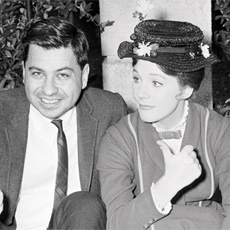
Richard Sherman and Julie Andrews have fun on the set of "Mary Poppins".
 
Many virtues define a true legend, but divine talent is what differentiates "Disney Legends." For the second segment of our "Lunch with a Legend" series, the Insider broke bread with Disney Legend Richard Sherman who (along with brother Robert) was half of the only songwriting-composing team ever to work on staff for The Walt Disney Company. From "Mary Poppins" to "Winnie the Pooh," this award-winning duo is known the world over – if not by name, then by song. Though Richard admits he's shared them a "million times," the master showman was thrilled to recount some of his most poignant memories.

Meeting Walt Disney

"Here's how it all began for my brother Bob and myself ... we were freelance pop songwriters and a little girl named Annette Funicello sang a song we'd written called 'Tall Paul,' which became a really big hit. We started writing songs specifically for her, and had hits with 'Pineapple Princess' and 'Jo Jo, the Dog-Faced Boy' – big rockers back in 1959/1960. Little did we know Annette was Walt Disney's very favorite Mouseketeer ... he listened to all her songs and liked what he was hearing."

Things changed when Walt wanted Annette to sing in a TV movie called "The Horsemasters" since her records were so popular – and requested that the brothers write the song. "Jimmy Johnson [head of the record company] asked if we wanted to give it a shot, so we wrote 'The Strumming Song.' Jimmy liked it, but said Walt would have the final word. We asked 'Walt who?'" After learning that the Walt in question was Walt Disney, Richard wanted to demo the song with a female singer before the meeting, but was told Walt likes hearing things the way they were written.

With trepidation, the brothers brought their song up to Walt's office. "Now picture this ... Walt was sitting behind his desk signing pictures. I'll never forget it because it was our first meeting with the great man. He looked up and asked if we were really brothers because there were a lot of brother acts in vaudeville with people who weren't really brothers. I said 'No, we actually have the same parents!'"

When Walt began discussing "The Parent Trap," both brothers immediately knew he was talking about the wrong film. "I was dying, but my brother Bob was brave enough to say that we were there with Annette's song for 'The Horsemasters.' I mean, how do you tell an icon he's telling you the wrong story?" After what Richard calls the most brutal performance of "The Strumming Song," Walt said, "That'll work," and gave them a script to see what they could come up with for "The Parent Trap." Richard and Robert were completely bewildered and thought the worst. "Jimmy said, 'Are you kidding? He bought one song and gave you another assignment!' We didn't even realize he LIKED what we had done. So that was our very first encounter with the man who changed our lives forever."

From there, they went on to write songs for "The Parent Trap," "Zorro," "Texas John Slaughter," and many other films and television shows. "Walt kept giving us assignments – he was testing us. He'd always say, 'That'll work,' and give us another assignment. Jimmy told us to keep'em coming."

"Mary Poppins"

Little did they know their careers would be thrown into overdrive when Walt asked "The Boys" (his nickname for the brothers) if they knew what a nanny was. Their reply? "Yeah, it's a goat! We thought he wanted us to write a song for a nanny goat!" But Walt asked them to read P.L. Travers' book "Mary Poppins," and let him know what they thought. "He threw the gauntlet down and wanted to see what we'd do with it. So Bob and I read these very charming stories, but panic struck when we realized there was no storyline – it was strictly about a nanny who flies in on the east wind, takes the Banks' children on wonderful adventures, and flies out when the west wind comes along."

Not knowing where to start, they selected six chapters to loosely base a story on – and the chosen adventures inspired scenes like "Jolly Holiday" and "Feed the Birds." Richard recalls the follow-up meeting with Walt. "Walt was as excited as we were! He fell in love with 'Feed the Birds,' which became his favorite song. When we were done, he asked to see our notes, which were pretty dog-eared from underlining and highlighting. We gave him our book and then he pulled out his copy. He had underlined the same six chapters – that was gooseflesh time. It really, really was amazing."

Walt then invited Richard and Robert to work at Disney. "We said YES, we'd love to work here! He already had a contract written up and told us we'd have an office down the hall. Walt wanted us to develop the story with screenwriters Bill Walsh and Don DaGradi, but called it our 'backburner project' because he planned on giving us lots of work. And that was the turning point in our lives ... two beloved stories that I vividly recall, and both involved Walt Disney."

Aside from "Mary Poppins," the Academy-Award®-winning duo (they garnered two for "Mary Poppins" alone!) wrote songs and scores for countless Disney classics, including "The Jungle Book," "The Aristocats," "Bedknobs and Broomsticks," and the "Winnie the Pooh" short films. Though Richard says they were always creatively connected to Walt, their time with him was limited but intense. "We started with Walt in 1960 until 1966. Walt was very, very thoughtful and kind to us ... if he liked what you were doing, he'd never gush. You'd always hear from someone else that he flipped for whatever it was you did. When he died, we worked at the studio for several years, but it just wasn't the same. We've had a wonderful career thanks to Walt Disney."

Richard is currently working on his second album of instrumental music, which he calls a cross between pop and semi-classical. "I've always been a happy person. I'm very positive and so was Walt ... that's what he liked. If our music makes people feel good about themselves and gives them hints about how to act, I think we were very lucky to write those songs. It's a nice feeling to know the rest of the world responds to your material."

Thursday, June 02, 2011

Disney Producer Walsh Shows Approach to Comedy with Blackbeard's Ghost

06.02.11 - If a much sought after formula for successful motion pictures really exists, then Disney producer-writer Bill Walsh, whose current offering is Blackbeard's Ghost, has found it.


Track coach Steve Walker (Dean Jones) tells Peter Ustinov he wants no part of his weird, wild and "spirited" antics after accidentally conjuring up the rotund pirate's ghost in Blackbeard's Ghost, Walt Disney's newest comedy-fantasy in color by Technicolor.
When examining the greatest successes in Walsh's 22-year Disney career — films like The Shaggy Dog, The Absent-Minded Professor, Son of Flubber, Mary Poppins, That Darn Cat, and Lt. Robin Crusoe, U.S.N. — his approach to comedy-fantasy becomes evident.

"The first portion of each film," comments Walsh, "takes time to establish characters and to delineate situation. Although this initial part may move more slowly than the rest of the film, it is a necessary and deliberate movement. Walt used to call this part of the picture winding the clock." Once the stage is set, the action picks up momentum as the picture unfolds.

"Too often comedies begin at a nervous clip, moving at a fast pace until they run out of gas, without having told a good story. The most important single consideration of any picture is the script," explains Walsh who has co-scripted 13 of his 16 features. "We are always on the lookout for fresh material that would be suitable for screen adaptation. Blackbeard's Ghost was developed from a very funny novel by noted illustrator Ben Stahl which tells the exploits of a long-dead pirate's spirit who is cursed to wander in limbo until he performs a good deed."

The second most important consideration is the cast. "Comedy-fantasies require actors who can play un-believable situations for real. Fred MacMurray and Dean Jones are that type of actor. Peter Ustinov, who has the title role in Blackbeard's Ghost, is another marvelous example."

"The success of Dean Jones, who has starred in three of my productions, including Blackbeard, lies in his sincerity. The nuttier the situation gets, the more he believes in it. Actors often go wrong in fantasy. They become cute with the material and lose audience contact.

"The supporting cast and secondary parts must also be all topnotch people who understand comedy. For example, Joby Baker, Elsa Lanchester and Richard Deacon beautifully complement the headline stars, Dean, Ustinov and Suzanne Pleshette, in Blackbeard."

Blackbeard's Ghost, filmed in color, stars Peter Ustinov, Dean Jones and Suzanne Pleshette. Robert Stevenson directed the Bill Walsh-Don DaGradi screenplay, which is based on a novel by the noted illustrator, Ben Stahl. Walsh is co-producer of the Buena Vista release.

From the original 1968 Blackbeard's Ghost press materials.

Sunday, May 22, 2011

A major Disney museum in Glendale? It may be the future for the company’s past

{EAV_BLOG_VER:e86f42cfca549bc8}

THE DISNEY ARCHIVES

This is a longer version of Geoff Boucher's article that ran Friday on the front page of the Los Angeles Times (June 2010).

Davesmith

After Walt Disney died in 1966, his grieving staff sealed his office suite in Burbank, and even as work proceeded on “The Jungle Book” there was anxiety that the company’s past might be brighter than its future.

Four years later, those worries deepened as key executives approached retirement, including Walt’s older brother, Roy O. Disney. That’s why, in 1970, the company handed the key to Walt’s still-sealed office to a former UCLA research librarian named Dave Smith, who was sent into the chamber to learn its history.

“I didn’t expect this to become my life’s work, but it did,” Smith, 69, said on a recent afternoon as he gave a tour of the Disney Archives, a massive collection spread across several in-house libraries and high-security warehouses filled with Disney movie props, costumes, toys, art, animation, vintage theme-park gear and company publications.

Geppetto

It all began with the items that Smith found in Walt’s desk all those years ago.

“It was an eerie thing to sit … in his chair and count the paper clips in the drawer,” Smith recalled with a nervous chuckle. On the bookshelves, he discovered books and letters given to Walt by Upton Sinclair, Winston Churchill and C. S. Lewis, who inscribed one of his books of poetry with the words: “From one visionary to another.”

On Friday, 40 years and a day after he was hired, Smith announced his imminent retirement from a corporation that, as he put it, “reuses and returns to its past more often than any company in the world.”

His one-man history department has become a team of 12 that is busy going through hundreds of boxes of artifacts never fully cataloged. For years, there simply wasn’t time for Smith to do anything more than grab, save and store. Now, with wide eyes and sometimes racing hearts, the younger preservation experts make almost daily discoveries of forgotten treasures.

Boxes

On a recent afternoon at one of the archive’s secret Glendale warehouses, Disney archive manager Becky Cline held up one recent find — a cache of storyboards and concept art for the 1964 classic “Mary Poppins.”

“This hasn’t been seen or touched since the movie came out, and it’s never been reproduced in any way,” said Cline, who will take over Smith’s title as official archivist after his departure in October. “This is simply amazing stuff. And we’re going to get to show it to the world.”

The texture of the job is different these days, but the spirit of the mission remains the same, Cline said.
“When I talk to Dave about it, it’s the same,” Cline said. “He was searching in different places but the job is the same. Find it, catalog it, save it. We’re still finding wonderful unique material. We just got cutting records from ‘Snow White’ that had been filed strangely in 1940 in the music department and no one came across them until now. I can’t tell you how it feels when something like that shows up.”
When Disney President and Chief Executive Robert Iger got his first tour of the warehouse — which resembles the piled-high repository shown at the end of “Raiders of the Lost Ark” — he knew the artifacts could be collecting more than dust.

Blackhole

Iger said this week that a fully dedicated Disney museum is a possibility and, when asked if the company’s largely undeveloped industrial park in Glendale might be an option, he said yes. That parcel includes the old Grand Central Airport, a 1920s Art Deco relic that might be a candidate, according to some Disney sources, but Iger did not speak about that building specifically. At the least, Iger said, the company heirlooms will be displayed at the D23 Expo planned for next year in Anaheim or in a touring museum exhibit.

“I’m certainly intrigued by that idea but we’re exploring multiple ways to do it,” Iger said. “It could be that end up in partnership with an existing museum, figure out ways to exhibit these great works at museums around the country or the world. It also could be that we create our own — obviously there’s significant investment associated with that. As we consider any significant investment we look at what kind of return we could get on that investment. In meantime we know one return from this would be all the great goodwill we’d see from making this collection accessible. We also need to be practical about it from the dollars and cents perspective.”

In its early years, Smith’s work was hardly revered in every corner of the company.

The research librarian got the job by being the right man in the right place at the right time. At UCLA, he had toiled on a Disney bibliography, and one day at the campus he overheard one of his bosses tell a Disney executive that the company should create its own in-house archive to hold on to its past. Smith was enthused Birdincage and offered his services, but no one in Burbank was sure what the job description could or should be.

Smith took a two-month leave from the Westwood stacks to poke through filing cabinets, unlock dusty storage rooms and interview Disney old-timers about long-gone colleagues and half-forgotten projects. Some staffers were puzzled or amused by the earnest young man scribbling down dates and names. In those days, the notion that youth entertainment deserved the permanent-record treatment seemed, well, goofy.

Smith wrote a proposal for an in-house archive and in 1970 officially joined the Disney payroll. The job was a mix of discoveries and dashed hopes in the early years. Some employees were reluctant to surrender caches that were so much a part of their history and, in many cases, connected to their current work. Others watched the parade of departing boxes with a smile.

“They were just happy,” Smith said, “to get the office space.”

Smith’s work was far more than a paper chase. Within a few years of its founding in 1923, Disney was licensing its characters to companies of all sizes and sorts for toys, trinkets, apparel and bric-a-brac. The Disney corporate attitude toward this mountain of “outsider” product was lack of interest or vague disdain. But the new archivist saw the Mickey Mouse wristwatches and “Fantasia” figurines as true artifacts, pieces of history.

“This was a period before there were a lot of Disney collectors, so it was easier to find things and they didn’t cost nearly as much as they would now,” Smith said, sitting in a Burbank office lined with rare Disney memorabilia.

“Take a look at this. I got this at the Rose Bowl swap meet for $18 in the 1970s,” Smith said, reaching for a small 1930s Donald Duck toy in a tiny, faded carton. “It’s in the original box, which is quite unusual. It’s preserved in perfect condition and worth about $2,500 now.”

Ticket

In the corporate corridors, Smith used to run into people who assumed he and his pesky school project would be gone within a few months. Roy O. Disney’s ferociously loyal secretary fought his efforts to get access to her boss’ papers and effects. Finally, the archivist prevailed.

Among Roy’s stuff was a ticket stub he kept in his top drawer. “It’s marked ‘No. 000001,’ Smith said, holding the first Disneyland ticket ever sold. “Roy bought the first ticket when the park opened 55 years ago. He paid $1 for it and then he kept it all those years right within reach.”

For the creative teams at work in the company today, the archive is a resource of the highest order.
“I think it took a few years for the company to realize it had an archive and what that meant,” Smith said. “It took a few years to understand how the archive could help them. Our primary reason for being is to help the various divisions….There were 10,000 employees when I started; now its 140,000. It’s a much different company and it makes it incumbent upon us to collect much different materials. When people come along in 30 years and want to know what this moment in time was like, they will be able to come to us and find out.”


Jackinthebox
Is there a list of rare items or lost information that Smith wishes he could find before he leaves his archive in the hands of a new generation? “The short list is really just one item. We have no lists of artists who painted the backgrounds for our cartoons. We have lists of directors, we have lists of the animators, we have lists of the voices in most cases — but the backgrounds, which had beautiful artistry, in a lot of the cases we don’t know who did the work. That bothers me.”

These days the archive is growing faster than ever. Iger issued an order in 2006 to all business divisions that if the archive wants something, it gets it — an acknowledgment of the growing value of movie props and Disney artifacts in the eBay era. Through the years, too many treasures walked out the door or went in the trash.

The team is now known around the company as the “Raiders of the Lost Archive.”

“We did get a little bit of a reputation for being the people who came in and said, ‘OK, we’ll take that and that and that …’ In a way, we are like, ‘We have our warrant and we’re coming in,’ ” said Steven Clark, vice president of corporate communications, who also oversees the administration of the archives.
“We try to be gentle, but we are taking things to be protected. And we are going to take them,” said Becky Cline, the archive manager.


Animatedheads 

So, despite turbulence, the team recently returned from Anaheim with three prized trophies from Disneyland: Melvin, Max and Buff, the three mounted animal heads that for decades serenaded visitors at the now-dismantled Country Bear Jamboree attraction.

Clark said that Iger has given the archives a budget that, for the first time, allows the team to acquire key Disney artifacts from private collectors. For instance, the carpet bag carried by Julie Andrews in “Mary Poppins” may soon be back in the company’s possession, though Clark won’t reveal details.
“We’ve found it,” he said somewhat cryptically. “We’re working on it.”

The job is defined by long hours of meticulous research and methodical cataloging. But there are flashes of adventure in unexpected places. Last year, Clark and Cline were in Orlando, Fla., to meet with Walt Disney World leaders to explain archive policies and plans, and they were told that, the next day, the attic section of the Haunted Mansion ride would be gutted to make way for a major renovation. The California visitors were told they were welcome to save the vintage assets — if they were ready to do it all on their own.

Nautilus 

In borrowed work clothes and hard hats, the two archivists went to work with drills to save the items that made up the entire spooky tableau. “Everything was screwed down,” Clark said, “because otherwise it would have walked off years ago.”

It was grueling work; the ride — and the air conditioning — were shut down and there were decades of spider webs in every corner. “If you’re the Haunted Mansion,” Cline noted, “you don’t even think about dusting.” In sweltering heat, the two gagged and wheezed through their face masks. The work was worth it. The two packed up The Bride and enough trappings from the ride sequence so that someday the entire scene could be re-created. On a recent afternoon, Cline and Clark were sitting in Smith’s office at Disney’s Burbank headquarters, chatting about their planned trip to Hawaii to gather props from the just-completed ABC television series “Lost.” Smith smiled as he listened in.

“They offered us the airplane — and I mean it’s a plane — but we had to say no,” Clark said. “Sometimes you do have to say no. But we are going to take the interior.”

Mickeyminnie 

During the meeting, Smith got up at one point and reached into a corner for something he wanted to share. It was much smaller than a commercial airliner and, really, much more impressive. Immediately interested and hushed, everyone leaned forward to inspect the yellowing pages of a booklet.

“People told me all the time that Walt wasn’t that interested in his own history and once he finished a film he put it away and never looked at it again. But when I inventoried his office, I found this,” Smith said.

He presented a 12-page sheaf with chunks of text interspersed with pencil drawings of a jaunty-looking cartoon character on a riverboat escapade.

“It’s the script for ‘Steamboat Willie,’ the first Mickey Mouse cartoon,” Smith said as he offered the 82-year-old artifact for inspection. “His chief artist, Ub Iwerks, did the drawings and Walt would have typed the text. I saw this and I knew Walt cared about his history, just like I do. Just like we do. And just like people always will.”

– Geoff Boucher

Thursday, April 14, 2011

Disneyland Comic Helped Launch Julie Andrews' Singing Career


Julie Andrews and Wally Boag reunited at the Golden Horseshoe Revue, Disneyland in 1963.
Every one of the many thousands who have seen Wally Boag go through his gun-shooting, teeth-popping, balloon-blowing act in Disneyland's Golden Horseshoe Revue will agree this is a mighty accomplished young man.

But how many people know Wally's greatest accomplishment? Fifteen years ago he pointed to a slight little girl among the audience in the vast London Hippodrome and invited her up to the stage. It was all part of the act, but no one was ready for the brilliantly clear tones of the aria the little girl sang.

For she was Julie Andrews, aged 12, and — quite accidentally — this was her first day as a performer. She was immediately signed to a run-of-the-show contract and thus launched on a fabulous career that would bring her to the world's attention as the delightful Miss Liza Doolittle in "My Fair Lady"; as Lady Guinevere in "Camelot," and ultimately as the beloved English nanny and in the title role of Walt Disney's musical motion picture, "Mary Poppins."

Julie was born in Walton-on-Thames, a little town near London. Her parents' divorce when she was very young brought her a step-father who would soon determine she had a great voice and to see to its training. He was Ted Andrews, musician and singer. The discovery was made during World War II when Ted and Julie's pianist mother, Barbara, decided singing lessons would serve well to keep the child's mind off the conflict around them.

"I hated it — loathed it," Julie recalls, "but it was suddenly certain that I had a freak voice, with a range of four to five octaves. A throat specialist made the diagnosis. I was a child possessed of a completely adult larynx."

Julie's vocal training continued as she traveled around the province with her parents, whose musical act had made them the toast of the music halls. This backstage life gave Julie her first taste of show business, but her first professional appearance did not come until her surprise discovery in the audience of the Hippodrome.

Other revues, concert tours, guest appearances on radio and television followed, but it was while appearing in a pantomime of "Cinderella" at the London Palladium that her first big break came. She was seen there by the producer-director of the hit show, "The Boyfriend," and asked to play the lead role in the New York company. Julie's Broadway bow was a brilliant one and paved the way for her future successes. The rest is now theatrical history.


From the original Mary Poppins press materials.
Related Posts Plugin for WordPress, Blogger...