Wednesday, April 20, 2011

How I Met the King of the Leprechauns by Walt Disney

04.20.11 - Being half Irish myself, I learned about the Leprechauns of Ireland while I was still a small boy on our farm at Marceline, Missouri. I began to believe in Leprechauns, then, because some of my relatives had pretty convincing stories to tell about the magic powers of these Little People, and the tricks they could play when angry.


So, I promised myself that one day, after I had grown up, I would go to the land of the Leprechaun myself, and meet one in person. The opportunity finally came last year when we decided to use real Little People instead of cartoon imitations in a movie we were planning.

Most Irish in the old country respect Leprechauns. They leave food out for them at night, to keep them happy, and are careful not to disturb old forts and other ruins these wee folk guard as their very own. They are particularly careful not to throw water across any of the tiny paths Leprechauns leave in the grass, because Little People hate water, and there is no telling what sort of mischief they will be up to if they get their feet wet.

Anyway, once we decided on using real Leprechauns in the picture, I set out for Ireland to hire some. We needed about 150, all told, for the picture we had in mind.

How to find a Leprechaun? That was a big question. I found it wasn't easy. It takes a man mighty knowledgeable in the ways of Leprechauns to find one to talk to. I went to a library in Dublin. It was filled with books on the habits of Leprechauns. Each book recorded an encounter someone had with the Little People. There was even a little green suit which had been sent in to the library by a lady from County Cork. She had thrown out her wash water without looking where it was going and later found the fairy clothes hanging on a furze bush to dry. It was lucky nothing worse had come from such a careless encounter.

The librarian was an elderly scholar who soon took me in tow. He measured the clothing with a ruler.

"There you are," he said. "The man who wore them was just two feet tall. You could easily carry him in your valise-case."

"I don't suppose anyone ever sent you in a photograph?" I asked. " No, but we have the next best thing."


He took down a huge book, blew off the dust and opened it. It was full of wood engravings made by an artist who, it was said, had lived with the Leprechauns for years. From the pictures and the old scholar, I learned how the Little People came to Ireland 5,000 years ago.

"Well," began the scholar, "the Little People once were in heaven, living among the angels much as they live among the Irish now. Millions of them flocked together, and Brian Connors was King of them all, as he is today. Their lives were happy and peaceable until Satan started a war against the Angel Gabriel.

"Now, on the morning of the great battle, King Brian was lined up on the side of the White Angels, while across a valley were the Black forces of Satan. And when it came to hurling hills and thunderbolts, the Black Angels were beat from the first.

"The size of the Little People was their undoing. They found they were too small to lift a rock, let alone throw one. So Brian took them all to the edge of heaven to await the outcome, and that is where the victorious Gabriel found them.

"Any man," said Gabriel angrily, " that won't stand for the right may not deserve hell, but he is not fit for heaven, either." With that, he ordered the Little People into space, granting them one last wish. It was that they could live among any kind of people they liked.

"For two years they fell before reaching the world. And when they had circled it round and round they saw at last a beautiful island glimmering and sparkling in the middle of the sea.


"Stop there," shouted King Brian, "for of all the places we've seen, this is the nearest to heaven!"

"And that's why you find Leprechauns in no other place but Ireland." The old scholar stopped, through with his story. "I would like to capture that king," I told him.

So the scholar sent me to County Kerry, to find Darby O'Gill. Darby, he explained, knows more about Little People than anyone else in Ireland.

Darby lived in Rathcullen, a beautiful little town nesting comfortably in velvet green hills almost next door to Knocknasheega, the mountain where King Brian maintains his permanent palace.

I found Darby sitting in his gatehouse, telling the neighbours of his latest meeting with King Brian.

"When was that?" I interrupted.

"Last summer in the ruins atop Knocknasheega," the old man replied with a wink.

"Could you take me there? "

"Well, I suppose I could. But if it's Leprechaun gold you want, he may cheat you out of it as he did me."

"It is not gold that I want," I replied. "It is the king himself."

We set out on foot for the ruins, which were about a mile away. They were of an ancient abbey, broken arches and ghostly pillars where monks lived long, long ago.

"The king and his people are singing and dancing far below us in a great throne room of gold and black onyx," Darby said, pointing to the ground at our feet. "We may have to wait a bit before one of them shows up."

We sat down on a large stone, making ourselves as comfortable as we could under the circumstances.

"Now," Darby spoke up again, "if once you see one, don't look away. He may try a trick or two, throwing dust in your face or pointing away to distract your attention. But keep your eye squarely on him. That way you can bend him to your will."

So we waited and waited until the moon had nearly set. Then suddenly, a tiny tapping made us look around. There, seated on a ledge, was a Leprechaun, pounding away at a little shoe held against his leather apron. He was all dressed in green, with a little red hat with a feather stuck in it.

Cocking one eye as Derby had shown me, I presented myself.

"Good lad!" shouted Darby. "You've got him!"

The little man screamed at me in Gaelic and kept pointing this way and that to distract me. But I held on and finally, with Darby interpreting for me, I got him to notify the king we desired an audience then and there.

To my surprise King Brian spoke English. He is an educated man, you know, who makes it a point to keep up with the times. But his voice was all there was to him. There was nothing at all to be seen.

"Mr. Disney has come all the way from America to see ye, sir," explained Darby, talking to thin air. "Why don't you let him?"

"I've come all the way from the middle of the mountain to have a look at him," replied Brian's voice. "What's this I hear that he doesn't want our gold — is it some new trick maybe?"

Well, the king was happy to hear of my Irish ancestry, and that I'd come all the way from America, and that I didn't want any of his gold. So he condescended to let me talk to his crown and suddenly there it was before me, hanging in space and moving around in starts and stops as if for all the world it had a mind of its own.

"I'm going to do a moving picture about Ireland — the real thing," I told the crown.

"What is that to me?"

"I want you to be in the picture."

"Is it mad you are??"

With that the king appeared. I must have shown my excitement for King Brian shouted, " What ails you? Did you never see an immortal mortal before? "

"I've seen an engraving of you, but it didn't do you justice. I expected an older man," I said in a friendly way.

"Faith, I've only been on this earth 5,000 years!" shouted the king.

"You don't look a day over 4,000," I told him, smiling.

I'd scored a point. The king was so flattered at the compliment, he promptly agreed to come to Hollywood and show his handsome face to all the world.

"Well," he said, "if it's a Leprechaun picture you want, then it's Leprechauns you'll be needin' for the parts of Leprechauns."

Two months later he arrived at the studio with 150 of his subjects, all ready to make the first Leprechaun picture in the history of Leprechauns, which in honour of those who made it possible, we call DARBY O'GILL AND THE LITTLE PEOPLE.

From the Darby O'Gill and the Little People press materials.

Monday, April 18, 2011

Horse, Motor Car Share Main Street, U.S.A.'s Thoroughfare

04.18.11 - An almost forgotten era of America's history is relived by guests entering Disneyland's Main Street, USA. The feeling of a typical small thoroughfare of the 1900 era will be experienced by guests strolling down Main Street, U.S.A.

Walt Disney, who was reared in a small mid-western town of Marceline, Missouri, worked with his staff in building Main Street, U.S.A. so that the uniqueness of this street would be authentic to the smallest detail.

The same demand for detail is designed into the Main Street vehicles. Many types of unique conveyances are represented on Main Street, U.S.A.

The four horse-drawn streetcars on Main Street are composite reproductions of 19th century streetcars you might have found in such late 1800 cities as Chicago, Boston, Philadelphia or New York.

WED Enterprises, Walt's planning and designing firm, built the horse-drawn streetcars by working from photographs of earlier authentic vehicles.

The large horses which pull the streetcars are either Percheron, Belgian, Clydesdale, or a cross between Shire and Percheron. These horses each receive a minimum of 30 hours special training before going "on stage." Each works a four-hour day, five-day week, and is given taxi service to and from the stables — it sure beats our work week!!

The horseless carriages on Main Street, U.S.A. are a composite of the design and size of many gas-driven cars of that early period of automobile history.

The three horseless carriages that carry guests entering and exiting the Park run on two-cylinder water pump engines that chug and snort just like the originals. But not everything is a reproduction. The external parts, such as the horns, lights and wheels, are authentic.

The green and yellow double-decker Omnibus is as authentic as any bus you might have found on the main streets of New York, Chicago or Boston at the turn of the century. An old electric English klaxon horn is the only original part used in the building of the two Disneyland Omnibuses.

The Studio designers built the Omnibuses or for that matter, all the vehicles, so that guests would have greater comfort, safety, and convenience. The drop frame chassis is from a modern day truck. Having a modern day engine, the buses also include power steering and power brakes.

On your next visit to the Magic Kingdom, leave the hustle and bustle of today's streamlined transportation and travel down Disneyland's Main Street, U.S.A. The years will roll back until there is only the sound of a casual clop-clop of a horse-drawn streetcar and the chug-chug of the horseless carriages.

From the fall 1968 edition of Disney News magazine, published by Disneyland.

Saturday, April 16, 2011

The Building of Model "G" Ford

 04.16.11 - "Mildly rugged. He looks like what he was — a football player."

"Sporty. A little more relaxed than most Presidents."

"He is a pretty-down-to-earth sort of dresser."


Disney sculptors and wardrobe designers looked even more than they listened as Gerald Rudolph Ford took the oath of office last year, becoming the 38th President of the United States.

While the rest of the world anxiously sought the political views of this first unelected American President, Disney craftsmen were critically examining President Ford's physical appearance and his manner of dressing, for soon he would be the 37th "guest of honor" in Walt Disney World's The Hall of Presidents' attraction.

Life-like "Audio-Animatronics"® figures of all the United States' chief executives appear together onstage in "The Hall of Presidents" for a historical roll call. (Although there have been 38 Presidents, including Ford, there are only 37 individuals, since Grover Cleveland served two separate terms in office.)

Before the Liberty Square attraction opened in 1971, the nation's leaders, from Washington to Nixon, were studied in detail by Disney "Imagineers" at WED Enterprises in California. Books, photographs, diaries, television programs, and personal accounts were examined so that the craftsmen could accurately create the life-size Presidential figures.

And by the time Gerald Ford had moved into the White House, the "Imagineers" were already compiling statistics on his size, personality, and wardrobe.

"I looked through all the magazines I could immediately after Ford became President, and one or two of them actually gave me his height and weight. What they didn't give me, was his girth," recalled the WED sculptor who created the Ford bust (and the busts of most of the other Presidents) and supervised the detailing of the figure.

"I had our librarian check with the White House, and the Secretary sent his measurements. He had a 38-inch waist and weighed 204 pounds, and was trying to lose weight. So we proportioned the figure based on that."

"President Ford has a face you cannot describe or caricature very easily," said the sculptor, but he added that Ford's eyes are unusual. "His eyes are a little closer together than average, and he has a rather piercing stare. He looks with intensity, yet his eyes are warm."

President Ford's nose is somewhat wide and roundish. This trait, combined with the fact that the distance from his eyes to the bottom of his nose is shorter than average, makes the area above his upper lip seem larger than usual, the Disney artist noted.

A mold was made from the original Ford bust which the sculptor created so that additional busts could be cast. Since the "Audio-Animatronics"® figures move and speak, the "skin" of the President was cast of a rubber-like material.

The wigmaker used another specially designed bust to fashion the hair for Disney's Ford. Placing each strand by hand, she styled the wig to match the President's blonde hair. Barely noticeable because of their natural lightness, Ford's eyebrows also were duplicated with hairpieces.

But facial expression and characteristics were not all that the "Imagineers" had to consider. As with every other Presidential figure, the wardrobe experts spent hours comparing White House, news, and magazine photographs to see if there was any continuity in the way the President dressed.

"He is very up-to-date — not mod. He wears a good, sensible businessman's suit," the costumers concluded.

"Ford seems to prefer lighter colors, especially blue. And he wears more plaid or striped suits and colored, button-down-collar shirts than we have seen for awhile on a President."

The costume designers agreed that President Ford is a "pretty-down-to-earth sort of dresser," so they chose a medium-blue plaid fabric with tiny white and rust stripes for his wool suit.

The Disney tailor then made a pattern for the size-42 outfit, and sewed a handsome suit that the President, himself, would probably love to wear.

Choosing a tie for President Ford meant more research. "He seems to especially like bold, diagonal-striped or geometric-patterned ties," said one costume designer, "so we decided to use one like the striped tie he wore when he was inaugurated."

In less than four months, the Disney team "built" a President who now stands in a grouping of modern-era Presidents among the 37 historic leaders of our country in Walt Disney World's "The Hall of Presidents."

From the Spring 1975 edition of Vacationland magazine, published by Walt Disney World.

Thursday, April 14, 2011

Disneyland Comic Helped Launch Julie Andrews' Singing Career


Julie Andrews and Wally Boag reunited at the Golden Horseshoe Revue, Disneyland in 1963.
Every one of the many thousands who have seen Wally Boag go through his gun-shooting, teeth-popping, balloon-blowing act in Disneyland's Golden Horseshoe Revue will agree this is a mighty accomplished young man.

But how many people know Wally's greatest accomplishment? Fifteen years ago he pointed to a slight little girl among the audience in the vast London Hippodrome and invited her up to the stage. It was all part of the act, but no one was ready for the brilliantly clear tones of the aria the little girl sang.

For she was Julie Andrews, aged 12, and — quite accidentally — this was her first day as a performer. She was immediately signed to a run-of-the-show contract and thus launched on a fabulous career that would bring her to the world's attention as the delightful Miss Liza Doolittle in "My Fair Lady"; as Lady Guinevere in "Camelot," and ultimately as the beloved English nanny and in the title role of Walt Disney's musical motion picture, "Mary Poppins."

Julie was born in Walton-on-Thames, a little town near London. Her parents' divorce when she was very young brought her a step-father who would soon determine she had a great voice and to see to its training. He was Ted Andrews, musician and singer. The discovery was made during World War II when Ted and Julie's pianist mother, Barbara, decided singing lessons would serve well to keep the child's mind off the conflict around them.

"I hated it — loathed it," Julie recalls, "but it was suddenly certain that I had a freak voice, with a range of four to five octaves. A throat specialist made the diagnosis. I was a child possessed of a completely adult larynx."

Julie's vocal training continued as she traveled around the province with her parents, whose musical act had made them the toast of the music halls. This backstage life gave Julie her first taste of show business, but her first professional appearance did not come until her surprise discovery in the audience of the Hippodrome.

Other revues, concert tours, guest appearances on radio and television followed, but it was while appearing in a pantomime of "Cinderella" at the London Palladium that her first big break came. She was seen there by the producer-director of the hit show, "The Boyfriend," and asked to play the lead role in the New York company. Julie's Broadway bow was a brilliant one and paved the way for her future successes. The rest is now theatrical history.


From the original Mary Poppins press materials.

Monday, April 11, 2011

Fantasmic From the spring 1992 edition of Disney News magazine

FANTASMIC!

05.13.92 - It's not a "ride" in the conventional sense, yet it promises to take Disneyland guests on a trip beyond imagining.


It is, in a word, "FANTASMIC!"

FANTASMIC! is the uncommon title for a most uncommon Disneyland experience scheduled for a spring debut: part magic show, part high-energy musical theater, and a large part special effects display featuring lights, lasers and fireworks. This combination is what led to the selection of that uncommon name.

FANTASMIC! incorporates properties of fantasy, "Fantasia," and phantasmagoria, defined by Webster as "1. an early type of magic-lantern show consisting of various optical illusions in which objects rapidly change size, blend into one another, etc.; 2. a rapidly changing series of things seen or imagined, as the figures or events of a dream."

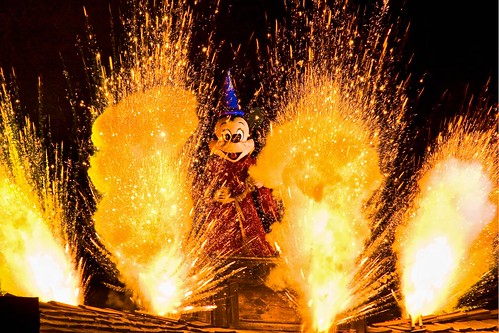
It all takes place on Tom Sawyer Island, long after dark, when guests have departed and the Island is empty or is it? Guests gathered along the Riverfront suddenly notice lights emanating from the deserted Island. There, in the midst of blazing color, appears Mickey as the Sorcerer's Apprentice, dreaming up images from 60 years of Disney animation. And then the fun — or is it terror? — begins.

Every bit as much care and attention to detail has gone into this entertainment spectacle as is put into any new Theme Park attraction.

"Disneyland is made up of a variety of experiences," explains Bob McTyre, Vice President of Entertainment at Disneyland, "attractions, food, merchandise, characters, live entertainment. We try to make the whole work together.

"As part of that effort, we were looking at ways to make nighttime at Disneyland a more exciting place to be. And we were most interested in New Orleans Square. Although we have done shows on the River in the past, a real show experience had never been done there."


Creating the environment for the presentation of FANTASMIC! required months of construction, not to mention the temporary draining of The Rivers of America, the drydocking of the Mark Twain Riverboat and the Sailing Ship "Columbia," and some extensive overhauling of Tom Sawyer Island.

When the dust cleared, the reconstructed Island, the refilled River, and the restored River traffic all looked much the same as they did before...by day that is.

That's just one of FANTASMIC!'s many illusions. By night, FANTASMIC! transforms the River into something wonderful...and sometimes sinister.

Creating the show that will come to life in this new environment actually took years.

"We had been wanting to do a spectacle on the River for at least 10 years," says Mike Davis, Director of Entertainment at Disneyland. "When we saw 'IllumiNations' at Walt Disney World we started thinking about it again. Then, last year, Michael (Eisner, The Walt Disney Company Chairman and CEO) gave us the go-ahead to try something new, so we said, 'Let's finally do that River spectacular."'

Through the high-tech sorcery of FANTASMIC!, Mickey Mouse draws the audience into a world of his own vivid and colorful imagination.

Of course, Mickey has more than 60 years of spectacular memories stored up, so it should come as no surprise that, once he turns his imagination loose, he can conjure up a sensational array of images — enormous blooming flowers, giant dancing marionettes, swashbuckling "Peter Pan" pirates (aboard a full-scale pirate ship), and exotic "Jungle Book" beasts, including a gigantic Kaa, which slithers its 100-foot-long body around the tip of Tom Sawyer Island.

There are some malevolent forces at work in FANTASMIC! however. A formidable array of Disney villains invades Mickey's imagination for a thrilling climax, pitting Mickey against the likes of the Wicked Queen from "Snow White," the demon Chernabog from "Fantasia," Ursula the Sea Witch from "The Little Mermaid," and the towering, fire-breathing dragon from "Sleeping Beauty." It takes all the goodness Mickey can muster to end the nightmare and return Disneyland to its normal state as The Happiest Place on Earth.

In addition to a cast of nearly 50 live performers in hundreds of costumes and a variety of roles, FANTASMIC! features lasers, fog effects, specially choreographed water fountains, fireworks, fiber-optics technology and a full cast of creeping, floating, fire-breathing and generally intimidating monsters.

One innovative technique employed by FANTASMIC! has never before been seen in a Disney Theme Park. As Mickey works his magic, three massive mist screens, each one 50 feet wide, 30 feet high and 6 inches thick, will appear on the River alongside Tom Sawyer Island. These screens are so dense that actual film images can be projected upon them.


Show Director Barnette Ricci says that the research into entertainment special effects technology dates back to 1989 when Disneyland was preparing to celebrate its 35th Anniversary. "I had an idea for an anniversary show at the Castle that would take special effects techniques like lasers and mist screens and combine them with live performers," Ricci recalls, "so there was a lot of research done on the different technologies available.

"Of course, the 35th Anniversary show never came to fruition," she says, "but maybe that was fate. Because then we were given this opportunity to do something really unique, on the River, a spectacle of spectacles!"

The key, Ricci remembers, was the discovery of the new water-screen technology.

"We had already gleaned all this information about mist screens on which we could project light beams and lasers. Then we received a demo reel from a French company. It showed a water screen with the film projected on it.

"Seeing it made the whole show just fall into place," she recalls. "What if Disney animation was projected on to those screens? It would be incredible!"

While Ricci was creating a script which incorporated the full range of characters and creatures that could emerge from Mickey's imagination, she and others were also finding ways to present these beings in unique, sometimes startling ways.

Some of the chief illusions of FANTASMIC! are created using specially prepared versions of scenes from classic Disney animated films, images which seem to appear in the air above the River as they interact with the live performers. The action is punctuated by an array of special effects and by Bruce Healey's dramatic orchestral score.

This was not as simple as might first appear. Familiar film footage could not just be "plugged into" the presentation. It had to be cleverly adapted, reedited under Ricci's supervision, and re-scored by Healey.

"The challenge," Healey notes, "was to reflect all of the different emotions and attitudes in the show."

In response to that challenge, he created something akin to a full-scale movie score. It includes original themes which explore the whimsical and romantic aspects of Mickey's imagination, and others which provide heroic emphasis for the action highlights.

Healey also did fresh orchestrations of existing music — ranging from "Night on Bald Mountain" to "Someday My Prince Will Come" to "Pink Elephants on Parade."


While Healey was occupied with what the audience would hear, others were helping to create the things the audience would see. While many of the characters seen in FANTASMIC! may look familiar, costume designer Marilyn Sotto points out that the costumes needed an extra dose of Disney "sparkle" because of the darkness and distance from the audience. Mickey and his friends also needed something their outfits don't require on Main Street, U.S.A. — waterproof lining!

A few costumes include fiber-optic illumination. Many had to be designed for quick changes — from "Jungle Book" monkey to "Peter Pan" pirate, for example. And then there was the challenge of creating a costume that enables a performer to impersonate one of the fanciful, flexible pink elephants from Dumbo's dream.

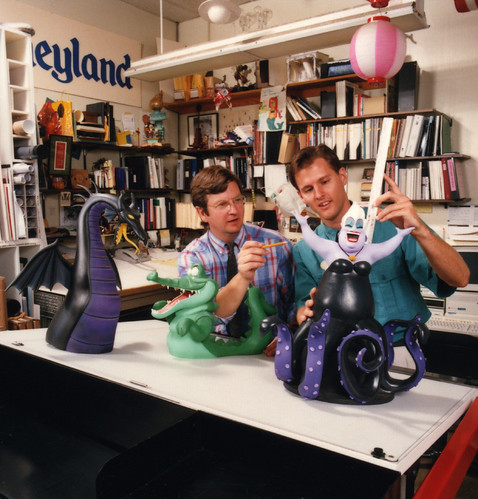
Ask art director Tom Butsch what he's been doing for the past year and he'll tell you about giant flower petals, a hundred-foot-long snake "with search-light eyes," a giant crocodile and a villainess to whom he refers as "the 20-foot tall floating Ursula creature."

The most spectacular effect on which Butsch and Co. have had to work is the one which climaxes the villains' invasion of Mickey's imagination. Maleficent, the "Sleeping Beauty" sorceress, is transformed into a 40-foot dragon, breathing fire which literally ignites the surface of the River.

"We've been designing that dragon for over a year in various permutations," Butsch recalls. "I don't know how many hundreds of different ways of 'doing dragons' we considered, but it was plenty. The trick was to make it believable and scary and all the things it needed to be."

"We hope to involve the audience emotionally," says Mike Davis. "FANTASMIC! is visceral; it's scary and exciting. We're using a 'sound-surround' effect that will make you think the villains are right behind you, lasers shoot over the audience's heads, and you'll even feel the heat of the River on fire."

According to Bob McTyre, FANTASMIC! is expected to be a regular part of Disneyland for years to come.

"A lot of time, effort and expense has gone into infrastructure," says McTyre. "What we've done is build a new theater for Disneyland. The show can be changed when there are new ideas, new technology.

"We built a venue here at the River, a place to put on the kind of show we've never been able to do before at Disneyland. And we'll have it for a long time."

From the spring 1992 edition of Disney News magazine, published by Disneyland.

Wednesday, April 06, 2011

01 year without Eddie Carrol [The Jiminy Cricket]

Eddie Carroll have been playing the role of Jiminy Cricket since 1973 after the death of original voice Cliff Edwards in 1971.


Eddie Carroll entertained in dinner theatres as a Jack Benny impersonator and provided the voice of Jiminy Cricket until his death in 2010.


Our friends from Voice Actors in the News received the following message from Laura Leff, president of The International Jack Benny Fan Club, on the morning of Tuesday, April 6th:


Eddie Carroll passed away about an hour ago. Today is also his and Carolyn’s wedding anniversary–47 years. And I read Eddie all the well-wishes that I had received up to about 10PM Pacific Time last night, so he knew that you were thinking of him.

There is a story told by one of the help at Jack’s house that shortly before he passed away, he woke up and said that he had been talking with Lyman Woods (his second vaudeville partner). Jack said that Lyman had shown him the afterlife, and that it was “beautiful”.

I’m sure many of us will want to envision Jack helping Eddie to make his exit to our standing ovation.

–Laura Leff
President, IJBFC
www.jackbenny.org


Tuesday, April 05, 2011

Mission to Mars From 1975 Disneyland Vacationland

Click Here to Read: The Voice in Mission to the Moon and Mission to Mars From 1988 Disneyland Line

Click Here to Read: Tomorrowland: Mars And Beyond from the original 1957 press materials

Past the Moon and onto the Mysterious Red Planet

04.05.11 - In a constant effort to keep pace with time and progress, Disney Imagineers replaced Tomorrowland's Flight to the Moon attraction with an exciting rocket trip to and around the mysterious red planet.


Flugelsnoots, Gaffelnarks and The Zarkum Weed have come to Disneyland. These characters make up the Mad Mars Myths a part of the Park's new attraction, Mission to Mars, presented by the McDonnell Douglas Corporation.

In a constant effort to keep pace with time and progress, Disney Imagineers have replaced Tomorrowland's Flight to the Moon attraction with an exciting rocket trip to and around the mysterious red planet. Photographs taken by the United States' Mariner Nine Program were used to develop the attraction.

Guests first enter the pre-flight Mission Control Center where activities on the ground and out in space are being monitored. Among the film highlights viewed are scenes from America's Skylab missions from the early 1970's. Films and narration point out how these continuing Skylab missions help man improve the environment here on earth. Disney artists and technicians have made every effort, in cooperation with the National Aeronautics and Space Administration (NASA), to make the new "Mission to Mars" adventure as authentic as possible.

After guests are escorted into the main cabin where their flight takes place, the cabin doors close and lights dim slowly as the voice of Third Officer Collins comes over the Spaceliner's public address system. "We are in final countdown and you can watch our lift-off on the lower screen in your cabin. I'll speak to you again after we're in space." Guests' eyes then turn to the upper and lower screens and two side screens in the round flight cabin. (Side screens have been enlarged from the original Flight to the Moon attraction, giving even more realism to some fascinating actual films of space flight and Disney-created sequences.)

This adventure encompasses many new and unique simulations, including a hyperspace-warp when passengers seem to be hurled through space in an anti-universe that is separate but parallel to our own. Guests are suddenly engulfed in sound and wild sights as the ship's deck and seats tilt while kaleidoscopic images stream across all of the cabin's screens. Sub-audible waves create a weird and disoriented out of this world feeling. After hyper-space-warp, the ship journeys close to Mars, and small, unmanned rockets equipped with cameras are launched, sending back television pictures of the planet's surface.


Guests get an exciting close-up view of the gigantic rift in Mars' surface called Mariner Valley, which is over three thousand miles long and ten times wider than the Grand Canyon. The camera drone also sends back pictures of the high point on Mars, Olympus Mons, the biggest volcano now known in the whole universe. It is 370 miles wide at the base and over 75,000 feet high at the top, which is two and a half times taller than Mount Everest, the highest point on earth. The photos from the drone viewed by guests were simulated in cooperation with Cal Tech's Jet Propulsion Lab (JPL) and NASA, utilizing photos from the Mariner Nine program and specially created Mars' models.

During the flight, Officer Collins talks about life on Mars and points out that even today we have not found life on the planet but that for centuries there has been speculation about it. Disneyland space travelers are then treated to the Mad Mars Myths, a cartoon about fantastic concepts of life on Mars, produced by the Walt Disney Productions In-Flight Distribution Division! Side screens come alive with the antics of Flugelsnoots, whose principal occupation is making music which they constantly play through their noses. The Plains of Elysium on Mars are inhabited by the Gaffelnark which is quite intelligent but shy. The Zarkum Weed is shown as it grows very tall in the weak gravity of Mars, but it is kept in check by the Tharsis Bugs with their extremely voracious appetites.

At one point in the flight, guests have a slightly uneasy moment when the camera rocket is knocked out by a shower of meteoritic particles, and Officer Collins says, with a nervous laugh, "Everything's all right now, but that was a close call! Actually, the chances are a million-to-one against meeting another emergency like that, so please fly with us again. We are immediately returning to earth."

The ship's rocket engines roar again as the guests speed back to earth. Flames fill the lower screen and there is a distinct sound of a touching down.

From Disneyland Vacationland, Summer, 1975


Click Here to Read: The Voice in Mission to the Moon and Mission to Mars From 1988 Disneyland Line


Click Here to Read: Tomorrowland: Mars And Beyond from the original 1957 press materials
 

Sunday, April 03, 2011

The Voice in Mission to the Moon and Mission to Mars From 1988 Disneyland Line

It Takes People

04.03.11 - George Walsh, who lent his voice to numerous narrations for Disney, voiced Mr. Johnson in Mission to the Moon, and later, Mission to Mars.


"Welcome to Mission Control, space travelers..." begins the opening remarks from Mission Control Director Mr. Johnson in the Mission to Mars attraction. The voice of Mr. Johnson belongs, coincidentally, to one of our own Disneyland Cast Members, George Walsh.

"Mr. Johnson" has been aboard the Mission to Mars attraction for many years. George has only been "on board" as a Disneyland cast member for a few months. His association with the Disney organization, however, has been a long one. He has voiced many narration spots for the Disney Studios over the years.

In addition to some educational films for the Studios, George has narrated several films promoting Mineral King and Epcot Center. George believes he may have narrated the last Epcot Center film on which Walt Disney appeared. So when the opportunity arose to do the voice of Mr. Johnson in Mission to the Moon — and later, Mission to Mars — George was well established as a Disney Studios narrator and a natural choice for the project.

George's 34 years as announcer for CBS/ KNX radio involved him in a diversity of projects. He is well remembered for being one of the voices of Smokey the Bear for many TV and movie spots. One of his most memorable achievements was announcing for a radio program called Gunsmoke, starring William Conrad, currently the star of TV's Jake and the Fatman. When the program went to an hour-long TV show, George did the lead-ins to the commercial spots for 20 years. He also narrated a popular radio show called Suspense, in which he was, as he puts it, "the spooky voice that told a tale, well calculated to keep you in suspense." He did a series of programs with award-winning designer Edith Head. When the radio division of CBS went to an all-news operation, George became a newscaster until his retirement two years ago. And somewhere among all of his achievements over the years, he was named Announcer of the Year by the Los Angeles Times.

George didn't always know that announcing would become his bread and butter. His first time "on the air" was in high school, where he took a public speaking course. He remembers that his first assignment was to describe "what I hope to become." He said, "My classmates were giving speeches about becoming doctors, lawyers, ministers and so forth and I didn't have the slightest idea what I wanted to become. So I decided to do something for laughs, just to get a grade in the class." He put together a skit, using voice impersonations of famous radio personalities. He received a good grade for his efforts. A couple of weeks later, for $15 and two tickets to the Senior Prom, George brought his impersonations act to the prom floorshow, and the rest is history. By the time George retired, he had spent half of his life with CBS and decided that it was time to try something else. So for a couple of years he "painted the house, pruned the roses, fixed up the old car and, one day last September, read in the newspaper that Disneyland was having a Job Fair. I came out to the Job Fair and left with a job."

"The voice of Mr. Johnson is alive and well at Disneyland," said George. "I've always been a Disney fan and now I have the pleasure of working here." George and his voice can be found in the Disneyana shop on Main Street where, he said, "I fit in very well with all of the old things."

From Disneyland Line, April 8, 1988

Thursday, March 31, 2011

Tomorrowland: Mars And Beyond from the original 1957 press materials

03.31.11 - With the film Mars and Beyond, in Disney's finest contemporary style, the sound scientific speculations of the universe are intriguingly probed.


When earthman finally walks upon the sands of Mars, what will confront him in this mysterious new world? Will any of his conceptions of strange and exotic Martian life prove to be true? Will he find the remains of a long dead civilization? Or will the more conservative opinions of present-day science be borne out with the discovery of a cold and barren planet where only a low form of vegetable life struggles to survive?

Our space pioneers of the future will answer these questions. And they are the ones posed in Walt Disney's Disneyland TV program dealing with the space age, Mars and Beyond. Via live-action, animation and a unique combination of both, the fascinating, exciting story of outer space travel and possibilities of life on other planets constitute an absorbing viewing hour.

Introducing the show, Disney says simply: "One of the most fascinating fields of modern science deals with the possibility of life on other planets. This is our story." It begins with the earliest speculation of life on Mars and other planets. From the cave man's initial awareness of the stars, the dramatization notes the suppositions about the earth and other planets advanced by a succession of philosophers, astronomers, historians and fiction writers down to the 20th Century. Taking cognizance of the frequent rumors that Martians disguised as earthmen walk among us — strengthened by thousands of reports of unidentified flying objects — Disney digresses momentarily with a hilarious cartoon satire on science-fiction stories.


In serious vein, the miracle of creation is explored. The structure of an infinite universe, cold and dark, inconceivably vast, without beginning and without end is depicted. Our own universe — The Milky Way, one of trillions in the great cosmic void, is portrayed to demonstrate the seeming universality of the laws of creation and the certainties that other planets may harbor life. The earth is singled out as an example of how the wonders of life may be evolving with infinite variation on other planets as well as throughout the universe. Its misty beginnings from cosmic dust, birth of our solar system and the slow, complex forces that develop into life and eventually man, are amazingly recreated.

Man is next revealed in the environment of other planets in our solar system to disclose his ability to survive. Broad as life's 100 degree temperature range seems to be, it is nothing compared to the bitter cold and intense heat that marks the extremes of other planets. Moving away from the sun, man is depicted as able, with proper protection, to live on Mars, a new frontier of increasing importance in future plans to solve the serious problems of over-population and depletion of natural resources.

Historical discoveries concerning Mars are traced, based on a succession of astronomical observations. These are pictured adding to the Martian mystery — the presence of white polar ice caps, canals and other incomprehensible sightings. This sets the stage for a live-action explanation from Dr. E.C. Slipher of Lowell Observatory, considered one of the world's foremost authorities on Mars, on just what the modern astronomers know about the planet.

Dr. Slipher leaves open to speculation what is known about Mars. In a unique Disney pictorial treatment, an ethereal montage is seen of speculative possibilities of Martian life... plant life that migrates in search of richer soil, or plants that feed on themselves. And, if animal life has developed on Mars, its many weird and mysterious forms are theorized upon in an imaginative display of the artists' and animators' skills.

The intriguing possibility of traveling to Mars in a space ship is explored by two of the world's most outstanding authorities in the rocket and guided missile field, Dr. Ernst Stuhlinger and Dr. Wernher von Braun. Their answer is an atomic-powered space ship, 500-feet across carrying a small landing craft for the final descent to the Martian surface.

How the ship is constructed in an orbit in the vacuum of space and the eventual expedition to Mars is accomplished, forms a gripping chapter for Disney's Tomorrowland science-factual presentations which have previously consisted of Man in Space and Man and the Moon.

Mars and Beyond concludes on a futuristic note with flying saucers leaving a Martian space port to enter a mother ship which zooms away into the cosmic void.
From the original 1957 Mars and Beyond press materials

Saturday, March 12, 2011

The Disneyland Band since 1950

Walt Disney loved music and he believed it had an important role to play in the experience at Disneyland park, so for opening day he hired a group of musicians to play band concerts in Town Square. He called the group the Disneyland Band. While the original run was only supposed to last two weeks, the band has performed for hundreds of millions of guests and the group is still playing 55 years later.


The Disneyland Band has logged more than 3,500 marching miles since opening day and has traveled to dozens of cities as a representative of the Resort.


The band performs annual music education concerts for 40,000 second graders at local schools from January through March every year. The 45-minute performances often include a visit from Mickey Mouse, as well as an introduction to musical instruments, musical styles and proper concert manners. An additional element of the program engages local high school students and gives them the opportunity to play on stage with the Disneyland Band. 


Related Posts Plugin for WordPress, Blogger...