Wednesday, May 18, 2011

Videopolis - The 100-Day Miracle

05.18.11 - Fondly referred to as "The 100-Day Miracle" by Disneyland Management, Videopolis encapsulated the beat of the 80s and the birth of music videos.


Videopolis offers a high tech teen dance area with a 5,000 square foot dance floor and70 television monitors offering popular music videos.
A blur of brilliant-colored neon. Flashing strobes. Whirling lights. And the pulsing. driving beat of electrifying music that seems to surround you. Towering stacks of MTV-style music video monitors flank the stage, mirroring the excitement of the sound. While high over head, huge "skytracker" follow-spots slice through the night sky. The band is wailing. The crowd is jumping. It's another Saturday night at Videopolis, Disneyland's first teen dance club, the place to be. The kids who dance here call it "radical," "wild" and "the best." Management calls it one of Disneyland's most successful attractions in recent years. But to the designers and engineers who produced it, Videopolis is better known as "The 100-Day Miracle."

"We had our first meeting on February 14, 1985," says Steve Carroll, Manager of Disneyland Show Operations and one of the key conceptual idea men behind the project. "And we scheduled to have it open by June 21, the first day of Disneyland's summer season... which just happened to be exactly 100 days later."

Carroll first put his ideas for a teenage dance spot on the back of a placemat in a Chinese restaurant. "But I typed it up before I submitted the idea," he adds with a grin. That was two years ago. The project was originally titled "Galaxy" and was intended to replace the Space Mountain stage. Instead a 3-D theater was scheduled for the area for the Michael Jackson film, "Captain EO" (tentatively set to open this Fall), and the teen club site was changed to its present location in the meadowby "It's a Small World."

Late 1984 brought a keen interest in making Disneyland a viable place in today's teenage market instead of relying as heavily on tradition as in the past. "Today's teens are caught between being a child and being a young adult, with the pressures in society pushing them to be this young adult. They want a place to go where they can feel comfortable — where they can dress up and be part of their peer group. Videopolis provides that for them. And that was our goal," recalls Dennis Despie, Vice President of Entertainment.

Because of Disneyland's high operating standards, Videopolis has the added advantage of putting parents' minds at ease. "It's a very safe, fun place that lets teens have a good experience without all the problems that may occur in other clubs in the city," Despie adds, himself the father of a I6-year-old boy and a 13-year-old girl, "My kids come out here as often as they can for those very reasons."

The collaborative effort of the Disneyland Entertainment Department and the "Imagineers" at the Walt Disney Imagineering Division, the Food Division and the Costume Design Department, resulted in a sparkling high-tech video nightspot that dazzles the first-time visitor with its sheer size and complexity.

Videopolis features a versatile 90-foot wide stage, three dance floors (one of which measures 5,000 square feet), and seating to accommodate up to 1,500 people. Two 12' by 16' video screens loom overhead, flanked by 90 television monitors which create a video "wall paper" effect around the floor. The main superstructure and the lively peristyle entrance is made of dramatic black scaffolding, based on the design used in the 1984 Olympic Games venues. Some of the structure actually contains portions of those very same historical venues.

Tucked in amongst the wild profusion of some 300 linear feet of neon graphics are five special effects called "light sticks." At first glance they appear to be simply vertical rows of red lights. But each stick is actually a matrix array of LEDs (light emitting diodes) which project up to 16 different light images such as stars, musical notes, dancers, surfers and palm trees. The trick is, these banks of LEDs blink on and off so fast the observer can only catch the image being projected as his eye tracks across it, not while looking directly at the light stick. The results are quick snatches of lighted pictures that catch guest by surprise as they appear to float independently in space.

Completing the facility is a snack bar called "Yumz" where club-goers can treat themselves to pizza, nachos, churros, popcorn and soft drinks. And a merchandise stand offers Videopolis T-shirts, visors and other accessories for those who want to take home a little of their dancing experience.

The show itself consists of a combination of live bands and music videos frequently hosted by a Disneyland emcee or a "guest" disc jockey from a local radio station. Three live television cameras scan the action on the floor televising dancers and their performances on the various video screens. And matching the mood of the moment, are some 600 lightning instruments on massive moving trusses that can drop as close as 12' above the floor.

"What we're using is concert technology versus disco technology," Steve Carroll explains. "The setting changes throughout the night, and the effect is definitely an environmental experience rather than just a show."

"If you could take an x-ray of the sheer volume of conduit running underneath the concrete all over that area you'd be amazed," says Videopolis Show Designer, John Kavelin, who estimates that number to be in the thousands of feet. "The reason for that is because we had to provide not only for Videopolis' current needs, but the needs of the future. We're not finished yet you know. This was just the first go-round."

Some of the future plans include more neon, more television monitors, and a "video wall" in which electronically enhanced multi-colored images will be created, using black and white cameras and spot-lighted dancers. There are also plans in the works to build a Videopolis railroad station so that the club can operate during Disneyland's winter season even when the rest of the Park is closed.

"Videopolis can never be complete," Steve Carrol explains. "It will never be what it was last year, because we keep coming up with new ideas to match the kid's changing entertainment styles."


From Disney News, Summer 1986

Monday, May 16, 2011

Spring Fling at Disneyland

05.16.11 - Annette Funicello, the Elliott Brothers... During the 1960s, teens flocked to Disneyland to see these bands, and many more, at the Spring Fling.


The grand prize at the 1962 Spring Fling is this 1962 MG Midget courtesy of the British Motor Corp.
Spring Fling at Disneyland has been announced as a special party Saturday night, April 14, to set off the beginning of Spring Vacation with dancing throughout the Park and hundreds of special prizes topped by a brand new MG Midget sport car.

Party time is 9 p.m. to 1 a.m. Tickets for the Spring Fling at Disneyland include admission to the Park, admission to any attraction as many times as desired, dancing to four bands in four locations, and a chance to win a wide array of exciting prizes.

For dancing and listening, the Elliott Brothers and their big band will swing at the Plaza Gardens; the Young Men from New Orleans will be at their old stand on the decks of the Mark Twain Riverboat; the Space Men will appear at the Space Bar in Tomorrowland; and the Barry Dane group will play in the Golden Horseshoe in Frontierland.

Grand prize is a brand new sport car, the MG Midget, through the courtesy of British Motor Corp., Ltd., world's largest producer of sports cars.

Among the hundreds of other prizes will be trips to San Francisco via Western Airline Fan Jet, Tanner Gray Line Tours, sport clothes, special dinners, and tickets to future special shows at Disneyland.

Advance sale tickets, priced at $4 each, are available April 9 through April 13, at Music City in Hollywood, Lakewood, and downtown; at Desmonds in Pasadena, Crenshaw and Fashion Square; and the Disneyland box office all day and evening April 14, at $4.40 each.

Disneyland's regular daytime schedule on April 14 will terminate at 7 p.m. The Park will then close for one hour and reopen at 8 p.m. for Spring Fling at Disneyland. Tickets to Spring Fling will not be honored until 8 p.m.


From the 1962 First Spring Fling Press Release

Sunday, May 08, 2011

1958 - Summertime at Disneyland - The Columbia 1790 sailing ship in Frontierland and Alice in Wonderland for Fantasyland

05.08.11 - The diversified Summer season at Disneyland gets under way in early June, when Walt Disney's Magic Kingdom will unveil two more spectacular new attractions, the Columbia 1790 sailing ship in Frontierland and Alice in Wonderland for Fantasyland.


Then, with bands playing, fireworks cascading a shower of color, and a wide variety of entertainment added to the popular attractions in the Park's five "lands," the Summer season will be underway.

By day, Disneyland is a beehive of activity. The Disneyland Band marches up and down Main Street and presents concerts in shaded Magnolia Park. Another group, the Strawhatters, plays lively Dixieland tunes from the bandstand overlooking the Rivers of America in Frontierland. A Mexican trio, Hawaiian entertainers and the Main Street Saxophone Quartet perform.

But daytime is only half the "show" during the Summer at Walt Disney's Magic Kingdom.

Each evening from June 13 to Sept. 14, Disneyland presents the spectacular "Fantasy in the Sky" fireworks display and Date Nite dancing entertainment, both provided free of charge for the enjoyment of nighttime visitors. During this Summer period Disneyland is open every day from 9:00 a.m. until Midnight, and until 1: 00 a.m. Friday and Saturday nights.

"Fantasy in the Sky," multi-colored bursts of fireworks, explodes over Disneyland each evening at 9:00 p.m. in a thrilling aerial show. This shower of color almost turns the mild Southern California evenings into daylight, and may be seen from anywhere in the Park.

Popular bands playing dance music to suit every taste highlight the nightly entertainment under the stars during the Summer months.

Each evening features a different type of musical and dancing entertainment, until 12 Midnight weekdays, and on weekends until 1: 00 a.m. There will be Western square dancing, polka and Rhinelander, and personality and talent nights each weekday evening. Friday and Saturday nights are special highlights, with three Date Nite bands performing.


In presenting these diversified attractions and special shows, with many things for every interest and every age, Disneyland continues to live up to its reputation as a place for people to have family fun together. In the words of Paul Speegle, columnist for the San Francisco Call Bulletin:

"The clear fact of the matter is that the moment you walk inside Disneyland's brightly-painted monument to childhood you check the nagging cares of the world and enter a land where everyone looks at everyone else through the joyful eyes of the young in heart. And don't look now — but the adults are bigger kids than the kids!"

From the Summer 1958 edition of Disneyland Holiday magazine, published by Disneyland.

Friday, May 06, 2011

Concrete Highway in the Sky From the March 1959 edition of the Disneylander employee publication

05.06.11 - Watch closely Disneylanders, for right here in Disneyland, U.S.A., history is being made — a preview of tomorrow's transportation systems.


Soon we will see a Stephens-Adamson "Speedramp" or moving sidewalk, carrying passengers from the ground level to the futuristic 2nd story station of the "concrete highway in the sky" — a beam-way reaching heights of 35 feet and supported by concrete pylons.

Under Walt Disney's personal direction, the architectural and engineering talents of Bill Martin, WED, Disneyland Engineering Dept., Roger Broggie, WDP, and Ernst Schroeder, Ernst Wendt and Eberhard Lemcke, of the Alweg Company, Cologne, West Germany, have been combined to produce the first rapid transit monorail system of its type to operate daily in the United States.

The Disneyland-Alweg system will cover four fifths of a mile of track, with two modern trains running on rubber tires over a concrete beamway.

The bluepints of the beamway and the wheel sections of the new attraction show some of the things most of us will never really see as the construction progresses. For instance, each wheel section has six, yes six, rubber tired wheels — two above and two on each side of the beamway. Because these tires are similar to those used on our automobiles of today, the contact surface has to be extremely smooth, and the precast forms must be of the finest concrete, with a surface tolerance of 1 16th of an inch.

The track will follow a route that crosses over and under itself, over the Autopia Freeways and the Submarine Lake, curving, then straightening, then curving again.

The track, like all other Disneyland trains will have a switch to a siding and maintenance area. This switch is interesting in itself. It will be the only section of track that will not be concrete. It will be an hydraulic powered aluminum beam capable of 12-15 second operation.

The close tolerance of the entire project is evident when you realize that every section of these precast concrete beams when placed end to end over the supporting pylons, will form a continuous length of track totalling 3,830 feet with no more than 3/8ths of an inch separation between any one of the sections.

These 3-car futuristic trains of tomorrow will preview the high-speed inter-urban transportation systems which could well be the answer to the growing problems of metropolitan area traffic congestion.

From the March 1959 edition of the Disneylander employee publication, published by Disneyland.

Wednesday, May 04, 2011

Get Ready for the Monorails From the Summer 1959 edition of Vacationland magazine


Crossing lakes and circling the Matterhorn, the Monorail provides a "first" in family fun, and a preview of tomorrow.
05.04.11 - Someday in the not-too-distant future, residents of many of America's major cities may be speeding across their metropolis aboard a monorail train. Electrically operated, these futuristic trains are regarded by many authorities as the answer to traffic congestion and speedway traffic tieups.

Summer visitors to Disneyland are previewing tomorrow's transportation — today!

Two streamlined monorail trains, racing across and around the entire new attraction area at the Magic Kingdom, are introducing Americans to the first daily-operated monorail system in the United States.

The Disneyland-Alweg Monorail System is letter-perfect in every detail. Demonstrating and testing every aspect of a monorail system for large cities — from high speeds to complete safety — the system has been described by Walt Disney as "not only an outstanding entertainment attraction, but a practical prototype of tomorrow's interurban transportation."

Two ultra-modern 82-passenger trains are providing Magic Kingdom guests with spectacular views as they race over the Submarine Voyage's coral lagoon, above the many-level Autopia Freeways and the new Motor Boat Cruises, and around Matterhorn Mountain. The trains run atop a concrete "highway in the sky" — a beamway supported by sturdy concrete pylons and reaching heights of up to 35 feet.


Even the access to the Monorail Station is futuristic. A Speedramp, or moving sidewalk, transports visitors from ground level to the loading platform and back down — while they don't even take a step!

Another great "first" in Disneyland entertainment: a preview of life in the future aboard the Disneyland-Alweg Monorail System — now operating at Walt Disney's Magic Kingdom.

From the Summer 1959 edition of Vacationland magazine, published by Disneyland.

Monday, May 02, 2011

The Matterhorn comes to the Magic Kingdom [1959]


The popular Skyway — the Swiss aerial cable-car trip between Fantasyland and Tomorrowland — passes directly through the Matterhorn Mountain, giving its passengers still other views of the colorful interior.
05.02.11 - Beautifully-hued grottos and caverns inside the Matterhorn are seen from the Skyway, the Swiss aerial cable cars, which now pass through the Mountain.

Thrilling bobsled runs down and through Disneyland's Matterhorn Mountain present a panoramic view of the Magic Kingdom, as well as a close look at the colorful Alpine grottos and caverns inside.

Rising skyward today at Disneyland is one of the most memorable sights in any land: the spectacular "snow-capped" Matterhorn Mountain.

Southern California's newest landmark is an exact replica of the famed peak in the Swiss Alps. Towering 146 feet above the Magic Kingdom, it's twice as high as the neighboring Sleeping Beauty Castle — once the tallest structure in the area.

Sight of the man-made Matterhorn alone will be a "show stopper," its "snowy" peak glistening in the Summer sun. From top to bottom, the Mountain is awesomely impressive, with every nook and cranny, slope and "snowcap" a perfect reproduction of its Alpine reality. But there's much more:
Two thrilling bobsled runs travel first to the near-summit, then circle downward to present a breath-taking panorama of the surrounding countryside. Before reaching the "glacier lake" below, the bobsleds glide through the Mountain itself for a view of Alpine caverns and grottos.


And now, the popular Skyway — the Swiss aerial cable-car trip between Fantasyland and Tomorrowland — passes directly through the Matterhorn Mountain, too, to give its passengers still other views of the colorful interior.

Once again, with the creation of the Matterhorn and other new attractions at the Magic Kingdom, Walt Disney has continued to fulfill his promise that Disneyland will always be adding new adventures that you and your family may participate in together.

From the Summer 1959 edition of Vacationland magazine, published by Disneyland.

Saturday, April 30, 2011

The Night it Snowed at Disneyland... or did it?


A foam similar to that used on runways was sprayed on the sidewalks producing the realistic effect of snow.
04.30.11 - Not really, but for several hours, one evening a little over a week ago, it seemed that way.

It was all part of a scene that will be included in the Christmas at Disneyland show starring Art Carney.

The television special airs December 8 at 8 p.m. on Channel 7 and features guest stars Sandy Duncan and Glen Campbell.

Along with these multi-talented performers, entertainers from our own Disneyland Cast, such as the Kids of the Kingdom and several Disney Characters, appear in the show.

The actual process of transforming Main Street into a winter wonderland took approximately four hours.

The first step was laying two foot square plastic tiles on the asphalt between the Market House and Town Square. These tiles were fitted together like a jigsaw puzzle and were later periodically sprayed during the filming with silicone to make the surface more suitable for ice skating. After the "plastic ice rink" had been layed, a foam similar to that used on runways was sprayed on the sidewalks producing the realistic effect of snow.

The final touch was provided by tossing plastic chips in front of a huge fan and a balmy California evening setting was transformed into what was seemingly a winter paradise.

From the Disneyland Line, December 9, 1976

Thursday, April 28, 2011

Notable 'Firsts' Highlight Spectacular Olympic Pageantry


04.28.11 - A series of notable "firsts" highlighted the spectacular Pageantry program, which helped make the VIII Olympic Winter Games at Squaw Valley the most successful in the history of this international event.


Squaw Valley's staging of the Winter Games marked the first time the Winter Olympics had ever been held in the West (on the only other occasion that the Games were held in the United States, they were staged at Lake Placid, New York, in 1932).

When the Sacred Olympic Flame was flown from Norway in late January, it was the first time that the flame had been carried air-borne over the North Pole.

In preparing a splendid all-star program of evening stage shows, Walt Disney's Pageantry Committee offered the first in-person entertainment specifically for the benefit of the athletes.

The imposing 16-foot statues used for Squaw Valley's Avenue of the Athletes also marked the first time snow sculptures had ever been used for the Winter Olympics.

To a somewhat lesser degree, there were other "firsts" to be added to this list. These included the use of daytime fireworks for the opening day ceremonies, and the fact that the daily victory ceremonies were regularly held in the main staging area where all the spectators could fully enjoy the occasion (in the past, Winter Olympics' victory ceremonies had been held in almost impromptu fashion in some far-off area, removed from the view of audiences).

Undoubtedly, the Pageantry for the VIII Olympic Winter Games was the most elaborate ever staged, and set new standards for this important occasion on the world's sports calendar.

International sports authorities agree that the Winter Olympics in the past have rated as a poor cousin of the tradition-conscious Summer Olympics, and as a result have been sadly neglected.


It is to the credit of the United States, and to California and its youth in particular, that this situation now has been drastically reversed.

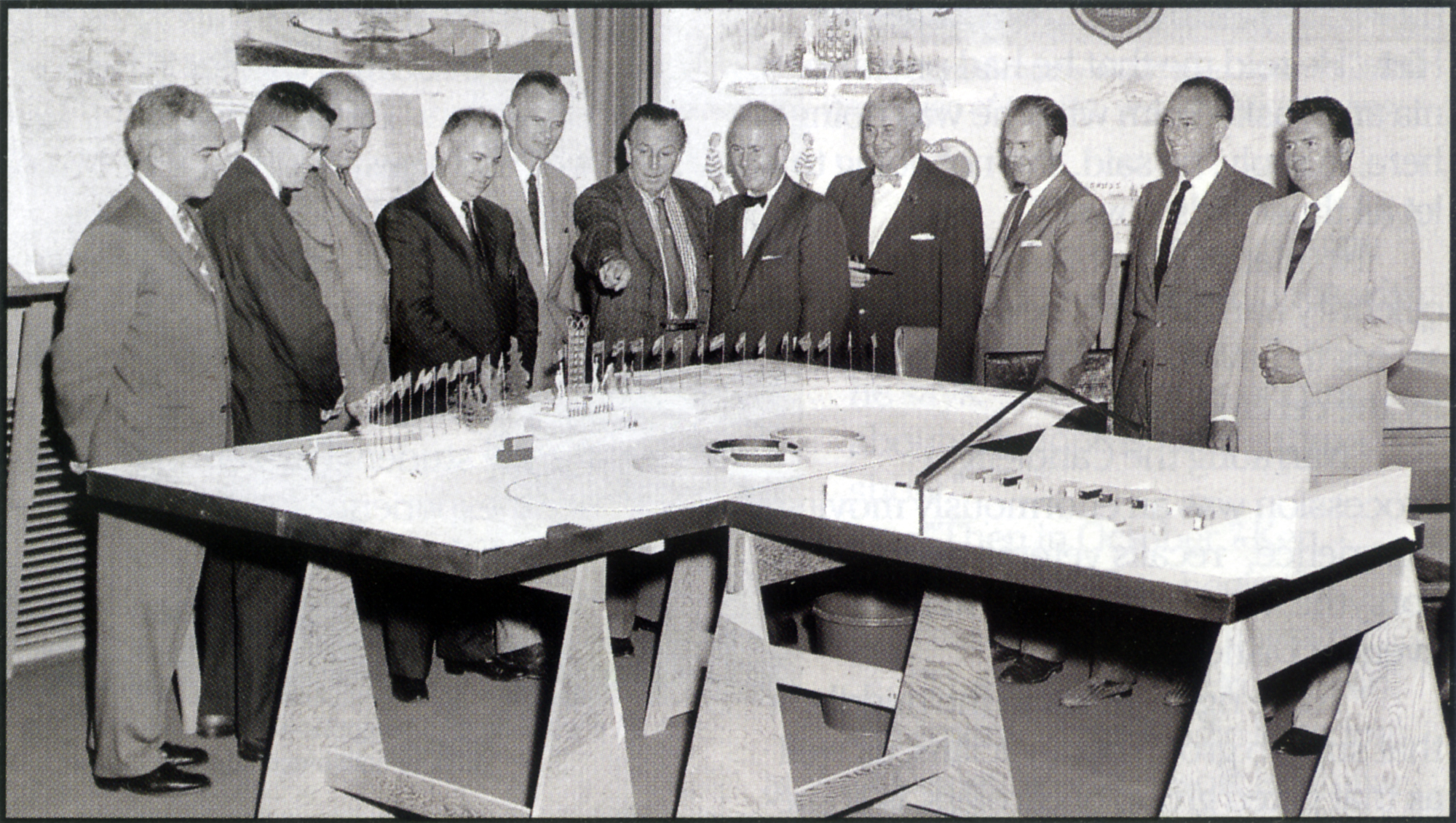
The full behind-the-scenes Pageantry story actually began, of course, when a group of Olympic officials, including Organizing Committee President Prentis Hale, visited the Disney studios in Burbank one day early in 1958.

Following a pleasant discussion over lunch of sports in general, Walt was invited to accept the post of Pageantry Committee Chairman.

"I didn't know then what I was getting into!" says Walt with a laugh.

However, the Burbank moviemaker tackled this assignment with the same enthusiasm that he utilizes so well, and to such advantage, in the making of his great motion pictures and television productions.

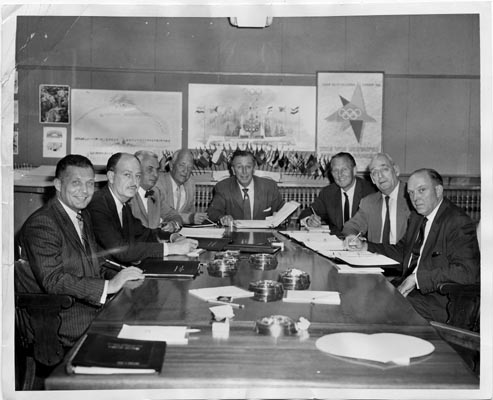
He quickly assembled a talented "crew" to handle the various facets of his ambitious Pageantry program.
Committee members included television star Art Linkletter, picked as Vice-President in Charge of Entertainment; Western Air Lines president Terrell Drinkwater, named Vice-Chairman in charge of Budget; Dr. Charles Hirt of the University of Southern California, named as Choral Director; Tommy Walker, former USC football star, and now a Disneyland official, as Pageantry Director; art designer John Hench in charge of Decor; Edsel Curry, Director of Special Projects; Joseph McEveety, Olympic Torch Relay Director; and Ron Miller, assistant director at Disney Studios, as Pageantry Coordinator.

In addition, a committee including Sam Brown, Margaret Herrick, and Lloyd Wright Sr., was formed at Hollywood's Academy of Motion Picture Arts and Sciences to select the feature films shown the athletes at the Squaw Valley theatres during the Games.


Inspired by Walt's own enthusiasm, his talented committee members travelled throughout the country in preparing the detailed plans necessary to make the Pageantry program functional.

Hench, for example, crossed the United States to visit Dartmouth College. There, he garnered valuable information regarding the famed Dartmouth ice festival, which features giant ice sculptures.

Numerous trips, of course, were made to Squaw Valley itself throughout the spring and summer of 1959. Every square foot of this scenic valley, nestling in the towering High Sierras, received special attention in considering the ground plans for layout of the Pageantry staging areas.

A few weeks before the Olympic Torch arrived by S.A.S. DC-7 from Oslo, torch relay director McEveety made a trial journey along the 600-mile route chosen for the carrying of the Sacred Flame to its new resting place at Squaw.

The weather on that occasion, of course, was different. It was good. When the actual torch relay was run, the weather proved to be just the opposite!

Dr. Hirt spent weeks visiting the many schools which provided choir students for the program. His tireless efforts contributed in large measure to the fine vocal results achieved that memorable day of the opening ceremonies.

Walt, himself, visited the valley on several occasions, going over every detail of the program fully.

The part to be played by the communications media in helping tell the Pageantry story was not overlooked, either.

A luncheon was held at the Disney studios before Christmas at which wire service, newspaper, television and radio officials, writers and announcers were fully acquainted by Walt of the upcoming Pageantry program.

Following this, periodic Pageantry bulletins were sent out to all program participants, as well as to key members of the press, to keep everyone up-to-date on the fast-breaking developments.


This ambitious news information project was supervised by Card Walker, Vice-President of Walt Disney Productions, and Director of Publicity on the-Pageantry committee.

The news project also helped point up another extremely important facet of the Pageantry: the great pride and enthusiasm demonstrated by California and Nevada youth in their key roles in the program.

Throughout the two states, wherever Walt and his committee members travelled, they encountered a great excitement and enthusiasm among the students.

"I have always said that the spirit of American youth cannot be daunted, and I think this was dramatically proven by their unselfish and wholehearted effort before and during the VIII Olympic Winter Games," said Walt Disney afterwards.

As noted elsewhere in this souvenir brochure, the 4,400 youngsters of the high school choirs and bands, and the CIF athletes, faced many problems in order to fulfill their assignments.

That they came through with flying colors is a tribute to all concerned. There were no "quitters" and there were no complainers. They had a job to do for their school, and for their state and for their country, and they completed this task in noble fashion.

An especial tip of the hat was due for the 125 Explorer Scouts who acted as official flag-raisers, Olympic messengers, and crowd controllers. These young men, aged 15 to 18 and under the leadership of Scoutmaster William King, proved exemplary representatives of one of the world's finest youth organizations.

Congratulations also were in order for Lt. Col. Albert Schoepper and his fine U.S. Marine Band, which lived up to all advance rave notices.

On opening day, when the large scale program was finally activated by Vice-President Nixon, many obstacles had already been overcome. Even so, there were many more met and successfully surmounted during the Games.

In the final analysis, however, the Olympic spirit prevailed throughout, and it was this great personal satisfaction of being an important cog in a really noble enterprise that made everything worthwhile.

Baron Pierre de Coubertin, originator of the modern Olympic Games, pointed out that the important thing in the Games was not to win but to take part. He emphasized the very essence of everyday living.

The youth of California and Nevada took his message to heart—and made us all very proud of them.
From The Pageantry Story, February 1960.


Tuesday, April 26, 2011

A 60-minute Ceremony that Took a Year to Prepare [1960 VIII Olympic Winter Games]


04.26.11 - The Opening Ceremonies of the VIII Olympic Winter Games lasted approximately one hour— but it took almost a year to prepare for that eventful 60 minutes!


It's a story that began in March 1959, with the first preliminary meetings between officials of the Music Educators National Conference and members of the Pageantry Committee.

At that time, authority was delegated to the California and Nevada Music Educators Associations to work with the Pageantry Committee in "amassing 2,000 or more trained singers and 1,250 or more trained instrumentalists from the public high school choruses and bands of California and Nevada to perform in the Opening Ceremonies."

Authority and achievement, however, are worlds apart. What followed were months of contacting band directors and choral leaders; applications submitted to the screening committee; selection of the "cream of the crop" among applicants to participate in the Ceremonies; hours and days of local and regional rehearsals; long hours of work to earn the money to get to Squaw Valley, and finally, "opening day" at Squaw Valley.

There was another side to student preparation in the pageantry story— the Olympic Torch. At a casual glance, transporting the Torch, symbol of international athletic competition between the nations of the world, would seem a simple matter. It could be flown directly from Morgedal, Norway (the "cradle" of winter sports) to Reno and thence to Squaw Valley.


But in the traditional Olympic spirit, the Pageantry Committee enlisted the aid of hundreds of runners from member high schools in the California Interscholastic Federation to carry the Torch some 600 miles through California to the site of the Games. More than 700 high school athletes and several Olympic track and field champions participated in relaying the Olympic Torch from the Los Angeles Memorial Coliseum— site of the 1932 Summer Olympics — to Squaw Valley.

This, then, is the basic "book" on the Opening Ceremonies pageantry. But the chapters of that book are filled with many dramatic moments in the overwhelmingly successful story of the preparations — and performances— that turned "authority" into outstanding achievement. And each and every one of the high school bandsmen, singers and athletes who took part turned in a Gold Medal Performance!


The Band and Choral Story

When the applications to participate in the Opening Ceremonies were mailed out, in the Fall of 1959, more than 30 bands and 70 choral groups from high schools of California and Nevada applied to be included in the mass band and chorus performance.

After long hours of listening and studying the recordings submitted by more than 100 high school groups, the committee, under the direction of USC's Dr. Charles Hirt, made its selection of the "cream of the crop" — 18 bands and 37 choruses from the two states.

Meanwhile, the selection and arrangement of choral and massed band numbers was being completed. A copy of the original Olympic hymn was discovered in Japan, translated from Greek into English, the music re-written and re-orchestrated. A special arrangement of the Star Spangled Banner was prepared. An original composition, "These Things Shall Be," was written, arranged and designated as one of the selections included in the Opening Ceremonies repertory. The others: "God of Our Fathers," "March of the Olympians," and "Conquest"

Finally, in mid-December, several key members of the Pageantry Committee gathered at UCLA. There, under the batons of Choral Director Hirt and Clarence Sawhill, Band Director, recordings of both the vocal and instrument numbers were made. By early January, arrangements were in the hands of choral and band directors at each of the individual schools.

Now the 3,680 students were ready to roll up their sleeves. Practice sessions— including 20 hours and more — were carried out on an individual school basis in 46 California schools and nine more in Nevada.

Late in January, Hirt and Sawhill became travelling musical ambassadors. In Reno, San Francisco, Fresno and Los Angeles, bands and choruses gathered for regional rehearsals. In less than a day's time, they were integrated into "one band" and "one choir"— at four locations separated by many miles. But the major hurdles still lay ahead.

Practice and local rehearsals were not the only job assigned to the students: they also had to earn their own transportation money to Squaw Valley. Many of them sold newspapers and candy, or worked nights at local stores, to earn their way to the Games.


Complicating the situation, there had been no dress rehearsal of the 1,322 bandsmen, or the 2,358 choir members, as single units— let alone a run-through with all 3,680 together. And the Opening Ceremonies were soon to begin.

On February 17, at Squaw Valley, Sawhill directed the combined bands in a full rehearsal. A few of the choral groups were also on hand. But the big dress rehearsal, the final tune-up, awaited the morning of February 18.

And of course it snowed. With a world-wide audience awaiting the verdict of whether the United States would prove to be an efficient, imaginative, enthusiastic host for the Winter Olympic Games, the snow came down in blizzard proportions.

The rest is history: the "warm-up rehearsal" that warmed few, the performance during the Opening Ceremonies that warmed the hearts of the world!

"It was," said Army Archerd in the Hollywood trade publication Variety, "the greatest show on Earth"

"It was," said John Garland of the International Olympic Committee, "one of the deciding factors in making the Games so successful."

"It was," said Cholly Angeleno in the Los Angeles Examiner, something that "Those who witnessed ... will talk about for years to come."

Perhaps Band Director Sawhill summed up the role of student participants as well as any other: "I have had occasion to work with and observe music students in 12 countries of Europe, Canada, Mexico, 48 mainland States and Hawaii. But on all these previous occasions the horizon had been limited to the locale.

"At Squaw Valley," Sawhill continued, "the purpose of performance was of world-wide proportions. I could tell that the students and their high school directors sensed this as I started working with the bands in small units. The universal language was coupled with the courageous spirit when the students stuck to their posts even through the storm."

The true spirit of youth that could not be daunted— a Gold Medal performance!


Olympic Torch Relay

Still another drama of major proportions began to take shape on January 31, 1960 at Morgedal, Norway, the renowned "cradle" of winter sports. With King Olaf in attendance, the Olympic Torch was sent on its way to the Winter Games.

Waiting in the wings for their cue to come "on stage" were 700 runners who were to convoy the sacred flame of international athletics safely through the State of California into Squaw Valley 19 days later.

If the spirit of the Olympic Games were to be capsuled, few better examples could be found than that of the runners from California Interscholastic Federation schools who participated in carrying the flame to its huge tripod in Squaw Valley.

For here were high school athletes— each of whom had trained for the one-mile he would run by carrying an eight pound shot-put in "practice" sessions—insisting on running in T-shirts and track shorts in spite of cold and wet weather.

As they ran, these CIF athletes were also kindling the interest of the people of California in the Olympic spectacle, bringing home to them the tremendous unifying spirit of the international competition about to unfold in the California Sierras. All along the 600-mile route, people lined the roads to catch a fleeting glimpse of the flame— perhaps seeing in it, and in the athletes who carried the torch, the hope for world peace through spirited but friendly competition among men and nations.

Radio reports, newspaper pictures and stories, and television newsreels carried this same message into homes throughout the United States and into many parts of the world.

School buses brought small children to the roadways to pass the message on to the generations of tomorrow. Many cities themselves joined in the Pageantry of the Olympics with special ceremonies heralding the arrival of the Torch. Bands assembled to play for mere moments as the torch passed. In smaller towns, residents lined the streets and passed the torch from hand to hand through the community.

Kudos were in order, too, for the California Highway Patrol, which assigned many of its top officers to escort the runners on their internationally-important mission. Patrol cars sped ahead of the athletes, heralding their impending arrival, and also cruised along as a rearguard protective unit.

From Norway by airplane the Torch came, to Olympic shot-putting champion Parry O'Brien at Los Angeles International Airport. Thence by helicopter to the Los Angeles Memorial Coliseum, site of the 1932 Summer Olympics. On to Glendale and Burbank in the pouring rain. To Gorman, 4,100 feet up on the Ridge Route on the third day. To Bakersfield and Delano, Tulare, Roseville, Modesto, where the tripods were as big as the one at Squaw Valley.

To Stockton on the ninth day, where it was carried aboard the yacht "Adventuress" Fleet Ship of San Francisco's Great Golden Fleet, to San Francisco for ceremonies at the City Hall; and on to Sacramento, where California Governor Edmund G. Brown officiated in special events on the steps of the State Capitol. Finally to Donner Pass, Emigrant Gap and the top of Papoose Mountain.

When Olympic ski champion Andrea Mead Lawrence sped down the slopes of Little Papoose, and Olympic speed skating champion Ken Henry relayed the flame to its destination, the 1960 Olympic Winter Games were underway.

But as they raced along the roadsides of California, 700 high school relay runners had performed a feat perhaps rivaling the actual lighting of the flame itself in importance: they had brought the spirit and meaning of the Olympics to the people of California and America.

From The Pageantry Story, February 1960.

Friday, April 22, 2011

Snow Sculptures at the 1960 VIII Olympic Winter Games

04.22.11 - The use of snow sculptures at the VIII Olympic Winter Games at Squaw Valley marked a new milestone in Pageantry history for this international event.

An impressive array of thirty 16-foot snow statues lined the Avenue of the Athletes at Squaw Valley, as well as other key points in the Olympic Village and staging area.

These huge sculptures created tremendous interest among the thousands who thronged the valley during the Games.

Wide-spread favorable comment was generated by the sculptures, which personified the various sports participants in the Olympic Winter events.

Perhaps merely by coincidence, the men outnumbered the ladies 21 - 9 among the sculptures.

Of the nine female snow statues, four were skiers, three figure skaters, and two speed skaters. Among the gents, there were nine skiers, seven hockey players, three speed skaters, and two figure skaters.

Months of careful planning and detailed work was required in the creation of these statues.

The paper work was carried out under the supervision of Decor Director John Hench at Walt Disney studios, with the subsequent construction being executed by Floats Inc., of Pasadena.

Use of the statues was first suggested by Walt Disney shortly after he was named Pageantry Committee chairman.

As a result, Hench visited the Dartmouth Winter carnival in February 1959, to investigate the technique used there in assembling their snow sculptures, which range as high as 40-feet.

The Disney art director also visited the winter carnival at Quebec, in Eastern Canada, to garner additional data for his long-term Olympic project.


Structurally, every Squaw Valley statue consisted of a metal frame base some seven feet high. A logpole in the center of the base was driven into the ground to insure stability. An intricate weaving of wire mesh and straps put "body" into the base.

The snow figures themselves, averaging eight feet in height, were added to the bases shortly before their shipment to the Games.

In addition to the 16-foot statues, Hench designed two massive 24-foot statues of a male and a female athlete, which were placed alongside the imposing Tower of Nations at the ceremonial staging area.

An eye-catching attraction in itself, the huge ceremonial Tower of Nations measured 79 feet high and 20 feet wide. It was here, of course, that the Opening, Victory and Closing ceremonies were staged during the Games.

Aluminum crests of all competing nations were suspended in the grid of the Tower of Nations frame, each five feet wide and six feet high. The familiar Olympic rings, set above the main frame, denoted the five major continents, linked to symbolize international friendship.

This file photo from Feb. 1, 1960 shows a ski jumper during the 1960

Thirty gleaming aluminum flagpoles were used around the Tower of Nations area for the flags of the competing nations.

As with the snow sculptures, these were donated by civic-minded companies and individuals, some of them from overseas.

With the Games over, the snow sculptures and flagpoles were being transported to their respective sponsor cities, companies or individuals.


From The Pageantry Story, February 1960 (a souvenir brochure created by the Walt Disney Co. for the 1960 Winter Olympics).
Related Posts Plugin for WordPress, Blogger...