Wednesday, October 27, 2010
Monday, October 18, 2010
1970 - At The Disneyland Hotel
Dining by the water's edge, watching multi-colored lights sparkle on 40-foot fountains, spending a soothing session at the Health Spa, or fishing in a pond stocked with several-thousand trout are just a few of the many assets the Disneyland Hotel offers its guests.
For this summer — and all-year-round — the Disneyland Hotel has 1,000 attractive and comfortable guest rooms, 24 conference and exhibit areas, not to mention the massive Convention Center, which includes the Exhibit Hall, meeting rooms, and the elegant Grand Ballroom.
And, for your comfort and pleasure, there are soothing saunas, an Olympic-size swimming pool, "The Cove" swimming pool with waterfall slides, "Luau" grounds for parties, Miniature Golf — even a Driving Range.
To make shopping an enjoyable and convenient experience, the Disneyland Hotel features over 20 boutiques that range from an art gallery to a gourmet shop. And the Hotel's many services for its guests include closed-circuit television to keep them informed on activities throughout the Hotel and Southern California, a Travelport, babysitters, and transportation to Disneyland via the sleek Disneyland-Alweg Monorail.
When it comes to dining, the Disneyland Hotel's eight specialty restaurants have something for every appetite whether it's a cocktail at the scenic "Sailmaker's Den," filet mignon in the quaint English atmosphere of "The Oak Room," or a sizzling steak at "El Vaquero."
Unique shops, superb restaurants, superior accommodations, plus many helpful and informative services make the Disneyland Hotel a vacationer's finest bet on where to stay when visiting Southern California. And, best of all, "the happiest place on earth" is just a monorail ride in the sunshine away.
From the Summer 1970 edition of Vacationland magazine, published by Disneyland.
ºoº
ºoº Marcio Disney Family Sites Network ºoºDisney's Dream Makers
Disney Picture of the Day
Vinylmation of the Day
http://vinylmationoftheday.blogspot.com/
Disney Fun Fact of the Day
http://tinyurl.com/MDFunFact
Today's Past in Disney History
http://tinyurl.com/PastDisney
Disney Tales [5 Weekly tales]
The Disney History
Marcio Disney Blog
Disney Pin of the Day
Marcio Disney Digital Media
Friday, October 15, 2010
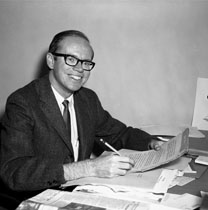
Dave Smith's from Disney Archives Final Day of Work
T H E D I S N E Y H I S T O R Y
October 15, 2010
Disney Legend Dave Smith, the founder and head of the Disney Archives, puts in his final day of work at the Burbank studio. Smith started the archives after being approached by Walt Disney’s family, including Roy O. Disney four years after Walt’s death in 1966, to preserve the history of the company.
The Marcio Disney Network has an entire blog dedicated to him! It's called The Disney Archives and Mysteries: http://tinyurl.com/DisneyArchives
In the video below, Dave Smith, receives the Disney Legends award, 10/10/2007:
Dave Smith (Archives)
Inducted 2007
Walt Disney Archives founder and chief archivist David R. Smith officially joined The Walt Disney Company on June 22, 1970, but his Disney roots are even deeper.
A fan of Disney films throughout his youth, Dave adds, "I grew up in Southern California, and so my appreciation of Disneyland began as a child." In 1967, he had become interested in compiling an extensive bibliography on Walt Disney. With approval from the Disney organization, he spent more than a year researching all Disney publications and productions.
When the Disney family and Studio management decided to attempt to preserve Walt Disney's papers, awards and memorabilia, it was natural for them to contact Dave to do a study, and make a recommendation which established the guidelines and objectives of the Archives. Dave was selected as archivist, and in the years since the Archives was established, it has come to be recognized as a model among corporate archives in the country?and Dave is regarded as the final authority on matters of Disney history.
Born on October 13, 1940, and raised in Pasadena, Dave graduated as valedictorian from both Pasadena High School and Pasadena City College. He earned his B.A. in history at the University of California at Berkeley. While in school, Dave worked part-time for six years in the Manuscript Department of the Huntington Library in San Marino.
Upon receiving his Masters Degree in Library Science from the University of California in June 1963, he was selected as one of seven outstanding graduates of library schools throughout the country to participate in an internship program at the Library of Congress in Washington.
He returned to California where he served for five years as a reference librarian at the UCLA Research Library. While there, Dave authored several articles and had bibliographies published on the Monitor and the Merrimac Civil War warships, and on Jack Benny.
Of his Disney role, Dave said, "The thing I like best is the tremendous variety in our work. We never know when we come to work in the morning what we'll be doing that day. It keeps the job interesting when you're not doing the same thing day in and day out."
Dave has written extensively on Disney history, with a regular column in The Disney Channel Magazine, Disney Magazine, Disney Newsreel, and numerous articles in such publications as Starlog, Manuscripts, Millimeter, American Archivist, and California Historical Quarterly. He is the author of the official Disney encyclopedia Disney A to Z (now in its third edition), with Kevin Neary he co-authored four volumes of The Ultimate Disney Trivia Book, with Steven Clark he co-wrote Disney: The First 100 Years, and he edited The Quotable Walt Disney. Dave has written introductions to a number of other Disney books.
"My greatest reward has been getting to know the many people who have come to use the Archives over the years. I have been especially proud to be a guide and mentor to so many young people who have gone on to exceptional careers in the Disney organization." Dave says humbly.
"I have had the pleasure and privilege to work with Dave Smith for nearly 35 years," author and animator John Canemaker says, "and, to me, he has always been legendary. For his steady building of the Disney Archives over the years into one of the greatest, most invaluable, world-class resources for studying American animation?and for his kindness and generosity to all researchers."
Monday, October 11, 2010
The Magic Worlds of Walt Disney - The August 1963 issue of National Geographic
The August 1963 issue of National Geographic featured "The Magic Worlds of Walt Disney," a 49-page article by Robert De Roos. It also featured a rare photo (taken by Thomas Nebbia) of Walt, his wife and their grandchildren in the Disneyland Fire Station apartment ... a photography first!
Monday, October 04, 2010
Disneyland's Helicopter Passenger Service
From the late 1950s to 1968 Los Angeles Airways provided regularly scheduled helicopter passenger service between Disneyland and Los Angeles International Airport (LAX) and other cities in the area. The helicopters first operated from Anaheim/Disneyland Heliport, located behind Tomorrowland. Service later moved, in 1960, to a new heliport north of the Disneyland Hotel. Arriving guests were then transported to the Disneyland Hotel via tram.
English: Los Angeles Airways Sikorsky S-61L helicopter,
lifting off from the Disneyland Heliport, 1963.
This is the same aircraft that crashed—killing all on board
in August, 1968. Note the Matterhorn Mountain in the background.
The service ended after two fatal crashes in 1968: The crash in Paramount, California, on May 22, 1968 killed 23 (the worst helicopter accident in aviation history at that time). The second crash in Compton, California on August 14, 1968, killed 21
Monday, September 20, 2010
1st Disneyland's Fireworks
Disneyland premiered its first fireworks presentation in 1956. The show was actually created by hand - with employees touching off the fuses with a flare! (A few years later, technology enabled fireworks to be launched electronically and synchronized with a soundtrack.)
“MAGICAL” – FIREWORKS BY THE NUMBERS
- The pyrotechnic devices are fully choreographed to “Magical’s” musical soundtrack, using 750 discreet digital control channels.
- Guests see the burst of fireworks before hearing it because light travels roughly a million times faster than sound.
- The Disney Air Launch system installed in 2004 creates less ground level smoke than the former system that used black powder.
- Disney is recognized as the world’s largest producer of fixed-base fireworks shows, at its parks in the United States, France, Japan and China.
A SPARKLING HISTORY OF FIREWORKS AT DISNEYLAND
- Disneyland opened to the public in July 1955. There was no fireworks show that year.
- In 1956, after seeing fireworks tests in the Disneyland parking lot when the park was closed, Walt Disney said, “Let’s give it a try.”
- Mickey Aronson, who worked in Disneyland Resort Entertainment for more than 50 years (originally as an outside fireworks consultant), began “shooting” Disneyland fireworks the summer of 1956. In those days, Aronson fired the show by hand, touching off the fuses with a flare.
- Beginning in the late 1960s, Disneyland Entertainment developed a system for firing the shells electronically, synchronized to a musical soundtrack.
- During this period, the fireworks “choreography” was storyboarded like an animated cartoon. At one time, the storyboard artist was Roy Williams, the “Big Mooseketeer” from “The Mickey Mouse Club.”
- The current system, with its multiple fireworks launch sites, special lighting and lasers, and high-tech marriage of music and choreographed pyrotechnics, was first installed for the 2000 Bicentennial/Disneyland 45th Anniversary show, “Believe…There’s Magic in the Stars.”
Elaborate fireworks shows synchronized with Disney songs and often have appearances from Tinker Bell or Dumbo, flying in the sky above Sleeping Beauty Castle. Since 2000, presentations have become more elaborate, featuring new pyrotechnics, launch techniques and story lines. In 2004, Disneyland introduced a new air launch pyrotechnics system, reducing ground level smoke and noise and decreasing negative environmental impacts. At the time the technology debuted, Disney announced it would donate the patents to a non-profit organization for use throughout the industry.
* Regular Fireworks Show:
o 1958–1999 Fantasy in the Sky
o 2000–2004 Believe... There's Magic in the Stars
o 2004–2005 Imagine... A Fantasy in the Sky
o 2005–2010 Remember... Dreams Come True
* Special Fireworks Show:
o June 12, 2009 – September 20, 2009 Magical: An Exploding Celebration In The Sky
o September 25, 2009 – November 1, 2009 Halloween Screams
o November 13, 2009 – January 3, 2010 Believe... In Holiday Magic
Since 2009, Disneyland has moved to a rotating repertoire of firework spectaculars.
* Yearly Fireworks Repertoire
o Winter – Spring Remember... Dreams Come True
o Summer Magical: Disney's New Nighttime Spectacular of Magical Celebrations
o Independence Day Week Disney's Celebrate America: A 4th of July Concert in the Sky
o Halloweentime Halloween Screams
o Holiday Believe... In Holiday Magic
During the Holiday Season, there is a special fireworks presentation called Believe... In Holiday Magic which has been running since 2000, except for a short hiatus in 2005 during the park's 50th Celebration.
Scheduling of fireworks shows depend on the time of year, during the slower off-season periods, the fireworks are only offered on weekends. During the busier times, Disney does offer additional nights, such as an extra night for a 3 day holiday. Also, Disney does offer Fireworks nightly during its busy periods, which includes Easter/Spring Break, Summer and Christmas time.
The show is normally offered at 9:25 PM if the park is scheduled to close at 10 PM or later, but shows have started as early as 5:45 PM. Also, a major consideration is weather/winds, especially at higher elevations, which can force the cancellation of the show. Disney usually waits an additional time (15 minutes) to see if the winds die down. Shows, with a few minor exceptions, such as July 4 and New Year's Eve, must finish by 10 PM due to the conditions of the permit issued by the City of Anaheim.
Monday, September 13, 2010
Jack Wagner - The Voice in the Monorails
Most of Jack Wagner's Disney recordings were made at his own house where he had a recording studio (which was installed by Disney in the 1970s).
A voiceover booth in his home was connected to Studio D at Disneyland in Anaheim.
At the time, Jack's home in Southern California was one of the first to use a direct audio link from a remote recording studio!
A voiceover booth in his home was connected to Studio D at Disneyland in Anaheim.
At the time, Jack's home in Southern California was one of the first to use a direct audio link from a remote recording studio!
CLICK HERE TO SEE HIS BIO AT THE DISNEY LEGENDS PAGE
You can hear Jack Wagner's Disney Monorail voice recordings here.
Statement made by Jack Bohannan on Hidden Mickeys
I would like to set the record straight on the voice. Throughout the 1970's and into the 1980's the voice heard on all Disney monorails, as well as most all the voiceover work for all the parks was the legendary "Voice of Disney", Jack Wagner.
I have had the privilege of working with him many times through the years.
One interesting side note is that Jack's home in Southern California was one of the first uses for a direct audio link from a remote recording studio. It was put in by Disney in the 70's and connected a voiceover booth in his home to Studio D at Disneyland in Anaheim. He frequently would receive last minute calls for special events and was able to just walk over to the booth and "beam" it directly to the park. Anyhow, with the amount of work that Florida was generating after Epcot and the Studios opened, plus the fact that Jack wanted to head towards retiring sometime, other voice talent was sought out locally in Florida.
There have been several people used in voiceover work since then, one of them being Kevin Miles, who is one of the original members of the Voices of Liberty at Epcot, and can still be heard there daily. Kevin recorded the monorail voiceovers after the Grand Floridian was built, and his voice was still there until the 25th Anniversary rolled around, when it was updated by one of the new voiceover talents.
The amount of voiceover work at the parks now is astronomical, and it is shared by a couple of people who have "the voice", including Kevin. Interestingly enough, though, Jack's voice can still be heard welcoming everyone to Orlando on the monorails at the airport terminals.
Monday, August 30, 2010
Introducing The Walt Disney Story
On October 16, 1923, Walt Disney signed his first contract to produce the "Alice Comedies" in California. For the young filmmaker and his brother, Roy, it was a momentous occasion. For the company they founded, Walt Disney Productions, it was the first step on a long road that would lead to its eventual recognition as one of the foremost names in the world of entertainment.
Walt and Roy proudly displaying their first Oscar
with the world's most famous mouse
In a more personal sense, the success of the company was the triumph of its founder's hard-earned and deeply felt values — the belief in the inherent goodness of man, the conviction that life is meaningful and happiness relevant, and an abiding faith in the capacity of the human spirit for joy, for beauty, and for greatness.
"The Walt Disney Story," a new attraction recently opened on Main Street, U.S.A. at Disneyland and presented in cooperation with the Gulf Oil Corporation, presents, in a dramatic way, the evolution of Walt Disney's philosophy in his work, in his personal commitments, and in his dreams for the future.
The central focus of the show, a 28-minute film tracing the lives of Walt and Roy Disney from their Midwestern boyhood through the tumultuous Hollywood years to eventual international celebrity, is unique.
Assembled from over 70 hours of taped interviews made by Walt Disney during his lifetime and combined with film footage obtained from sources as various as the Motion Picture Department of the Library of Congress and the Los Angeles County Museum, the film literally features Walt Disney telling the Disney story in his own words.
Guests will learn of the origin of Mickey Mouse as his creator first envisioned him, hear how the world's first full-length animated feature — "Snow White and the Seven Dwarfs," — developed and how it was received, share the creative thoughts which led to the development of "Audio-Animatronics" (the electronic process of animating three-dimensional figures), and enjoy the optimistic vision Walt Disney had of the future when he speaks of EPCOT, the community "where people actually live a life they can't find anywhere else in the world."
Prior to entering the motion-picture theater, guests pass through an elaborate exhibit area where individual Disney achievements and accomplishments are presented in a highly unusual manner.
An array of visual and audio media, including a speeded-up film of the creation of Disneyland and a demonstration of the complicated process of combining animation with live actors, is used to single out five important areas of the Disney career: Walt Disney the Film Maker; the TV Pioneer; the Naturalist; the International Ambassador; and the Artist and Impresario.
As guests stroll among the five areas, they will recognize many mementos of the past: Zorro's dashing black cape and shining sword from the early days of television; original Mickey Mouse posters and the earliest Mickey Mouse watches; some of the hundreds of insignias created for American forces during World War II; and original art from such Disney classics as "Cinderella," "Pinocchio," "Fantasia," "Snow White and the Seven Dwarfs" and "Mary Poppins."
Assembled from over 70 hours of taped interviews made by Walt Disney during his lifetime and combined with film footage obtained from sources as various as the Motion Picture Department of the Library of Congress and the Los Angeles County Museum, the film literally features Walt Disney telling the Disney story in his own words.
Guests will learn of the origin of Mickey Mouse as his creator first envisioned him, hear how the world's first full-length animated feature — "Snow White and the Seven Dwarfs," — developed and how it was received, share the creative thoughts which led to the development of "Audio-Animatronics" (the electronic process of animating three-dimensional figures), and enjoy the optimistic vision Walt Disney had of the future when he speaks of EPCOT, the community "where people actually live a life they can't find anywhere else in the world."
Prior to entering the motion-picture theater, guests pass through an elaborate exhibit area where individual Disney achievements and accomplishments are presented in a highly unusual manner.
An array of visual and audio media, including a speeded-up film of the creation of Disneyland and a demonstration of the complicated process of combining animation with live actors, is used to single out five important areas of the Disney career: Walt Disney the Film Maker; the TV Pioneer; the Naturalist; the International Ambassador; and the Artist and Impresario.
As guests stroll among the five areas, they will recognize many mementos of the past: Zorro's dashing black cape and shining sword from the early days of television; original Mickey Mouse posters and the earliest Mickey Mouse watches; some of the hundreds of insignias created for American forces during World War II; and original art from such Disney classics as "Cinderella," "Pinocchio," "Fantasia," "Snow White and the Seven Dwarfs" and "Mary Poppins."
Guests will also see Walt Disney's original office, furnished with authentic pieces used during his lifetime, and will have the opportunity to view some of the most significant of the 950 honors, awards and citations presented to Walt Disney from every nation in the world.
Located in the Main Street Opera House in Town Square, "The Walt Disney Story" is a free attraction. It is a dramatic tribute to the "Master Storyteller of the World" no guest will want to miss.
From the Summer 1973 edition of Vacationland magazine, published by Disneyland.
Monday, August 23, 2010
Tom Nabbe - The Luckiest Boy in the World
Today, June 22, 1968, Disneyland's Cast Members Tom and Janice Nabbe are married. Tom's career started when he was just 12-years-old - as the park's first Tom Sawyer. (He will transfer to Walt Disney World in Orlando as part of its opening crew in 1971, and later be named a Disney Legend.)
This is his amazing history!
The last time Tom Nabbe paid to get into a Disney Park, it was July 18, 1955 — the first day Walt Disney opened his new Park to the public.
Tom was a rusty-haired 12-year-old, enjoying his day at Disneyland. The very next day he landed a job as a “newsie,” hawking “The Disneyland News” to Main Street Guests.
In 1956, Walt Disney recognized the “Tom Sawyer” in a young Nabbe, and he became the “Luckiest Boy in the World.” That’s what the cover of the April 7, 1957 issue of “Parade” magazine said, beneath a full-color
photo of Tom dressed as Mark Twain’s paragon of American boyhood.
“I used to approach Walt every time I saw him around the Park,” Tom said of his yearlong pursuit of Disney and the starring role on Tom Sawyer Island.
Disney’s first response to Tom was “Why should I put you on the island when I can put a mannequin there? Especially considering the dummy won’t be running off for hot dogs every half-hour.”
Disney, quoted in the “Parade” article, had a somewhat more gracious recollection: ” He was friendly and bright — and he sure looked the part.” One job requirement was that Tom had to keep a C average in school. So every quarter, the boy brought his report card directly to Walt for inspection. It was perhaps the hardest part of playing the character.
After outgrowing the role of Tom Sawyer, Nabbe went on to manage other attractions. In 1964, he met his wife, Janice, while they were working together at Frontierland’s Oak Tavern at Disneyland. They were married on June 22, 1968.
In 1971, Tom was transferred to Walt Disney World in Orlando as part of its opening crew, where he started as the Transportation Supervisor for the Monorail System. He also helped in the opening of Disneyland
Paris.
Paris.
Forty-eight years later, in June 2003, 60-year-old Tom retired from his job as manager of distribution services at Walt Disney World. He was the last working member of Club 55, a group of original Disneyland Cast
Members named for Disneyland’s inaugural year and for their chief qualification of membership — a paycheck from Walt Disney dated 1955.
Shortly after his retirement, Tom received the highly selective honor of having his name on one of the windows down Main Street at Walt Disney World’s Magic Kingdom.
In September 2005, he was inducted as a Disney Legend during a ceremony that took place at Disneyland. His wife Janice and son Ken were in attendance as he received this honor. Since then, he has spoken at
numerous Disney enthusiast events, telling of his experiences as the “Luckiest Boy in the World”.
Monday, August 16, 2010
Important Dates for Disney
IMPORTANT DATES IN THE HISTORY OF THE WALT DISNEY COMPANY
| October 16, 1923 | Walt signed a contract with M. J. Winkler to produce a series of "Alice Comedies" — the date used as the start of the Disney company first known as "The Disney Brothers Studio" |
| March 1, 1924 | Release of first Alice Comedy - "Alice's Day at Sea." |
| January, 1926 | The Disneys move to their new studio at 2719 Hyperion. The name of the company is changed from "The Disney Brothers Studio" to "Walt Disney Studios". |
| September 5, 1927 | Release of first "Oswald the Lucky Rabbit" cartoon. |
| November 18, 1928 | Steamboat Willie is released at the Colony Theatre in New York — the first Mickey Mouse cartoon released, also the first appearance of Minnie Mouse. |
| August 22, 1929 | The Skeleton Dance, the first Silly Symphony, is released. |
| December 16, 1929 | The Disney brothers' partnership is replaced by four companies: Walt Disney Productions, Ltd.; Walt Disney Enterprises; Liled Realty and Investment Company; and the Disney Film Recording Company. |
| January 13, 1930 | Mickey Mouse comic strip begins. |
| September 5, 1930 | The Chain Gang, first appearance of Pluto, is released. He did not receive the name Pluto until The Moose Hunt (1931). |
| November, 1930 | First Disney book (Mickey Mouse Book). |
| July 30, 1932 | Flowers and Trees, first full-color cartoon and first Academy Award winner, is released. |
| November 15, 1932 | Art School formed at Disney Studio to train animators. |
| May 27, 1933 | Three Little Pigs, Academy Award winner, is released. |
| June, 1933 | First Mickey Mouse watch is sold by Ingersoll. |
| June 9, 1934 | The Wise Little Hen, first appearance of Donald Duck, is released. |
| February 23, 1935 | The Band Concert, first Mickey Mouse cartoon in color, is released. |
| December 21, 1937 | Release of Snow White and the Seven Dwarfs, first feature-length animated film, at the Carthay Circle Theatre. |
| February 7, 1940 | Release of Pinocchio. |
| April 2, 1940 | Walt Disney Productions issues its first stock. |
| May 6, 1940 | Move of the Disney Studio to Burbank completed. |
| November 13, 1940 | Release of Fantasia |
| August 17, 1941 | Walt and artists leave on a goodwill trip to South America. |
| December 8, 1941 | The U.S. Army moves onto the Disney Studio lot. |
| January 1, 1943 | Der Fuehrer's Face, Academy Award winner, is released. |
| November 12, 1946 | Song of the South released. |
| December 21, 1948 | Release of Seal Island, first True-Life Adventure. |
| October, 1949 | Walt Disney Music Company formed. |
| July 19, 1950 | Release of Treasure Island, first completely live- action feature. |
| December 25, 1950 | One Hour in Wonderland first television show. |
| December 16, 1952 | WED Enterprises founded by Walt. |
| February 5, 1953 | Peter Pan is released. |
| February 18, 1953 | Release of first People and Places film — "The Alaskan Eskimo." |
| November 10, 1953 | Release of The Living Desert, first film distributed by the new Buena Vista Distribution Company. |
| October 27, 1954 | First airing of Disneyland television show. |
| December 15, 1954 | Davy Crockett story is told on the Disneyland show. |
| December 23, 1954 | Release of 20,000 Leagues Under the Sea |
| uly 17, 1955 | Opening of Disneyland. |
| October 3, 1955 | First program of the Mickey Mouse Club television series. |
| October 10, 1957 | First program of the Zorro television series. |
| March 19, 1959 | Release of The Shaggy Dog, first of a series of wacky comedies. |
| June 14, 1959 | Vice-President Nixon dedicates Monorail. Matterhorn and Submarine Voyageopen also at Disneyland. |
| June 23, 1963 | Enchanted Tiki Room opens at Disneyland, first use of Audio-Animatronicsfigures. |
| April 22, 1964 | Four Disney exhibits open at the New York World's Fair. |
| August 29, 1964 | Release of Mary Poppins. |
| February 3, 1965 | WED Enterprises incorporated as a subsidiary of Walt Disney Productions (WED was personally owned by Walt from 1952 to 1965.) |
| July 23, 1965 | MAPO incorporated. |
| December 15, 1966 | Walt Disney dies. |
| March 13, 1969 | Release of The Love Bug. |
| June 25, 1969 | Walt Disney Educational Materials Co. incorporated. |
| December 25, 1969 | "Disney on Parade" debuts in Chicago. |
| June 22, 1970 | Establishment of the Walt Disney Archives. |
| June 17, 1971 | 100,000,000th guest welcomed at Disneyland. |
| October 1, 1971 | Opening of Walt Disney World. |
| December 20, 1971 | Roy O. Disney dies. |
| January 26, 1972 | The Mouse Factory debuts on television. |
| October 16, 1973 | 50th Anniversary of Walt Disney Productions. |
| March 22, 1975 | Walt Disney World Village opens. |
| June, 1975 | America on Parade debuts for the Bicentennial at Disneyland and Walt Disney World |
| January 17, 1977 | The new Mickey Mouse Club airs. |
| November 18, 1978 | Mickey Mouse celebrates 50th birthday. |
| July 17, 1980 | Disneyland celebrates 25th anniversary. |
| October, 1980 | First Home Video titles released |
| December 3, 1980 | Tokyo Disneyland groundbreaking and site dedication. |
| October 1, 1982 | EPCOT Center opens. |
| April 15, 1983 | Tokyo Disneyland opens. |
| April 18, 1983 | The Disney Channel begins broadcasting. |
| May 25, 1983 | New Fantasyland opens at Disneyland. |
| March 9, 1984 | Release of first Touchstone film, Splash. |
| June 9, 1984 | Donald Duck celebrates 50th birthday. |
| September 23, 1984 | Michael Eisner and Frank Wells become Chairman and President of Walt Disney Productions. |
| September 14, 1985 | First Saturday morning animated TV shows air; "Golden Girls" debuts. |
| February 2, 1986 | The Disney Sunday Movie debuts on television. |
| February 6, 1986 | Walt Disney Productions name changed to The Walt Disney Company. |
| March 25, 1986 | 500,000,000th guest to a Disney park welcomed. |
| September 4, 1986 | Airing of syndicated Disney features and TV shows begins. |
| January 9, 1987 | Star Tours, built in collaboration with George Lucas, opens at Disneyland. |
| February 11, 1987 | The Walt Disney Company re-incorporated in Delaware. |
| March 24, 1987 | Euro Disneyland agreement signed in France. |
| March 28, 1987 | First Disney Store opens, in Glendale Galleria. |
| May 5, 1987 | First Disney Dollars sold at Disneyland. |
| September 21, 1987 | DuckTales released in syndication. |
| January 21, 1988 | The Wrather Corp. (including the Disneyland Hotel) is acquired. |
| February 2, 1988 | First filming done at The Disney/MGM Studios. |
| May 26, 1988 | Childcraft is acquired. |
| June 21, 1988 | Who Framed Roger Rabbit released. |
| June 24, 1988 | Grand Floridian Beach Resort dedicated at Walt Disney World. |
| October 1, 1988 | Caribbean Beach Resort opens. |
| October 16, 1988 | First Disney/Soviet Film Festival opens. |
| December 2, 1988 | TV station KHJ acquired. |
| February 1, 1989 | Hollywood Pictures begins operations. |
| May 1, 1989 | Opening of Disney/MGM Studio Theme Park and Pleasure Island. |
| June 1, 1989 | Opening of Typhoon Lagoon. |
| July 17, 1989 | Splash Mountain opens at Disneyland. |
| September 1, 1989 | Disneyland welcomes 300,000,000th guest. |
| December 1, 1989 | KHJ-TV changes its call letters to KCAL-TV. |
| January 1, 1990 | Hollywood Records begins operation |
| July 18, 1990 | Release of Hollywood Pictures' first film, "Arachnophobia." |
| August 26, 1990 | Disneyland begins a 5-year sponsorship of the Pigskin Classic football game at Anaheim Stadium. |
| September 10, 1990 | Premiere of The Disney Afternoon syndicated TV programming. |
| November, 1990 | Yacht and Beach Club Resorts open at Walt Disney World. |
| May 6, 1991 | The Walt Disney Company joins the Dow Jones Industrial Average. |
| May 29, 1991 | 100,000,000th guest welcomed at Tokyo Disneyland. |
| September 26, 1991 | Hyperion Books publishes its first book. |
| April 12, 1992 | Euro Disney opens. |
| October 10, 1992 | Approval of The Mighty Ducks hockey franchise by the NHL Board of Governors. |
| December 31, 1992 | Stopped operating the Queen Mary in Long Beach |
| June 30, 1993 | The Walt Disney Company acquires Miramax Film Corp. |
| October 8, 1993 | Inaugural Game of The Mighty Ducks vs. The Detroit Red Wings at The Anaheim Pond. |
| April 18, 1994 | Beauty and the Beast stage show opens on Broadway. |
| June 15, 1994 | Release of The Lion King |
| November 4, 1994 | The first Walt Disney Gallery opens at the MainPlace Mall in Santa Ana, California. |
| December 5, 1994 | Disney Interactive formed. |
| April 1, 1995 | Blizzard Beach opens at Walt Disney World |
| May 18, 1995 | Agreement to purchase 25% of the California Angels baseball team from Gene Autry |
| July 31, 1995 | Agreement to purchase Capital Cities/ABC for $19 billion |
| September, 1995 | Disney Online, a business unit of Disney Interactive, is founded. |
| October 1, 1995 | The Disney Channel begins operation in the UK. |
| October 2, 1995 | Michael Ovitz becomes President of the Walt Disney Company. |
| January 4, 1996 | Stockholders approve Disney merger with Capital Cities/ABC |
| January 27, 1996 | Inaugural race of the Indy Racing League Indy 200 at Walt Disney World Speedway |
| February 22, 1996 | Disney Online launches Disney.com on the World Wide Web |
| February 9, 1996 | Final FCC approval of and filing of merger documents for completion of the acquisition of Capital Cities/ABC. |
| February 9, 1996 | The Disney Institute opens at Walt Disney World. |
| April 18, 1996 | Disney announced the purchase of Dream Quest Images, a visual-effects studio in Simi Valley, California |
| June 18, 1996 | The Haber family is the first to move into their new home in Celebration. |
| July 17, 1996 | Disney announced plans for Disney's California Adventure in Anaheim. |
| November 18, 1996 | Debut of Radio Disney on the ABC Radio Networks. |
| November 25, 1996 | The Main Street Electrical Parade makes its final appearance at Disneyland. |
| March 28, 1997 | Disney's Wide World of Sports baseball stadium opened to the public for the first time (Atlanta Braves/Cincinnati Reds exhibition game). |
| March 31, 1997 | Disney Online introduces Disney's Daily Blast website. |
| April 2, 1997 | Inauguration ceremony officially opened the New Amsterdam Theatre in New York City. |
| June 1, 1997 | Lyric Street Records founded as a country music label. |
| September 15, 1997 | Downtown Disney West Side opens at Walt Disney World. |
| November 13, 1997 | The Lion King stage production opens on Broadway. |
| March 23, 1998 | ESPN Magazine debuts. |
| April 22, 1998 | Opening of Disney's Animal Kingdom at Walt Disney World. |
| June 19, 1998 | Release of Mulan. |
| June 19, 1998 | First Disney Quest opens at Downtown Disney West Side at Walt Disney World. |
| June 24, 1998 | 600,000,000th guest welcomed at Walt Disney World |
| July 12, 1998 | First ESPN Zone opens in Baltimore, MD. |
| July 30, 1998 | Disney Magic cruise ship departs on its inaugural cruise. |
| January 12, 1999 | Launch of "GO" Network |
| January 15, 1999 | All-Star Movies Resort opens at Walt Disney World |
| March 1, 1999 | Asia opens at Disney's Animal Kingdom |
| March 31, 1999 | Disney completes the purchase of the Anaheim Angels |
| May 1, 1999 | Mickey MouseWorks debuts on television |
| June 18, 1999 | Tarzan released |
| August 6,1999 | The Sixth Sense released, and becomes the Company's highest-grossing live-action film |
| August 15, 1999 | Maiden voyage of the Disney Wonder |
| September 29, 1999 | Euro Disney announces plans for its second gate, The Disney Studios, to open in the Spring of 2002. |
| October 1, 1999 | Millennium Celebration begins at Epcot |
| November 18, 1999 | GO.com stock begins trading on the New York Stock Exchange |
| November 24, 1999 | Toy Story 2 opens with Disney's highest weekend gross |
| January 1, 2000 | Fantasia 2000 is released in IMAX theaters |
| March 23, 2000 | Aida opens on Broadway |
| February 8, 2001 | Disney's California Adventure opens |
| April 16, 2001 | Disney's Animal Kingdom Lodge opens |
| May 25, 2001 | Pearl Harbor is released |
| June 15, 2001 | Atlantis: The Lost Empire is released |
| September 4, 2001 | Tokyo DisneySea opens |
| October 24, 2001 | Fox Family Channel acquired and renamed ABC Family Channel |
| November 2, 2001 | Monsters Inc. released |
| November, 2001 | The Baby Einstein Company acquired |
| December 5, 2001 | 100th anniversary of Walt Disney's birth |
| March 16, 2002 | Walt Disney Studios, Paris, opens |
| June 21, 2002 | Lilo & Stitch is released |
| August 2, 2002 | Signs is released |
| November 27, 2002 | Treasure Planet is released |
| May 22, 2003 | Disney sells the Anaheim Angels. |
| May 30, 2003 | Finding Nemo is released, becoming Disney's highest grossing animated film. |
| July 9, 2003 | Pirates of the Caribbean: Curse of the Black Pearl is released, and became Disney's highest-grossing live action film. |
| November 18, 2003 | Mickey Mouse celebrates his 75th anniversary with the unveiling of 75 Mickey statues at Walt Disney World. |
| December 14, 2003 | Pop Century Resort opens at Walt Disney World. |
| March 3, 2004 | Senator George J. Mitchell becomes Chairman of the Board of The Walt Disney Company. |
| April 2004 | Disney acquires the Muppet properties and Bear in the Big Blue House. |
| September 22, 2004 | Lost debuts on ABC. |
| October 3, 2004 | Desperate Housewives debuts on ABC. |
| November 5, 2004 | The Incredibles is released. |
| February 25, 2005 | Disney sells The Mighty Ducks hockey team. |
| March 27, 2005 | Grey's Anatomy debuts on ABC. |
| May 5, 2005 | Happiest Celebration on Earth begins at all Disney theme parks to honor 50 years of Disneyland. |
| June 15, 2005 | Adventures by Disney runs their first trip with paying guests. |
| September 12, 2005 | Hong Kong Disneyland opens. |
| October 1, 2005 | Robert A. Iger becomes Chief Executive Officer of The Walt Disney Company. |
| October 12, 2005 | Disney is first to license TV episodes, from ABC and Disney Channel series, for download on Apple's iTunes Music Store. |
| November 4, 2005 | Chicken Little is released. |
| December 9, 2005 | The Chronicles of Narnia: The Lion, the Witch and the Wardrobe is released. |
| January 20, 2006 | High School Musical airs and breaks all Disney Channel records, with its soundtrack going platinum. |
| March 14, 2006 | High School Musical is the first full-length movie to be sold via digital download, on Apple's iTunes Music Store, followed by theatrical features in September. |
| March 24, 2006 | Hannah Montana debuts on Disney Channel. |
| May 5, 2006 | Disney purchases Pixar Animation Studios. |
| July 7, 2006 | Pirates of the Caribbean: Dead Man's Chest is released, and soon becomes the company's highest-grossing release. |
| September 28, 2006 | Ugly Betty debuts on ABC. |
| October 1, 2006 | The Year of a Million Dreams begins at the Disney parks with special prizes for guests. |
| January 1, 2007 | John E. Pepper, Jr., becomes chairman of the board. |
| June 11, 2007 | Finding Nemo Submarine Voyage opens at Disneyland. |
| June 29, 2007 | The Secret of the Magic Gourd, first Disney co-production in China, is released. |
| June 29, 2007 | Ratatouille, from Pixar, is released. |
| August 1, 2007 | Club Penguin acquired. |
| August 17, 2007 | High School Musical 2 set cable records on its premiere on Disney Channel. |
| October 16, 2007 | Hannah Montana & Miley Cyrus: Best of Both Worlds Concert begins sold-out tour to 69 cities. |
| November 3, 2007 | The Little Mermaid begins previews as a stage show on Broadway. |
| November 21, 2007 | Enchanted is released. |
| December 21, 2007 | National Treasure: Book of Secrets is released. |
| January 7, 2008 | Disney-MGM Studios is renamed Disney's Hollywood Studios. |
| May 31, 2008 | Toy Story Mania opens at Walt Disney World. |
| June 17, 2008 | Toy Story Mania opens at Disneyland. |
| June 20, 2008 | Camp Rock debuts as a Disney Channel Original Movie. |
| June 20, 2008 | WALL·E, from Pixar, is released. |
| February 13, 2009 | Disney XD channel is launched. |
| February 22, 2009 | WALL·E wins Academy Award for Best Animated Film. |
Subscribe to:
Comments (Atom)


