Showing posts with label Walt Disney. Show all posts

Wednesday, August 27, 2014

Walt Disney and the Villains

"Whether we like them or not," said Disney's Director of Studio Publicity Tom Jones in a 1972 interview, "villains are a necessary evil." "For example, most of Walt Disney's animated cartoons are morality plays -- that is, good triumphs over evil. To draw a definite contrast between the two extremes, the hero/heroine is the epitome of all that is good and brave in comparison to the villain/villainess, who personifies all that is unscrupulous, dastardly, and evil. Before the fadeout, the villain gets his/her comeuppance while the hero emerges triumphant."

In the 1956 "Disneyland" television episode "Our Unsung Villains," the Slave in the Magic Mirror boasts, "Take away the villain and what have you got? Everybody's happy. No problems. Nothing to worry about. All in all, a pretty dull story."


From the earliest Mickey Mouse shorts, villains were as prominent as the sympathetic leading characters. Because of Walt's deep roots as a storyteller, he understood the fundamental truth that great triumph can only result from great struggle -- and great heroism from great menace. 

In the Mickey Mouse shorts and Silly Symphonies, there were various broad menaces such as skeletons ("The Haunted House," 1929), a nameless gorilla ("The Gorilla Mystery," 1929), an unnamed spider ("The Spider and the Fly," 1931), and a nonspecific woodland witch ("Babes in the Woods," 1932). Nuanced and fleshed-out villains such as Pete (the burly cat who forever tormented Mickey and Minnie Mouse) and the pig-taunting Big Bad Wolf were far more threatening, although typically buffoonish and played for laughs.

It wasn't until 1934, when development was underway for "Snow White and the Seven Dwarfs," that Disney's animation team turned their focus on characters without a whiff of laughter or the slightest hint of irony -- serious cinematic villains with a threatening presence of true malice. 

The film's initial designs and story took time to evolve beyond the coy cuteness and comical simplicity common within the brief structure of an animated short. As the creative team began seeing the real potential of their animated feature, they realized that the longer format gave them time to unfold a story, pace situations and events, and increase the sophistication of the script and music. This, in turn, enhanced their efforts to animate lifelike humans, credible movement, and personality performance from their cast of characters. 

The stately and elegant Queen was a departure from "cartoon" villains of the era

The core of the story became a more balanced mix of story attitudes and timbre that brought out true "heart" rather than simple situations punctuated by visual and audio "gags." Walt later recalled, "Without that heart, you see, I don't think anything will laugh. In other words, with any laugh, there must be a tear somewhere. I believe in that. The thing with Chaplin is his pathos, you know? That's it. That is humor, I think. I had it in 'Snow White.' I mean, you felt sorry for her. You felt sorry for the dwarfs when she died."


In order to gain that "heart," the little princess' tormentor underwent a significant evolution. A heavy-set, daffy, oblivious, and egotistical comedy queen gave way to a cold and heartless, but elegant, stately, and beautiful monarch modeled after the ageless ice goddess ("She who must be obeyed"), from the 1935 film adaptation of H. Rider Haggard's tale "She."

The Peddler Hag was a terrifying result of an unforgettable transformation

The result was a legendary screen villain -- and one that still ranks high in the pantheon of cinematic evil. An urban legend (that may or may not be true) is that either the Carthay Circle Theater in Los Angeles or New York City's Radio City Music Hall had to replace all of their seat upholstery during their runs of "Snow White." It seems that young children were so frightened by Snow White's nightmarish chase through the forest and the transformation of the wicked Queen that a certain visceral reaction was commonplace.

"I showed 'Snow White' to my own two daughters when they were small," Walt recalled. "And when they came to me later and said they wanted to play witch, I figured it was all right to let other kids see the film." Walt's daughter Diane confessed that she hid her face in her hands when the Queen's scenes played out.

W a l t   p e r f o r m s   t h e   " p o i s o n   a p p l e "   s c e n e   d u r i n g   a   s t o r y   s e s s i o n

In following films, Walt's villains were typically terrifying -- the droll or antic villain was a rarity. In "Pinocchio," the comic business of J. Worthington Foulfellow and Gideon the Cat barely offset the terror of Monstro the Whale, the shock of the sinister, leering Coachman, or the blazing temper of Stromboli.

The sheer, overwhelming, profane power of Chernabog in "Fantasia" remains an example of villainous excellence in design, staging, and movement. In "Bambi," the constant and underlying threat of Man in the forest is a forceful, sinister presence.

Lady Tremaine's quiet hostility and jealous antagonism in "Cinderella" was a masterpiece of ominous understatement, while the theatrical flair and phenomenal graphic design of Maleficent (in both human and dragon form) has made the "Sleeping Beauty" evil fairy a legendary scoundrel.

Walt was fearless about fear.

In their classic 1993 book "The Disney Villain," Frank Thomas and Ollie Johnston wrote, "Our own personal impressions of Walt are that his great ability to observe and his fantastic memory helped furnish a reservoir of ideas for his miraculous imagination. When we would see his face screwed up, eyes half closed, trying to figure out what villainous act would do the most harm, we felt he had experienced much of that from bullies in his own childhood. He certainly met much villainy throughout his life. The greater his success, the more conflict he encountered as others tried to take it away from him." There was a deep understanding of the dark side of life that Walt used to create heroes in his films.

Even in a film as seemingly benign as "Mary Poppins," the villain was omnipresent, but not a person. Although Walt was never a fan of banks or bankers in general, the bank isn't the villain in this story. It's the absence of parents (the father in particular, due to Mr. Banks's work at the bank), that creates an overarching threat to the stability of the Banks' household -- and to the security of the Banks children. 

Walt's friend and "Mary Poppins" star Dick Van Dyke recalled, "Walt once said, 'What I understand about kids [that nobody else understands] is that they think it's delicious to be frightened. Kids love to be scared. They love ghost stories.' And he always put the witch or something in there, to give them that delicious goose bump. He knew." 

By Jeff Kurtti


10 years as a Disney employee, and has written more than twenty books, dozens of magazine articles, and scores of blog columns about Walt Disney, his life, and his work. 

Now, Jeff brings his passion and expertise to Disney Insider through a unique online presence called "The Wonderful World of WALT."

Friday, March 02, 2012

Disney Studio Store


Following the success of Disney’s Snow White and the Seven Dwarfs, Walt Disney saw a need to increase the size of his studio. Using the profits from Snow White, Walt made a deposit on 51 acres of land in Burbank, California in 1940 and began work on a modern studio specifically designed for the making of animated films. 
Original Walt Disney Studios
Walt was personally involved in every aspect of the studio’s conception and he ensured that the studio would be a self-sufficient facility that provided everything his team would need for the entire production process.

Article about new Disney Studio

There was the Animation Building in the center, which housed the artists and animators, the Inking and Painting buildings across the way, and the Camera buildings next door, where the completed artwork was photographed. Walt had a number of the buildings linked together by an underground tunnel so that even in bad weather, the production process would not be interrupted.

Walt Disney Studio
Walt Disney Studios in 1956

This new Burbank studio would be the production site of several of Disney’s most prominent animated features, including Bambi, Cinderella, Alice in Wonderland, and Peter Pan.

Walt and Team Designing the Studio
Original Disney Animators

On October 15, 1995, Walt Disney Studios welcomed its very own Disney Store to the lot, named the Studio Store. This Disney Store was created with the intention of providing Cast Members with a home store to purchase the exclusive and unique products Disney offers in Stores everywhere. Located next to the Hyperion Bungalow, an original building from the studio’s first location in Hollywood, the Studio Store was redesigned in 2011 to display a beautiful new interior design of a Disney historical timeline, featuring the major milestones and famous characters that define the extensive history of the Walt Disney Company.

Disney Studio Store Interior
Disney Studio Store Timeline
Disney Studio Store Product Displays
Studio Store Exterior
To learn more, visit Liz, the Official Disney Store Blogger: http://blog.disneystore.com/blog/2012/03/flashback-friday-disney-studio-store-history.html
 Walt and Mickey Statue
Liz

Tuesday, December 20, 2011

Disney Legend Richard Sherman Shares His Memories of Walt


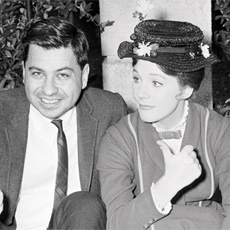
Richard Sherman and Julie Andrews have fun on the set of "Mary Poppins".
 
Many virtues define a true legend, but divine talent is what differentiates "Disney Legends." For the second segment of our "Lunch with a Legend" series, the Insider broke bread with Disney Legend Richard Sherman who (along with brother Robert) was half of the only songwriting-composing team ever to work on staff for The Walt Disney Company. From "Mary Poppins" to "Winnie the Pooh," this award-winning duo is known the world over – if not by name, then by song. Though Richard admits he's shared them a "million times," the master showman was thrilled to recount some of his most poignant memories.

Meeting Walt Disney

"Here's how it all began for my brother Bob and myself ... we were freelance pop songwriters and a little girl named Annette Funicello sang a song we'd written called 'Tall Paul,' which became a really big hit. We started writing songs specifically for her, and had hits with 'Pineapple Princess' and 'Jo Jo, the Dog-Faced Boy' – big rockers back in 1959/1960. Little did we know Annette was Walt Disney's very favorite Mouseketeer ... he listened to all her songs and liked what he was hearing."

Things changed when Walt wanted Annette to sing in a TV movie called "The Horsemasters" since her records were so popular – and requested that the brothers write the song. "Jimmy Johnson [head of the record company] asked if we wanted to give it a shot, so we wrote 'The Strumming Song.' Jimmy liked it, but said Walt would have the final word. We asked 'Walt who?'" After learning that the Walt in question was Walt Disney, Richard wanted to demo the song with a female singer before the meeting, but was told Walt likes hearing things the way they were written.

With trepidation, the brothers brought their song up to Walt's office. "Now picture this ... Walt was sitting behind his desk signing pictures. I'll never forget it because it was our first meeting with the great man. He looked up and asked if we were really brothers because there were a lot of brother acts in vaudeville with people who weren't really brothers. I said 'No, we actually have the same parents!'"

When Walt began discussing "The Parent Trap," both brothers immediately knew he was talking about the wrong film. "I was dying, but my brother Bob was brave enough to say that we were there with Annette's song for 'The Horsemasters.' I mean, how do you tell an icon he's telling you the wrong story?" After what Richard calls the most brutal performance of "The Strumming Song," Walt said, "That'll work," and gave them a script to see what they could come up with for "The Parent Trap." Richard and Robert were completely bewildered and thought the worst. "Jimmy said, 'Are you kidding? He bought one song and gave you another assignment!' We didn't even realize he LIKED what we had done. So that was our very first encounter with the man who changed our lives forever."

From there, they went on to write songs for "The Parent Trap," "Zorro," "Texas John Slaughter," and many other films and television shows. "Walt kept giving us assignments – he was testing us. He'd always say, 'That'll work,' and give us another assignment. Jimmy told us to keep'em coming."

"Mary Poppins"

Little did they know their careers would be thrown into overdrive when Walt asked "The Boys" (his nickname for the brothers) if they knew what a nanny was. Their reply? "Yeah, it's a goat! We thought he wanted us to write a song for a nanny goat!" But Walt asked them to read P.L. Travers' book "Mary Poppins," and let him know what they thought. "He threw the gauntlet down and wanted to see what we'd do with it. So Bob and I read these very charming stories, but panic struck when we realized there was no storyline – it was strictly about a nanny who flies in on the east wind, takes the Banks' children on wonderful adventures, and flies out when the west wind comes along."

Not knowing where to start, they selected six chapters to loosely base a story on – and the chosen adventures inspired scenes like "Jolly Holiday" and "Feed the Birds." Richard recalls the follow-up meeting with Walt. "Walt was as excited as we were! He fell in love with 'Feed the Birds,' which became his favorite song. When we were done, he asked to see our notes, which were pretty dog-eared from underlining and highlighting. We gave him our book and then he pulled out his copy. He had underlined the same six chapters – that was gooseflesh time. It really, really was amazing."

Walt then invited Richard and Robert to work at Disney. "We said YES, we'd love to work here! He already had a contract written up and told us we'd have an office down the hall. Walt wanted us to develop the story with screenwriters Bill Walsh and Don DaGradi, but called it our 'backburner project' because he planned on giving us lots of work. And that was the turning point in our lives ... two beloved stories that I vividly recall, and both involved Walt Disney."

Aside from "Mary Poppins," the Academy-Award®-winning duo (they garnered two for "Mary Poppins" alone!) wrote songs and scores for countless Disney classics, including "The Jungle Book," "The Aristocats," "Bedknobs and Broomsticks," and the "Winnie the Pooh" short films. Though Richard says they were always creatively connected to Walt, their time with him was limited but intense. "We started with Walt in 1960 until 1966. Walt was very, very thoughtful and kind to us ... if he liked what you were doing, he'd never gush. You'd always hear from someone else that he flipped for whatever it was you did. When he died, we worked at the studio for several years, but it just wasn't the same. We've had a wonderful career thanks to Walt Disney."

Richard is currently working on his second album of instrumental music, which he calls a cross between pop and semi-classical. "I've always been a happy person. I'm very positive and so was Walt ... that's what he liked. If our music makes people feel good about themselves and gives them hints about how to act, I think we were very lucky to write those songs. It's a nice feeling to know the rest of the world responds to your material."

Monday, December 05, 2011

It All Began With a Man: A Biography of Walt Disney

During a 43-year Hollywood career, which spanned the development of the motion picture medium as a modern American art, Walter Elias Disney, a modern Aesop, established himself and his product as a genuine part of Americana. 


David Low, the late British political cartoonist, called Disney “the most significant figure in graphic arts since Leonardo.” A pioneer and innovator, and the possessor of one of the most fertile imaginations the world has ever known, Walt Disney, along with members of his staff, received more than 950 honors and citations from throughout the world, including 48 Academy Awards® and 7 Emmys® in his lifetime.

Walt Disney’s personal awards included honorary degrees from Harvard, Yale, the University of Southern California, and UCLA; the Presidential Medal of Freedom; France’s Legion of Honor and Officer d’Academie decorations; Thailand’s Order of the Crown; Brazil’s Order of the Southern Cross; Mexico’s Order of the Aztec Eagle; and the Showman of the World Award from the National Association of Theatre Owners.

The creator of Mickey Mouse and founder of Disneyland and Walt Disney World was born in Chicago, Illinois, on December 5, 1901. His father, Elias Disney, was an Irish-Canadian. His mother, Flora Call Disney, was of German-American descent. Walt was one of five children, four boys and a girl.

Raised on a farm near Marceline, Missouri, Walt early became interested in drawing, selling his first sketches to neighbors when he was only seven years old. At McKinley High School in Chicago, Disney divided his attention between drawing and photography, contributing both to the school paper. At night he attended the Academy of Fine Arts.

During the fall of 1918, Disney attempted to enlist for military service. Rejected because he was only 16 years of age, Walt joined the Red Cross and was sent overseas, where he spent a year driving an ambulance and chauffeuring Red Cross officials. His ambulance was covered from stem to stern, not with stock camouflage, but with drawings and cartoons.

After the war, Walt returned to Kansas City, where he began his career as an advertising cartoonist. Here, in 1920, he created and marketed his first original animated cartoons, and later perfected a new method for combining live-action and animation.

In August of 1923, Walt Disney left Kansas City for Hollywood with nothing but a few drawing materials, $40 in his pocket and a completed animated and live-action film. Walt’s brother Roy O. Disney was already in California, with an immense amount of sympathy and encouragement, and $250. Pooling their resources, they borrowed an additional $500 and constructed a camera stand in their uncle’s garage. Soon, they received an order from New York for the first “Alice Comedy” short, and the brothers began their production operation in the rear of a Hollywood real estate office two blocks away.

On July 13, 1925, Walt married one of his first employees, Lillian Bounds, in Lewiston, Idaho. They were blessed with two daughters — Diane, married to Ron Miller, former president and chief executive officer of Walt Disney Productions; and Sharon Disney Lund, formerly a member of Disney’s Board of Directors. The Millers have seven children and Mrs. Lund had three. Mrs. Lund passed away in 1993.


Mickey Mouse was created in 1928, and his talents were first used in a silent cartoon entitled Plane Crazy. However, before the cartoon could be released, sound burst upon the motion picture screen. Thus Mickey made his screen debut in Steamboat Willie, the world’s first fully synchronized sound cartoon, which premiered at the Colony Theatre in New York on November 18, 1928.

Walt’s drive to perfect the art of animation was endless. Technicolor® was introduced to animation during the production of his “Silly Symphonies.” In 1932, the film entitled Flowers and Trees won Walt the first of his 32 personal Academy Awards®. In 1937, he released The Old Mill, the first short subject to utilize the multiplane camera technique.

On December 21 of that same year, Snow White and the Seven Dwarfs, the first full-length animated musical feature, premiered at the Carthay Circle Theatre in Los Angeles. Produced at the unheard of cost of $1,499,000 during the depths of the Great Depression, the film is still accounted as one of the great feats and imperishable monuments of the motion picture industry. During the next five years, Walt completed such other full-length animated classics as Pinocchio, Fantasia, Dumbo and Bambi.
In 1940, construction was completed on Disney’s Burbank studio, and the staff swelled to more than 1,000 artists, animators, story men and technicians. During World War II, 94 percent of the Disney facilities were engaged in special government work including the production of training and propaganda films for the armed services, as well as health films which are still shown throughout the world by the U.S. State Department. The remainder of his efforts were devoted to the production of comedy short subjects, deemed highly essential to civilian and military morale.

Disney’s 1945 feature, the musical The Three Caballeros, combined live action with the cartoon medium, a process he used successfully in such other features as Song of the South and the highly acclaimed Mary Poppins. In all, 81 features were released by the studio during his lifetime.

Walt’s inquisitive mind and keen sense for education through entertainment resulted in the award-winning “True-Life Adventure” series. Through such films as The Living Desert, The Vanishing Prairie, The African Lion and White Wilderness, Disney brought fascinating insights into the world of wild animals and taught the importance of conserving our nation’s outdoor heritage.

Disneyland, launched in 1955 as a fabulous $17 million Magic Kingdom, soon increased its investment tenfold and entertained, by its fourth decade, more than 400 million people, including presidents, kings and queens and royalty from all over the globe.

A pioneer in the field of television programming, Disney began production in 1954, and was among the first to present full-color programming with his Wonderful World of Color in 1961. The Mickey Mouse Club and Zorro were popular favorites in the 1950s.

Roy and Walt visit Marceline, Missouri in 1956, taking time to stand under the tree Walt used to sit beneath, dreaming of the future.

But that was only the beginning. In 1965, Walt Disney turned his attention toward the problem of improving the quality of urban life in America. He personally directed the design on an Experimental Prototype Community of Tomorrow, or EPCOT, planned as a living showcase for the creativity of American industry.

Said Disney, “I don’t believe there is a challenge anywhere in the world that is more important to people everywhere than finding the solution to the problems of our cities. But where do we begin? Well, we’re convinced we must start with the public need. And the need is not just for curing the old ills of old cities. We think the need is for starting from scratch on virgin land and building a community that will become a prototype for the future.”

Thus, Disney directed the purchase of 43 square miles of virgin land — twice the size of Manhattan Island — in the center of the state of Florida. Here, he master planned a whole new Disney world of entertainment to include a new amusement theme park, motel-hotel resort vacation center and his Experimental Prototype Community of Tomorrow. After more than seven years of master planning and preparation, including 52 months of actual construction, Walt Disney World opened to the public as scheduled on October 1, 1971. Epcot Center opened on October 1, 1982.

Prior to his death on December 15, 1966, Walt Disney took a deep interest in the establishment of California Institute of the Arts, a college level, professional school of all the creative and performing arts. Of Cal Arts, Walt once said, “It’s the principal thing I hope to leave when I move on to greener pastures. If I can help provide a place to develop the talent of the future, I think I will have accomplished something.”

California Institute of the Arts was founded in 1961 with the amalgamation of two schools, the Los Angeles Conservatory of Music and Chouinard Art Institute. The campus is located in the city of Valencia, 32 miles northeast of downtown Los Angeles. Walt Disney conceived the new school as a place where all the performing and creative arts would be taught under one roof in a “community of the arts” as a completely new approach to professional arts training.

Walt Disney is a legend, a folk hero of the 20th century. His worldwide popularity was based upon the ideas which his name represents: imagination, optimism and self-made success in the American tradition. Walt Disney did more to touch the hearts, minds and emotions of millions of Americans than any other man in the past century. Through his work, he brought joy, happiness and a universal means of communication to the people of every nation. Certainly, our world shall know but one Walt Disney.

from D23

Friday, December 02, 2011

A Very Merry Musical: Walt Disney’s Babes in Toyland


 “I’m here to invite you to a celebration in our village… so put on your best smile, set free your imagination, and come with us to Mother Goose Village,” Mother Goose says in the introduction to Babes in Toyland.

Have you ever wondered where Santa Claus gets all the wonderful toys he gives at Christmas?  According to Babes in Toyland (1961), Walt Disney’s magical mix of music, laughter, and fun, it’s Toyland’s lovable Toymaker who creates the soon-to-be-treasured playthings Santa delivers on Christmas Eve. In this charming fantasy, Walt’s first live-action musical, all of Mother Goose Village is celebrating two of its most beloved citizens, lovely Mary Contrary and handsome Tom Piper, who are about to wed—only the dastardly Barnaby seeks to stop their happiness. In a tuneful, colorful adventure that leads to merry, magical Toyland, our heroes team up with their young friends, including Bo Peep and Willie Winkie, to help the Toymaker meet his Christmas deadline. Babes in Toyland is a cherished holiday tradition, and this year D23 celebrates the feature as a 50 and Fabulous film. Let’s pack up the enchanted sleigh and take a look back at all the wonders of Walt Disney’s Toyland.

“The music for our motion picture Babes in Toyland is based on Victor Herbert’s original score, which he wrote more than half a century ago,” Walt explained in 1961. “We have updated the music and lyrics to fit current trends, but the melodies remain the same.” Combining classic Mother Goose characters with an entrancing vision of a Toyland where wooden soldiers come to life, Herbert’s musical fantasy is an audience favorite. Much as he had done with Tchaikovsky’s classic ballet for Walt’s animated version of Sleeping Beauty (1959), Disney composer George Bruns adapted Herbert’s score, changing the tempo of many songs, making new arrangements, transforming some themes into complete songs, and composing three new tunes—all to enliven Disney’s version of the timeless stage show.

While there had been many theatrical productions of this evergreen musical before Walt mounted his spectacular big-screen adaptation, there had also already been a screen version of the show, released in 1934 and starring Laurel and Hardy. Produced by comedy maven Hal Roach, this black-and-white film—re-titled March of the Wooden Soldiers in 1961 so as not to compete with the Disney release—also featured several “live” versions of Disney animated characters. (Roach personally sought Walt’s permission to use Mickey Mouse and the Three Little Pigs, and he provided his full cooperation.)

“About 1958 or ’59,” recalled animator/director Ward Kimball, one of Walt’s fabled Nine Old Men, “Walt called me up to his office and explained he had the rights to Babes in Toyland. Walt wanted to know if I’d like to take a crack at it because it would go into the public domain in 1960. There had already been two or three attempts at the Disney Studio to write some sort of story, but Walt figured that maybe I would have a different angle on it. I never agreed with the original Victor Herbert plot structure because the relationships between the characters seemed confusing. I forgot about what had been done before and worked out a plot where there was no doubt about what Barnaby was up to. Then I sat down with [veteran story artist] Joe Rinaldi and we did the storyboards. That’s what Walt saw and he liked it. Next, I got Mel Leven to write some new ‘Gilbert and Sullivan’ type lyrics. Walt always thought that a song should advance the plot. That was the big change in Babes, and Walt liked it.”


The sweet star of Babes in Toyland is Annette Funicello—Disney’s “girl next door” from TV’s Mickey Mouse Club—then at the crest of her success as a recording star. Though one might assume Babes in Toyland was planned as an Annette vehicle, Walt actually mused for some time about who to cast as Mary Contrary. Finally assistant to the producer Lou Debney said, “Well, Walt, in my opinion, if Columbia or Universal were making this, they’d probably be calling you, saying, ‘Can we borrow Annette?’” In fact, Annette remembered “all these redheaded gals coming to the studio for years being auditioned for the part of Mary. One day, however, Walt Disney walked up to me and said, ‘Follow me to the hairdressing department. I want to see how you look as a redhead.’ I guess he liked the way I looked because I got the role. For me it was a dream come true. People ask me what is my favorite film that I have done, and I have to admit, this is it.”

Annette’s vocal performances of the film’s songs are lovely, even though she considered Victor Herbert’s light opera melodies the most difficult she ever attempted. “Tommy Sands had a magnificent voice,” noted Annette, “he never had any problems, but I was a little shy about singing those beautiful songs.”

Teen idol Tommy Sands stars opposite Annette as Mary’s sweetheart, Tom Piper. The young singer was a national sensation since his starring role in The Singin’ Idol, a 1957 presentation on NBC’s Kraft Television Theatre, in which he was cast at the behest of admirer Elvis Presley. “I was doing a film with Fabian called Love in a Goldfish Bowl (1961) at Paramount,” related Tommy. “There were actually several of us up for the role in Babes—James Darren, Michael Callan, and myself—but one day Walt asked if he could come over and see the dailies. I was a bit concerned. I had my hair bleached blonde for Goldfish Bowl, so I would contrast with Fabian, but after Walt saw the dailies, he told my manager I had the part. I signed the contract and was thrilled.”

For the comically villainous Barnaby, Walt made the offbeat choice of Ray Bolger, beloved as the Scarecrow in MGM’s The Wizard of Oz (1939). Walt cast Ray because, Lou Debney recalled, “he said, ‘I remember Ray Bolger when I was taking a trip to Hawaii on a boat. Ray Bolger was there, and after dinner, why, he would perform. God, that guy can dance.’” Returning to the screen after an eight-year absence in which he starred on Broadway and television, Ray essayed his most unusual role as the scheming Barnaby. “I’ve never done a part like this before, and I couldn’t resist the challenge,” admitted Ray. “He enjoyed playing Barnaby,” recalled Ward Kimball, “and played it in an old-fashioned melodrama kind of way.” Walt said, “Here’s a guy who can dance, sing, and has a face we can make a villain out of.”

Longtime comedy favorite Ed Wynn was deliciously cast as the befuddled Toymaker. “It was Walt’s challenge to recapture something we laughed at 30 years ago that intrigued me. That something is a combination of the dramatic, together with parts of The Perfect Fool and The Fire Chief characters I played on stage and radio that long ago.” Ed’s newly found status as a movie actor in such films as Marjorie Morningstar (1958) and The Diary of Anne Frank (1959) even caused him to be mobbed at the Dallas airport on a publicity tour. “Nowadays, I have almost as many fans as Elvis Presley,” laughed Ed. “Only difference is that when they swoon, they have a hard time getting up again.” “Ed Wynn was always ‘on,’” commented co-star Tommy Kirk. “He was a nut.”


Based on the young actor’s popularity in films ranging from Old Yeller (1957) to Swiss Family Robinson (1960), Walt found a role for Tommy Kirk whenever he could. In Babes in Toyland, Tommy plays the daffy inventor Grumio. “Tommy was very talented,” observed Annette. “He never realized what a fantastic comedian he was.” Another Disney favorite, Kevin “Moochie” Corcoran is joined by his bother Brian as two of the titular Babes. Kevin and Brian appear as Boy Blue and Willie Winkie respectively. Like his older brother, 10-year-old Brian was under Studio contract and was seen in such Disney TV mini-series as Elfego Baca, Texas John Slaughter, and Daniel Boone. Doing a hilarious Laurel and Hardy-like turn as Barnaby’s henchmen, Gene Sheldon (one of America’s foremost pantomime artists) and Henry Calvin steal the show, just as they had done on the Zorro TV series. Interestingly, Henry performed as Oliver Hardy opposite Dick Van Dyke’s Stan Laurel on a classic episode of TV’s The Dick Van Dyke Show.

Singer Ann Jillian made her motion picture debut in Babes in Toyland. This talented young actress went on to appear in Gypsy (1962), the 1980s TV series Jennifer Slept Here, and for Disney, the well-loved Sammy the Way-Out Seal on Walt Disney’s Wonderful World of Color in 1962. “Working in Babes was like living out a fairy tale,” remembered Ann. “Ray Bolger taught me how to tango while we were both in costume one day. It’s such a blessing, as a child, to be encouraged to pretend. It fascinated me that people were actually paid to make up all those wonderful sets. Yes, it really was like living out a fairy tale.”

Three Disney soundstages were utilized to house the fanciful film’s enormous sets. These candy-colored backdrops, designed by legendary art directors Carroll Clark and Marvin Davis, set a whimsical stage for the lively action, creating a cartoon-like world of fantasy. “We had carpenters who’d worked all those years on the Mickey Mouse Club, and they could make anything,” revealed Ward Kimball. “There was also a certain cartoon quality that we tried to go for. Originally, they were thinking of doing Babes as a cartoon, but when you’re doing a feature cartoon, you’re talking about two years of work. There was the time element involved here. Doing it as a live-action film, we could do it quickly. Walt also had his stable of stars available at that time.”

“The Babes sets were a fun place to be when you’re a kid,” recalled Kevin. “The Pumpkin House and Mother Hubbard’s shoe were set up like living rooms with little tables and chairs, dollhouse furniture. Walt was very particular in what he did, and he didn’t do anything halfway—he wanted to do it right or not do it.” Filling a stage longer than two football fields, the spooky Forest of No Return included smoke-like fog, cobwebs, and 100 fiberglass trees, hauntingly highlighted by blue and purple spotlights and backed by a 180-degree cyclorama-like painting. For the singing-and-dancing sentinel trees, special effects artist Robert Mattey fashioned tubular foam rubber into trunks, sculptured with burners and spray-painted for a weathered look. Movable eyes, arms, and mouths were operated by dancers inside the tree “costumes” through a specialized set of rigs.


For the scenes in which the Toyland characters are made toy-size by Grumio’s “poof” gun, eye-popping oversize versions of many of the Toymaker’s shop’s sets and props—including furniture, toys, and an immense birdcage—were crafted. Among the most elaborate of the film’s fantastical props is the wacky Toymaking machine. It took 28 Disney stage electricians to control its operation from a panel of 400 switches. Composed of everything from Lucite globes, glass tubing, steel pipe, rubber hoses, and oscilloscopes to neon lights, multi-colored cellophane, balloons, and ping-pong balls, the contraption even included a childlike design complete with robotic face. “It looks great,” said Walt. “But if it could only work, really work, we could revolutionize the toy business.”

One of the movie’s most delightful props is actually one of its most lovable characters: Sylvester (“my friends call me Silly”) Goose, a puppet voiced by director Jack Donahue. “Mary McCarty as Mother Goose held this puppet,” explained Ward Kimball,” and right out of sight behind her was Jimmy Macdonald, head of our Sound Effects department. He made the goose’s mouth move, synchronizing it with the dialogue, by reaching his hand up Mary’s arm.” Mel Leven recalled that in the “Floretta” number, “it was my gag when the gypsy picked up the goose’s foot to read its palm and sang, ‘I see in your palm you are lonesome for Tom’ [to the goose instead of Mary]. Well, Walt thought that was so funny he almost fell off his seat. He just roared about that one.”

Oscar®-winner Bill Thomas designed the lavish costumes including Mary’s holiday-themed hand-embroidered red-velvet robe with white fur stole and matching muff. This elegant cloak was worn over Mary’s exquisite winter-white wedding dress. Annette was so thrilled with Bill’s costumes that he designed the bridal gown for her real-life fairy-tale wedding in 1965. The Walt Disney Archives proudly counts Mary’s Christmas ensemble and Tom’s wedding outfit, as well as their magical sleigh, among its treasures.

Disney special effects sparkle throughout Babes in Toyland, from the animated stars that emanate when Tom is hit on the head with a mallet to the ever-deepening pool of Roderigo’s crocodile tears during the “Slowly He Sank to the Bottom of the Sea” number. Another highlight is “I Can’t Do the Sum,” in which Ms. Funicello splits into a series of multi-colored Annettes, forming a chorus in which she sings with herself, echoing the famed “Annette sound” of overlaid vocals. “‘I Can’t Do the Sum’ was actually one of my favorite scenes,” Annette said, citing the movie magic throughout the number. “I was working on wires when I was walking on my hands.”


The film’s climax is the rousing “March of the Wooden Soldiers” sequence, in which a miniaturized Tom leads a toy battalion against Barnaby. Ward Kimball, who was also an avid toy collector, headed the special unit set up for the making of the more than 100 toys created especially for this dynamic scene. Many of the toys incorporated working parts from store-bought playthings, converted to fit the enchanting sequence’s uniquely designed characters.  Disney’s resident stop-motion animation experts, Bill Justice and X. Atencio, with an assist from master sculptor Yale Gracey and Ted Tillman, of the studio property department, handled the creation and “animotion” (the Disney-created term for stop-motion animation) of the individual characters.

The toy soldiers were made with interchangeable sets of arms and legs so that the stop-motion camera could capture their parading. “The marching sequence was all on a 12-beat,” explained Bill, “which meant the toy soldiers would each take a step every 12 frames. Each one of those soldiers—we had 40 in some scenes—had 12 sets of legs that had to be changed every frame in order to make a complete step.” The soldier figures were about 12 inches high with bodies cast out of hollow fiberglass. Babes in Toyland‘s red-uniformed toy solders became the breakout stars of the film and have been featured in holiday parades at Disney theme parks ever since the movie’s premiere.

Babes in Toyland marked the first time Disney’s licensees had the opportunity to manufacture toys that were actually seen in a movie. The Fairy Princess doll played with by Annette in the endearing “Just a Toy” number was designed especially for the film by Uneeda Doll Co., and 367 separate fun-filled Babes in Toyland items, including puzzles, puppets, Colorforms, costumes, and games were manufactured by 45 companies participating in the giant Christmas promotion.

Feature stories ran in The New York Times and Life, but the most spectacular celebration of the film came courtesy of Walt Disney himself. Originally colorcast on December 17, 1961, on Walt Disney’s Wonderful World of Color, “Backstage Party” featured Walt inviting his viewers to the Babes in Toyland wrap party. The principal Toyland stars performed songs and comedy routines, accompanied by such Disney staffers as composer George Bruns on trombone, lyricist Mel Leven on ukulele, and sound effects expert Jimmy Macdonald on drums. Choreographer Tom Mahoney danced, director Jack Donohue took some good-natured ribbing, and Tommy Kirk presented Ed Wynn with a “Mousecar” award commemorating Ed’s 60th anniversary in show business.

Released on December 14, 1961, Babes in Toyland was showcased as the Christmas attraction at Radio City Music Hall where Ray Bolger, coincidentally, had danced at the great theater’s grand opening in 1932. This toy-riffic tune film was honored with two Academy Award® nominations: Best Scoring of a Musical Picture (George Bruns) and Best Costume Design (Color) (Bill Thomas). So colorful and fascinating in themselves were the film’s ornate settings that an elaborate exhibit of Toyland sets were displayed at Disneyland’s Main Street Opera House from December 1961 through September 1963. The movie made its television premiere in two parts on The Wonderful World of Disney, on December 21 and December 28, 1969, where Mary Contrary herself, Annette, introduced the merry musical as a Christmas event. Since then, after multiple yuletide airings and its first release on home video in 1982, this kaleidoscopic collage of holiday treats has become a seasonal tradition in many homes.

Weaving such wondrous screen enchantment was child’s play for Walt and his motion-picture merrymakers. And for the rest of us, Babes in Toyland remains a tuneful treat at Christmas or any time of year.

By D23′s Jim Fanning

Saturday, July 23, 2011

Disney Keeps the Magic in the Familly

Walt Disney and "The Boys" 

When Walt Disney took new talent under his wing, he built a strong sense of family felt throughout the Company today. Despite his demanding reputation, Walt was revered as an incredible mentor, leader, and beloved father figure – making those who worked for him firsthand want to please the boss with excellence and undying loyalty. Thanks to the pride imbued by Walt's spirit, it's not surprising to find employees with generations of family ties from every facet of the Company. We've selected the magic-making examples of a distinguished few to illustrate how the tradition's been upheld.

The Shermans

Disney Legends (and brothers) Richard and Robert Sherman started their own Disney dynasty that's still going strong – more than 50 years later. Responsible for creating classic Disney music like "It's a Small World," "Chim Chim Cheree," and "I Wan'na Be Like You," the prolific pair (more than 1,000 published songs and 50 film scores) remain the only staff songwriters ever hired in Company history. Richard's son Gregory and Robert's son Jeffrey followed in their famous dads' footsteps and reveal how "growing up Disney" affected their lives.


Writer, producer, director, and composer Jeff Sherman realized his destiny early on. "My childhood was absolutely magical ... I'd ride the rides at Disneyland before they'd open, see movies before anyone else, attend recording sessions, visit sets and sound stages. Being exposed to Disney culture was very important – I knew how privileged I was to have this family background. One of my goals was to work for Disney because there was a warmth that felt like home to me. That continues to this day."

Jeff met Walt several times and recalls one particular instance. "My dad brought me to the studio often, especially while filming 'Mary Poppins.' We were having lunch at the commissary and Walt walked in. After telling him that the 'London rooftops' set was only four feet tall (and NOT like real rooftops at all), Walt knelt down, framed his hands in front of me, and explained how the buildings would translate on camera. He called it 'movie magic' and said I could never tell my friends. From then on I felt challenged to think of my own ways of creating magic."

His brand of magic grew into creating, writing, and producing one of the first Disney Channel shows ("The Enchanted Musical Playhouse," which featured songs by his dad and uncle), and writing/producing various Disney-ABC television shows and movies (including the hit series "Boy Meets World" and top-rated "Au Pair III"). In 2008, Jeff and a partner founded their current entertainment development, production, and marketing firm – Traveling Light Partners – based on one of Disney's core values, teamwork. His sons Alex and Ryan (another generation of Sherman Brothers!) have both inherited the musical gene – Alex writes music and plays several instruments while Ryan plays the piano, particularly songs created by his grandfather and great-uncle.

The younger of the two cousins – writer, producer, show creator Gregg Sherman – also experienced an idyllic childhood, growing up in "an atmosphere of happiness, creativity, and constantly playing music." (Not hard with five pianos in the house!) He worked for years at Buena Vista Television (part of the Disney family) on award-winning game shows like "Debt" and "Win Ben Stein's Money." After working on numerous Disney shows and developing game shows for other studios throughout the mid-to-late 1990s and beyond, Gregg decided to focus on projects that were a bit more "substantial."

"Ironically, I took a break from game shows and had the opportunity to attend the opening of the London stage production of 'Chitty Chitty Bang Bang,' [the score was originally composed by his dad and uncle] where I met and spoke with my cousin Jeff for the first time. We discovered that we both wanted more lasting and meaningful work." That conversation ultimately led to their labor of love – "The Boys: The Sherman Brothers Story" (2009), a critically acclaimed film documenting their dads' lives, unique personal relationship, and career highlights.

"Jeff and I realized there was a story there and we're both storytellers ... we got to work for Disney in a totally different capacity than either of us had ever done before. It was really rewarding." Gregg points out that the contrast between their dads' differences and the style of music and lyrics that they wrote created a visceral reaction from audiences worldwide. Both Gregg and Jeff agree that putting their dads' legacy on the map is their most important work to date.

Gregg too has his own set of musically talented, third-generation Sherman Brothers – Matt "Third Rail" Sherman is an up 'n' coming rapper while William "The Super" Sherman is making a name for himself as a YouTube sensation. "Being a Disney kid meant my dad embodied the spirit that Walt imparted to his employees. It was a phenomenal way to live one's life, and I've tried to do the same with my two boys."

The Normans

Another Disney Legend, animator Floyd Norman, shares his love of all things Disney with wife Adrienne Brown, a senior staff artist at Disney Publishing (that's where they met back in 1993!). Floyd began his Disney career in 1956, eager to learn from the best (he still refers to himself back then as "this kid from Santa Barbara") and made his mark animating classic Disney films like "Sleeping Beauty," "101 Dalmatians," and "The Sword in the Stone." Floyd's tutelage under Walt came about 10 years later, after being drafted to the story department to rewrite "The Jungle Book."

While Floyd still works for Disney at age 75, wife Adrienne has been illustrating books for almost every animated film the Studio's produced since 1994. As modest and multitalented as her husband, Adrienne (who's also an accomplished photographer) has illustrated everything from Mickey Mouse to "Monsters, Inc.," but is most proud of her artwork for the Fairies books, a series about Tinker Bell and her Pixie Hollow pals. Flitter-iffic fans take note – Adrienne also painted the end credits for the animated feature "Tinker Bell" in 2008!

Goldie Hawn and Kurt Russell

Behind the scenes or in front of the camera, pixie dust (and the spell it casts) knows no bounds. In 1968, celebrity couple-to-be Goldie Hawn and Kurt Russell met while filming Disney's "The One and Only, Genuine, Original Family Band," Goldie's feature film debut as a dancer (she played the Giggly Girl, while Kurt portrayed Sidney Bower). Kurt went on to star in numerous Disney movies, including "The Barefoot Executive" (1971), "The Horse in the Gray Flannel Suit" (1968), "The Computer Wore Tennis Shoes" (1969), "Walt Disney's Wonderful World of Color" (TV, 1967-1972), and "The Fox and the Hound" (1981, as the voice of Copper).

Floyd lovingly asked, "What better boss could you work for than Walt Disney?" These are only a few of the many families who agree!

Wednesday, July 20, 2011

Walt Before Mickey by Timothy Susanin

05.05.11 - D23 catches up with Timothy Susanin, the unlikely author who chronicled Walt Disney's early life in the new definitive biography, Walt Before Mickey.


  Young Walt Disney at an animator's desk in Kansas City.
Before taking a trip to Walt Disney World with his wife and family in 2004, Timothy Susanin wouldn't have considered himself much of a Disney fan let alone a candidate to write a biography about Walt Disney. "We went there for the kids and we ended up loving it," he recalls. Intrigued by the resort and in turn the man who dreamed up the idea for it, Susanin picked up Bob Thomas' Walt Disney: An American Original. "That biography is what got me hooked," he laughs. From there, he delved into just about anything written about Walt until he had soaked up all that was published. An investigative lawyer by trade, Susanin noticed there were some missing details about Walt's past in the years leading up to the first Mickey Mouse cartoon. Thus began his own search for Walt's missing decade and the rest is history, well, a very specific time in it. Walt Before Mickey transports you back in time, from 1919 to 1928, to meet the 17-year-old black-and-white version of Walt Disney who was just taking his first brush strokes at creating the wonderful world of Disney.

The idea was to come up with a timeline. "There was a whole decade there that I felt a need to put in order for myself," Susanin explains. He began searching through the trail of documents and details that Walt had left behind. From newspaper articles and interviews to correspondence, census records and obituaries, a life story began to take shape — not only of Walt's, but of those around him. "So the timeline turned into a chronology that turned into a draft that turned into a book," Susanin reveals. "I saw pictures of Walt with all these young kids and you wonder, 'Who are these people?' and 'Could they have ever imagined that they were at the start of this whole iconic saga?' I wanted to jump in and learn about the fun stuff in his glory years and focus on the Hollywood years. And then, as I joked with [Disney Legend] Dave Smith and a number of people, I got stuck in Kansas City."


     Walt's business card while he was in Kansas City.
One of the things Susanin noticed was that most of what had been written about Walt's early years began with Steamboat Willie. And if an author dared to go earlier into his past, it usually began with Laugh-O-Gram Films in Kansas City. "Laugh-O-Gram Films is always the headliner when they talk about his Kansas City years, or his career there anyways," Susanin points out. "That was the second of the two studios he had there." The first was called Kaycee Studios. And most people incorrectly think he started doing those first fairytales — Little Red Riding Hood and The Four Musicians Bremen — at Laugh-O-Gram, but he really animated those while he was at Kaycee Studios."

As a reader you really get a sense of what it was like to be right there with Walt and his animators during the experimental days of animation and the birth of Hollywood. "The book starts out with a flashback, and putting that aside, I try to stay in the moment," Susanin says. "So I'm not referencing Winnie the Pooh or Disneyland. I'm not breaking the image that I am creating there." From photos and interviews, Susanin connects historical quotes with vivid descriptions. Readers learn about Walt's trek to California through his own words and, based on newspaper articles, ads and photos, Susanin describes the surroundings in vivid detail. The book also provides a rare glimpse at Walt's early struggles and his perseverance to go back to the drawing board when things didn't work out. "I was struck at how many years went by before he did hit it big," Susanin says. "One presumes it was an overnight thing."

Walt and Roy, brothers with their whole life ahead of them

Monday, May 30, 2011

Walt Disney Brings in Treasure Island Actionful Saga of Fabulous Pirate Gold

05.30.11 - Robert Louis Stevenson's classic adventure is now translated to the screen in color by Technicolor, with Bobby Driscoll, Robert Newton and Basil Sydney topping a great cast of characters.


Eureka! — Marooned Ben Gunn reveals pirate loot to awe-struck Jim Hawkins (Bobby Driscoll), Long John Silver (Robert Newton) and Squire Trelawney (Walter Fitzgerald), in Walt Disney's all-live action Treasure Island, in color by Technicolor, based on Robert Louis Stevenson's saga.
Walt Disney has brought to the screen his completely live action production, Robert Louis Stevenson's Treasure Island, as a thrill-studded melodrama filmed on a spacious and realistic scale and with a story of a great prestige and red-blooded appeal to all amusement lovers, young and old.

Scene by scene and in color by Technicolor the producer matches the turbulent action, the play of elemental passions, the terrific character conflicts and the suspense inherent in famous saga of pirate treasure that lured to a distant island the young cabin boy Jim Hawkins, as played by Bobby Driscoll, the deadly rogue Long John Silver, as played by Robert Newton and Captain Smollett as played by Basil Sydney.

Treasure Island was filmed in England to get full location and atmospheric values and certain casting advantages for this "great adventure". Principals in the all- male cast, in addition to Newton, Bobby Driscoll and Sydney, are Walter Fitzgerald as Squire Trelawney, Denis O'Dea as Doctor Livesey, Ralph Truman as George Merry, Finlay Currie as Captain Billy Bones, Geoffrey Keen as Israel Hands, Francis de Wolff in the Black Dog role, John Laurie as Blind Pew and Geoffrey Wilkinson as the marooned Ben Gunn.

The all-live action method of picturing the swashbuckling tale is radically different from the animated drawings medium in which Disney customarily works his screen wonders. He organized his production personnel accordingly, selecting Director Byron Haskin for his repute in the living action field; Lawrence E. Watkin, well-known novelist and screen writer, for adaptation of the adventure tale which has been read by some 200,000,000 persons; Thomas Morahan for the stagings which supplement the outdoor English locations described by Stevenson, and his veteran producer. Perce Pearce, to manage the project.

Stevenson wrote his great sea tale of pirates and buried treasure and the hunt and battle for it expressly for his 13-year- old stepson, Lloyd Osborne. But he confessed that he himself and his older friends thrilled to the immortal saga as it came full-blooded from his pen. The author's work now has been translated to a living form, conceded to be electrifying in its impact on the screen, as the greatest adventure of all.

From the original 1950 Treasure Island press materials.

Saturday, March 12, 2011

The Disneyland Band since 1950

Walt Disney loved music and he believed it had an important role to play in the experience at Disneyland park, so for opening day he hired a group of musicians to play band concerts in Town Square. He called the group the Disneyland Band. While the original run was only supposed to last two weeks, the band has performed for hundreds of millions of guests and the group is still playing 55 years later.


The Disneyland Band has logged more than 3,500 marching miles since opening day and has traveled to dozens of cities as a representative of the Resort.


The band performs annual music education concerts for 40,000 second graders at local schools from January through March every year. The 45-minute performances often include a visit from Mickey Mouse, as well as an introduction to musical instruments, musical styles and proper concert manners. An additional element of the program engages local high school students and gives them the opportunity to play on stage with the Disneyland Band. 


Monday, November 15, 2010

Disneyland Presents The Walt Disney Story

What Walt Disney and his staff did was to create for the world a realm of wonder and make believe never before experienced — and that fabulous world has become a part of our lives, a part of our culture. 


Walt Disney shown in his "formal" office at the Disney Studio in Burbank.
Most Americans and much of the world have grown up with pleasant memories of Dumbo, the Three Little Pigs, Cinderella and dozens of other characters of fact and legend as they were pictured by Disney. A whole generation watched television's Mouseketeers and thrilled to the exploits of Davy Crockett and Zorro. Millions of people have visited Disneyland in California and Walt Disney World in Florida. 

The man behind it all, Walt Disney, received nearly 1,000 plaques, scrolls, Emmys and Academy Awards for his work. The Walt Disney Story at Disneyland's Main Street Opera House exhibits many of these awards in honor of the man who always remembered that "it all started with a mouse." 

The exhibit is presented free by the Gulf Oil Corporation, and features Great Moments with Mr. Lincoln in the Opera House's 500-seat auditorium. 

One of the most intriguing displays of The Walt Disney Story concerns Disneyland. Surrounded by photographs taken during the building of the Park, a small viewing screen shows a speeded-up movie of the actual construction. Thus, the one-year-plus-one-day construction project, which turned an orange grove into a Magic Kingdom, is seen in only three minutes. 

The highlight of the attraction for many is a capsule history of Walt Disney's career. The short film features Disney himself as he tells the story in his own words. 

Guests see film clips from the earliest Disney cartoons (the "Alice" series), Mickey Mouse's first appearance in "Steamboat Willie," and how Disney advanced the art of film animation, beginning with his "Silly Symphony" series right up to "Mary Poppins." He also explains the philosophy behind the "Audio-Animatronics" figures developed by Walt Disney Productions for use at Disneyland and Walt Disney World. 

From the beginning, people began to collect anything bearing the imprint of Mickey Mouse or the other Disney characters — watches, toothbrushes, games, cups, bracelets, soap, candy. 

A few of these rare and valuable collector's items are displayed in a glass case towards the back of the exhibit area. There is an original Mickey Mouse watch, manufactured by Ingersoll in 1933, plus the five millionth and 25 millionth Mickey Mouse watches produced. 

On view also are books, clocks, dolls, glasses, plates, a toy stove, Christmas lights, an Emerson Mickey Mouse radio (circa 1933), records, a tea set — most of all of them manufactured in the 1930s or '40s. Today they are eagerly sought by dedicated collectors of Disneyana. 

Disney supervised his operations from two offices at the Disney Studio in Burbank, about 35 miles from Disneyland. They have been re-created as part of The Walt Disney Story, authentically furnished with pieces used during his lifetime. 

His "working" office was used for conferences with directors, writers, artists, and almost anyone involved in creating Disney projects. Behind his desk are a few of his favorite awards: a 1938 award for "Snow White and the Seven Dwarfs" from the International Film Festival in Venice, Italy; the very special Irving Thalberg Award, presented by the Academy of Motion Picture Arts and Sciences in 1942 for consistent high quality of Disney films; and an Oscar, symbolic of the 51 Academy Awards received by Walt Disney and his staff throughout the years. 

The other office, also re-created for The Walt Disney Story, is the "formal" office. It was used for appointments with special guests visiting the Studio and contained a baby grand piano. Leopold Stokowski played some of the music for "Fantasia" on it more than 39 years ago, and Richard M. and Robert D. Sherman used it to play songs from "Mary Poppins" in the 1960s. 

Behind the desk are two sketches of Disney's daughters, drawn by Norman Rockwell. Between them is a portion of Disney's miniature collection — animals, dolls and small figures gathered from around the world. 

The Walt Disney Story also includes a section on Disney's famous television creations: the Zorro and Davy Crockett series and the Mickey Mouse Club. Featured are Zorro's cape, sword and mask, an original Mouseketeer hat, and two Emmys, on for Best Variety Series (1955) and the other for Outstanding Achievement in Children's Programming (1964). 

One award that held a special place in Walt Disney's heart was the Oscar presented to him in 1932. This special award was given to him for the creation of Mickey Mouse, who, in a few short years, had become famous the world over. The Oscar presented to Disney now stands in a place of honor in The Walt Disney Story, surrounded by photographs from some of the early Mickey Mouse cartoons. 

A third film, shown in an area designed as an old-fashioned schoolroom, is devoted to Walt Disney, the Naturalist. The short movie, narrated by the "Audio-Animatronics" figure Y. Zol Owl, contains film clips from several of Disney's True-Life Adventure series. 

Launched in 1948 with the release of "Seal Island," the films are a continuing reminder of Disney's deep interest in ecology, the environment and the condition of man. 

Also on display in this area are various international awards and three Oscars, representative of the eight Academy Awards won by the 13 True-Life Adventure films. 

There is more: other international awards, pictures and posters of Mickey Mouse and Donald Duck, honorary degrees. 

The Walt Disney Story pays fitting tribute to a man whose genius made dreams come true — for himself, and for the world. 

From the Spring 1976 edition of Vacationland magazine, published by Disneyland.
Related Posts Plugin for WordPress, Blogger...